 Starvard.वापसStarvard.वापस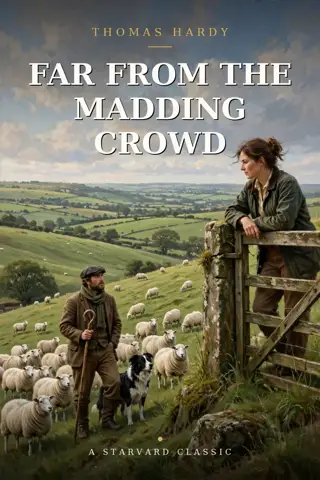
Starvard · The Masters Library

नमस्ते, मेरा नाम Finn है और मैं इस किताब को समझने में आपकी मदद करूंगा।
यह रहा, ऐसे समझाया गया जैसे आप 10 साल के हों:
बथशेबा एवरडीन को एक खेत विरासत में मिलता है और वह उसे ख़ुद कुशलता से चलाती है, एक ऐसी दुनिया में जो उम्मीद करती है कि एक पति उसे चलाए, जबकि तीन आदमी उसके गिर्द घूमते हैं, एक दृढ़ चरवाहा, एक सम्मानित किसान और एक राज़ वाला शानदार सैनिक। Hardy प्यार, अहंकार और मौसम को उन्हीं खेतों पर छोड़ देता है और देखता है क्या उगता है। यह उसका पहला महान वेसेक्स उपन्यास है।
पूरी किताब अंग्रेज़ी में पढ़ी जाती है। यहाँ सभी अध्याय हैं:
किताब PDF डाउनलोड करें (अंग्रेज़ी)
In reprinting this story for a new edition I am reminded that it was in the chapters of Far from the Madding Crowd, as they appeared month by month in a popular magazine, that I first ventured to adopt the word “Wessex” from the pages of early English history, and give it a fictitious significance as the existing name of the district once included in that extinct kingdom. The series of novels I projected being mainly of the kind called local, they seemed to require a territorial definition of some sort to lend unity to their scene. Finding that the area of a single county did not afford a canvas large enough for this purpose, and that there were objections to an invented name, I disinterred the old one. The press and the public were kind enough to welcome the fanciful plan, and willingly joined me in the anachronism of imagining a Wessex population living under Queen Victoria;—a modern Wessex of railways, the penny post, mowing and reaping machines, union workhouses, lucifer matches, labourers who could read and write, and National School children. But I believe I am correct in stating that, until the existence of this contemporaneous Wessex was announced in the present story, in 1874, it had never been heard of, and that the expression, “a Wessex peasant,” or “a Wessex custom,” would theretofore have been taken to refer to nothing later in date than the Norman Conquest.
I did not anticipate that this application of the word to a modern use would extend outside the chapters of my own chronicles. But the name was soon taken up elsewhere as a local designation. The first to do so was the now defunct Examiner, which, in the impression bearing date July 15, 1876, entitled one of its articles “The Wessex Labourer,” the article turning out to be no dissertation on farming during the Heptarchy, but on the modern peasant of the south-west counties, and his presentation in these stories.
Since then the appellation which I had thought to reserve to the horizons and landscapes of a merely realistic dream-country, has become more and more popular as a practical definition; and the dream-country has, by degrees, solidified into a utilitarian region which people can go to, take a house in, and write to the papers from. But I ask all good and gentle readers to be so kind as to forget this, and to refuse steadfastly to believe that there are any inhabitants of a Victorian Wessex outside the pages of this and the companion volumes in which they were first discovered.
Moreover, the village called Weatherbury, wherein the scenes of the present story of the series are for the most part laid, would perhaps be hardly discernible by the explorer, without help, in any existing place nowadays; though at the time, comparatively recent, at which the tale was written, a sufficient reality to meet the descriptions, both of backgrounds and personages, might have been traced easily enough. The church remains, by great good fortune, unrestored and intact, and a few of the old houses; but the ancient malt-house, which was formerly so characteristic of the parish, has been pulled down these twenty years; also most of the thatched and dormered cottages that were once lifeholds. The game of prisoner’s base, which not so long ago seemed to enjoy a perennial vitality in front of the worn-out stocks, may, so far as I can say, be entirely unknown to the rising generation of schoolboys there. The practice of divination by Bible and key, the regarding of valentines as things of serious import, the shearing-supper, and the harvest-home, have, too, nearly disappeared in the wake of the old houses; and with them have gone, it is said, much of that love of fuddling to which the village at one time was notoriously prone. The change at the root of this has been the recent supplanting of the class of stationary cottagers, who carried on the local traditions and humours, by a population of more or less migratory labourers, which has led to a break of continuity in local history, more fatal than any other thing to the preservation of legend, folk-lore, close inter-social relations, and eccentric individualities. For these the indispensable conditions of existence are attachment to the soil of one particular spot by generation after generation.
T. H.
February 1895