 Starvard.뒤로Starvard.뒤로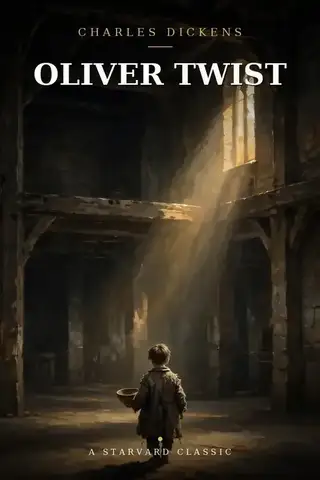
Starvard · The Masters Library

안녕하세요, 저는 Finn입니다. 이 책을 이해할 수 있도록 도와드릴게요.
10살 아이에게 설명하듯 말하면 이렇습니다:
Oliver는 구빈원 고아인데, 음식을 더 달라고 말하는 충격적인 죄를 저질러요. London으로 도망친 Oliver는 교활한 노인 Fagin이 이끄는 어린 소매치기 무리에 들어가고, 다정한 낯선 사람들은 그를 구하려 하고 위험한 남자들은 그의 입을 막으려 해요. 착한 아이가 자신을 짓밟으려고 만들어진 세상에서 살아가는 이야기예요.
책 전체는 영어로 읽습니다. 모든 장은 여기 있습니다:
Treats of the Place Where Oliver Twist Was Born and of the Circumstances Attending His Birth
Among other public buildings in a certain town, which for many reasons it will be prudent to refrain from mentioning, and to which I will assign no fictitious name, there is one anciently common to most towns, great or small: to wit, a workhouse; and in this workhouse was born; on a day and date which I need not trouble myself to repeat, inasmuch as it can be of no possible consequence to the reader, in this stage of the business at all events; the item of mortality whose name is prefixed to the head of this chapter.
For a long time after it was ushered into this world of sorrow and trouble, by the parish surgeon, it remained a matter of considerable doubt whether the child would survive to bear any name at all; in which case it is somewhat more than probable that these memoirs would never have appeared; or, if they had, that being comprised within a couple of pages, they would have possessed the inestimable merit of being the most concise and faithful specimen of biography, extant in the literature of any age or country.
Although I am not disposed to maintain that the being born in a workhouse, is in itself the most fortunate and enviable circumstance that can possibly befall a human being, I do mean to say that in this particular instance, it was the best thing for Oliver Twist that could by possibility have occurred. The fact is, that there was considerable difficulty in inducing Oliver to take upon himself the office of respiration—a troublesome practice, but one which custom has rendered necessary to our easy existence; and for some time he lay gasping on a little flock mattress, rather unequally poised between this world and the next: the balance being decidedly in favour of the latter. Now, if, during this brief period, Oliver had been surrounded by careful grandmothers, anxious aunts, experienced nurses, and doctors of profound wisdom, he would most inevitably and indubitably have been killed in no time. There being nobody by, however, but a pauper old woman, who was rendered rather misty by an unwonted allowance of beer; and a parish surgeon who did such matters by contract; Oliver and Nature fought out the point between them. The result was, that, after a few struggles, Oliver breathed, sneezed, and proceeded to advertise to the inmates of the workhouse the fact of a new burden having been imposed upon the parish, by setting up as loud a cry as could reasonably have been expected from a male infant who had not been possessed of that very useful appendage, a voice, for a much longer space of time than three minutes and a quarter.
As Oliver gave this first proof of the free and proper action of his lungs, the patchwork coverlet which was carelessly flung over the iron bedstead, rustled; the pale face of a young woman was raised feebly from the pillow; and a faint voice imperfectly articulated the words, “Let me see the child, and die.”
The surgeon had been sitting with his face turned towards the fire: giving the palms of his hands a warm and a rub alternately. As the young woman spoke, he rose, and advancing to the bed’s head, said, with more kindness than might have been expected of him:
“Oh, you must not talk about dying yet.”
“Lor bless her dear heart, no!” interposed the nurse, hastily depositing in her pocket a green glass bottle, the contents of which she had been tasting in a corner with evident satisfaction.
“Lor bless her dear heart, when she has lived as long as I have, sir, and had thirteen children of her own, and all on ’em dead except two, and them in the wurkus with me, she’ll know better than to take on in that way, bless her dear heart! Think what it is to be a mother, there’s a dear young lamb do.”
Apparently this consolatory perspective of a mother’s prospects failed in producing its due effect. The patient shook her head, and stretched out her hand towards the child.
The surgeon deposited it in her arms. She imprinted her cold white lips passionately on its forehead; passed her hands over her face; gazed wildly round; shuddered; fell back—and died. They chafed her breast, hands, and temples; but the blood had stopped forever. They talked of hope and comfort. They had been strangers too long.
“It’s all over, Mrs. Thingummy!” said the surgeon at last.
“Ah, poor dear, so it is!” said the nurse, picking up the cork of the green bottle, which had fallen out on the pillow, as she stooped to take up the child. “Poor dear!”
“You needn’t mind sending up to me, if the child cries, nurse,” said the surgeon, putting on his gloves with great deliberation. “It’s very likely it will be troublesome. Give it a little gruel if it is.” He put on his hat, and, pausing by the bedside on his way to the door, added, “She was a good-looking girl, too; where did she come from?”
“She was brought here last night,” replied the old woman, “by the overseer’s order. She was found lying in the street. She had walked some distance, for her shoes were worn to pieces; but where she came from, or where she was going to, nobody knows.”
The surgeon leaned over the body, and raised the left hand. “The old story,” he said, shaking his head: “no wedding-ring, I see. Ah! Good night!”
The medical gentleman walked away to dinner; and the nurse, having once more applied herself to the green bottle, sat down on a low chair before the fire, and proceeded to dress the infant.
What an excellent example of the power of dress, young Oliver Twist was! Wrapped in the blanket which had hitherto formed his only covering, he might have been the child of a nobleman or a beggar; it would have been hard for the haughtiest stranger to have assigned him his proper station in society. But now that he was enveloped in the old calico robes which had grown yellow in the same service, he was badged and ticketed, and fell into his place at once—a parish child—the orphan of a workhouse—the humble, half-starved drudge—to be cuffed and buffeted through the world—despised by all, and pitied by none.
Oliver cried lustily. If he could have known that he was an orphan, left to the tender mercies of churchwardens and overseers, perhaps he would have cried the louder.