 Starvard.Quay lạiStarvard.Quay lại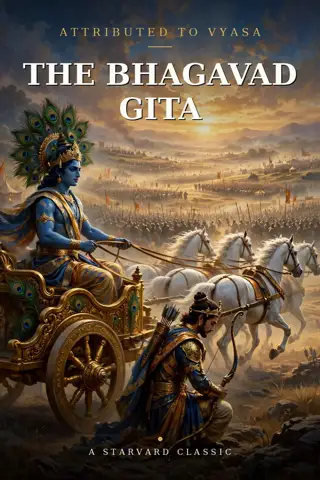
Starvard · The Masters Library

Xin chào, mình là Finn, và mình sẽ giúp bạn hiểu cuốn sách này.
Đây, được giải thích như cho một bạn 10 tuổi:
Trên một chiến trường, hoàng tử chiến binh Arjuna đứng sững: phía bên kia chiến trường là anh em họ và thầy của chính anh, và anh không nỡ chiến đấu. Người đánh xe của anh là Krishna, tức là Chúa trong hình dạng con người, và cuộc trò chuyện của họ về bổn phận, linh hồn, và cách hành động mà không bị xiềng xích bởi kết quả đã trở thành kinh thánh được yêu quý nhất trong Ấn Độ giáo. Một bài thơ chiến tranh thực ra nói về cách sống.
Toàn bộ sách đọc bằng tiếng Anh. Đây là tất cả các chương:
This famous and marvellous Sanskrit poem occurs as an episode of the Mahabharata, in the sixth--or "Bhishma"--Parva of the great Hindoo epic. It enjoys immense popularity and authority in India, where it is reckoned as one of the ``Five Jewels,"--pancharatnani--of Devanagiri literature. In plain but noble language it unfolds a philosophical system which remains to this day the prevailing Brahmanic belief, blending as it does the doctrines of Kapila, Patanjali, and the Vedas. So lofty are many of its declarations, so sublime its aspirations, so pure and tender its piety, that Schlegel, after his study of the poem, breaks forth into this outburst of delight and praise towards its unknown author: "Magistrorum reverentia a Brachmanis inter sanctissima pietatis officia refertur. Ergo te primum, Vates sanctissime, Numinisque hypopheta! quisquis tandem inter mortales dictus tu fueris, carminis bujus auctor,, cujus oraculis mens ad excelsa quaeque,quaeque,, aeterna atque divina, cum inenarraoih quddam delectatione rapitur-te primum, inquam, salvere jubeo, et vestigia tua semper adore." Lassen re-echoes this splendid tribute; and indeed, so striking are some of the moralities here inculcated, and so close the parallelism--ofttimes actually verbal-- between its teachings and those of the New Testament, that a controversy has arisen between Pandits and Missionaries on the point whether the author borrowed from Christian sources, or the Evangelists and Apostles from him.
This raises the question of its date, which cannot be positively settled. It must have been inlaid into the ancient epic at a period later than that of the original Mahabharata, but Mr Kasinath Telang has offered some fair arguments to prove it anterior to the Christian era. The weight of evidence, however, tends to place its composition at about the third century after Christ; and perhaps there are really echoes in this Brahmanic poem of the lessons of Galilee, and of the Syrian incarnation.
Its scene is the level country between the Jumna and the Sarsooti rivers-now Kurnul and Jheend. Its simple plot consists of a dialogue held by Prince Arjuna, the brother of King Yudhisthira, with Krishna, the Supreme Deity, wearing the disguise of a charioteer. A great battle is impending between the armies of the Kauravas and Pandavas, and this conversation is maintained in a war-chariot drawn up between the opposing hosts.
The poem has been turned into French by Burnouf, into Latin by Lassen, into Italian by Stanislav Gatti, into Greek by Galanos, and into English by Mr. Thomson and Mr Davies, the prose transcript of the last-named being truly beyond praise for its fidelity and clearness. Mr Telang has also published at Bombay a version in colloquial rhythm, eminently learned and intelligent, but not conveying the dignity or grace of the original. If I venture to offer a translation of the wonderful poem after so many superior scholars, it is in grateful recognition of the help derived from their labours, and because English literature would certainly be incomplete without possessing in popular form a poetical and philosophical work so dear to India.
There is little else to say which the "Song Celestial" does not explain for itself. The Sanskrit original is written in the Anushtubh metre, which cannot be successfully reproduced for Western ears. I have therefore cast it into our flexible blank verse, changing into lyrical measures where the text itself similarly breaks. For the most part, I believe the sense to be faithfully preserved in the following pages; but Schlegel himself had to say: "In reconditioribus me semper poetafoster mentem recte divinasse affirmare non ausim." Those who would read more upon the philosophy of the poem may find an admirable introduction in the volume of Mr Davies, printed by Messrs Trubner & Co.
EDWIN ARNOLD, C.S.I.