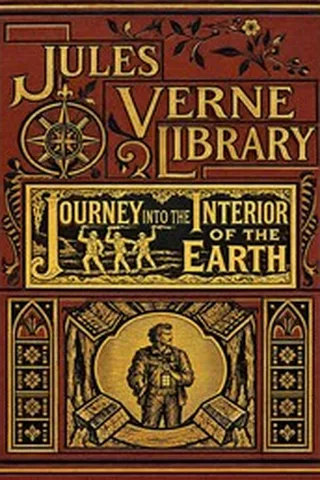

Hello, my name is Finn, and I'm going to help you understand this book.
Here it is, explained like you are 10:
A professor finds an old coded message claiming a passage leads down an Icelandic volcano into the center of the Earth, and of course he has to try it. Jules Verne sends him, his reluctant nephew, and their steady guide down into glowing caves, underground seas, and forests of giant mushrooms. The science is playful, the dangers keep coming, and the wonder never stops. It is one of the great adventure stories that started science fiction.
Jules Verne published this novel in 1864, the book that made his name and helped invent science fiction as a literature of learned adventure. Verne was a young Paris writer fascinated by geology, geography and exploration, and he built his story from the best science of his day, stretched boldly. It appears here in the Victorian English translation by Frederick Malleson, the version generations of English readers grew up on.
The story is told by Axel, the reluctant nephew of Professor Otto Lidenbrock, a Hamburg geologist who deciphers a runic manuscript pointing to a passage into the earth through the crater of an Icelandic volcano. With their guide Hans, the party descends into darkness: underground rivers, forests of giant fungi, a subterranean sea, storms, prehistoric monsters battling in the depths, and bones of vanished worlds. Verne pauses happily for lessons in strata, fossils and instruments, and the suspense of whether they can ever return keeps tightening.
Later science fiction, from lost world tales to modern adventure films, lives in this book's debt. It is learned, funny, frightening and full of wonder. Young readers and grown ones alike still fall happily down that volcano.
Jules Verne, the French writer who turned modern science into adventure, published A Journey into the Interior of the Earth in 1864, here in F. A. Malleson's translation. Professor Lidenbrock deciphers a runic manuscript, descends with his nephew Axel and the guide Hans into an Icelandic volcano, and finds caverns, seas, and prehistoric wonders below. It offers early science fiction at its most inviting, learned and wonder filled.
Verne published this novel in 1864, early in the Voyages Extraordinaires, and it remains the purest of his journeys: straight down. This is F. A. Malleson's translation, with 45 chapters and a preface praising Verne's method of mingling the researches of modern science with cleverly invented fiction for ordinary readers.
Professor Liedenbrock of Hamburg deciphers a runic manuscript by the Icelandic alchemist Arne Saknussemm, pointing to a passage to the center of the Earth through the crater of Sneffels. His reluctant nephew Axel narrates what follows: the voyage to Iceland, the guide Hans, the descent, geological studies underground, thirst and the discovery of water, separation and rescue in a whispering gallery, and then the vast subterranean sea, its monsters, its electric storm and its museum of prehistoric life, before an explosion shoots the travellers out through a volcano into the Mediterranean.
Verne's geology was the science of his day, and Axel's catalogues wear their learning openly. Read it for the structure every underground adventure since has copied, and for Axel's fear, which keeps the professor's magnificent certainty humanly priced.
Edition: Translated by F. A. Malleson. Text: Project Gutenberg ebook 3748.
The first chapter
On the 24th of May, 1863, my uncle, Professor Liedenbrock, rushed into his little house, No. 19 Königstrasse, one of the oldest streets in the oldest portion of the city of Hamburg.
Martha must have concluded that she was very much behindhand, for the dinner had only just been put into the oven.
"Well, now," said I to myself, "if that most impatient of men is hungry, what a disturbance he will make!"
"M. Liedenbrock so soon!" cried poor Martha in great alarm, half opening the dining-room door.
"Yes, Martha; but very likely the dinner is not half cooked, for it is not two yet. Saint Michael's clock has only just struck half-past one."
"Then why has the master come home so soon?"
"Perhaps he will tell us that himself."
"Here he is, Monsieur Axel; I will run and hide myself while you argue with him."
And Martha retreated in safety into her own dominions.
I was left alone. But how was it possible for a man of my undecided turn of mind to argue successfully with so irascible a person as the Professor? With this persuasion I was hurrying away to my own little retreat upstairs, when the street door creaked upon its hinges; heavy feet made the whole flight of stairs to shake; and the master of the house, passing rapidly through the dining-room, threw himself in haste into his own sanctum.
But on his rapid way he had found time to fling his hazel stick into a corner, his rough broadbrim upon the table, and these few emphatic words at his nephew:
"Axel, follow me!"
I had scarcely had time to move when the Professor was again shouting after me:
"What! not come yet?"
And I rushed into my redoubtable master's study.
Otto Liedenbrock had no mischief in him, I willingly allow that; but unless he very considerably changes as he grows older, at the end he will be a most original character.
He was professor at the Johannæum, and was delivering a series of lectures on mineralogy, in the course of every one of which he broke into a passion once or twice at least. Not at all that he was over-anxious about the improvement of his class, or about the degree of attention with which they listened to him, or the success which might eventually crown his labours. Such little matters of detail never troubled him much. His teaching was as the German philosophy calls it, 'subjective'; it was to benefit himself, not others. He was a learned egotist. He was a well of science, and the pulleys worked uneasily when you wanted to draw anything out of it. In a word, he was a learned miser.
Germany has not a few professors of this sort.
To his misfortune, my uncle was not gifted with a sufficiently rapid utterance; not, to be sure, when he was talking at home, but certainly in his public delivery; this is a want much to be deplored in a speaker. The fact is, that during the course of his lectures at the Johannæum, the Professor often came to a complete standstill; he fought with wilful words that refused to pass his struggling lips, such words as resist and distend the cheeks, and at last break out into the unasked-for shape of a round and most unscientific oath: then his fury would gradually abate.
Now in mineralogy there are many half-Greek and half-Latin terms, very hard to articulate, and which would be most trying to a poet's measures. I don't wish to say a word against so respectable a science, far be that from me. True, in the august presence of rhombohedral crystals, retinasphaltic resins, gehlenites, Fassaites, molybdenites, tungstates of manganese, and titanite of zirconium, why, the most facile of tongues may make a slip now and then.
It therefore happened that this venial fault of my uncle's came to be pretty well understood in time, and an unfair advantage was taken of it; the students laid wait for him in dangerous places, and when he began to stumble, loud was the laughter, which is not in good taste, not even in Germans. And if there was always a full audience to honour the Liedenbrock courses, I should be sorry to conjecture how many came to make merry at my uncle's expense.
Nevertheless my good uncle was a man of deep learning--a fact I am most anxious to assert and reassert. Sometimes he might irretrievably injure a specimen by his too great ardour in handling it; but still he united the genius of a true geologist with the keen eye of the mineralogist. Armed with his hammer, his steel pointer, his magnetic needles, his blowpipe, and his bottle of nitric acid, he was a powerful man of science. He would refer any mineral to its proper place among the six hundred [1] elementary substances now enumerated, by its fracture, its appearance, its hardness, its fusibility, its sonorousness, its smell, and its taste.
The name of Liedenbrock was honourably mentioned in colleges and learned societies. Humphry Davy, [2] Humboldt, Captain Sir John Franklin, General Sabine, never failed to call upon him on their way through Hamburg. Becquerel, Ebelman, Brewster, Dumas, Milne-Edwards, Saint-Claire-Deville frequently consulted him upon the most difficult problems in chemistry, a science which was indebted to him for considerable discoveries, for in 1853 there had appeared at Leipzig an imposing folio by Otto Liedenbrock, entitled, "A Treatise upon Transcendental Chemistry," with plates; a work, however, which failed to cover its expenses.
To all these titles to honour let me add that my uncle was the curator of the museum of mineralogy formed by M. Struve, the Russian ambassador; a most valuable collection, the fame of which is European.
Such was the gentleman who addressed me in that impetuous manner. Fancy a tall, spare man, of an iron constitution, and with a fair complexion which took off a good ten years from the fifty he must own to. His restless eyes were in incessant motion behind his full-sized spectacles. His long, thin nose was like a knife blade. Boys have been heard to remark that that organ was magnetised and attracted iron filings. But this was merely a mischievous report; it had no attraction except for snuff, which it seemed to draw to itself in great quantities.
When I have added, to complete my portrait, that my uncle walked by mathematical strides of a yard and a half, and that in walking he kept his fists firmly closed, a sure sign of an irritable temperament, I think I shall have said enough to disenchant any one who should by mistake have coveted much of his company.
He lived in his own little house in Königstrasse, a structure half brick and half wood, with a gable cut into steps; it looked upon one of those winding canals which intersect each other in the middle of the ancient quarter of Hamburg, and which the great fire of 1842 had fortunately spared.
[1] Sixty-three. (Tr.)
[2] As Sir Humphry Davy died in 1829, the translator must be pardoned for pointing out here an anachronism, unless we are to assume that the learned Professor's celebrity dawned in his earliest years. (Tr.)
It is true that the old house stood slightly off the perpendicular, and bulged out a little towards the street; its roof sloped a little to one side, like the cap over the left ear of a Tugendbund student; its lines wanted accuracy; but after all, it stood firm, thanks to an old elm which buttressed it in front, and which often in spring sent its young sprays through the window panes.
My uncle was tolerably well off for a German professor. The house was his own, and everything in it. The living contents were his god-daughter Gräuben, a young Virlandaise of seventeen, Martha, and myself. As his nephew and an orphan, I became his laboratory assistant.
I freely confess that I was exceedingly fond of geology and all its kindred sciences; the blood of a mineralogist was in my veins, and in the midst of my specimens I was always happy.
In a word, a man might live happily enough in the little old house in the Königstrasse, in spite of the restless impatience of its master, for although he was a little too excitable--he was very fond of me. But the man had no notion how to wait; nature herself was too slow for him. In April, after he had planted in the terra-cotta pots outside his window seedling plants of mignonette and convolvulus, he would go and give them a little pull by their leaves to make them grow faster. In dealing with such a strange individual there was nothing for it but prompt obedience. I therefore rushed after him.
Source: Project Gutenberg. Published 1864. Author died 1905. F. A. Malleson translation. Public domain worldwide. Share this book: WhatsApp
 Starvard