
Hello, my name is Finn, and I'm going to help you understand this book.
Here it is, explained like you are 10:
Long ago, people blamed luck, fate and angry gods for things they did not understand. Laplace, a great French thinker, said we can do better. In this book he explains, in plain words and with almost no hard sums, how chance really works. He looks at games, at juries and votes, at how long people live, and at why we so often fool ourselves about luck.
Laplace was one of the great mathematicians of France, famous for his work on the planets. In 1795 he gave a lecture on probability, the study of chance, and this essay grew from it. He had already written a large book on the subject, full of formulas. Here he does something kinder: he sets the formulas aside and explains the ideas in ordinary words, so any thoughtful reader can follow.
His starting point is famous. Imagine a mind so vast that it knew every force in nature and the place of every thing at this moment. For such a mind, nothing would be left to chance: past and future would lie open like a book. We are not that mind. So we weigh what we know against what we do not, and that weighing is probability.
Then come questions. How far can we trust witnesses? How do courts and assemblies go wrong? Why do gamblers fool themselves? Laplace uses tables of births, marriages and deaths to show the steady patterns hiding inside disorder, and he closes with a history of his subject. Chance, in his hands, is not magic. It is careful thinking for minds that cannot know everything.
Pierre Simon Laplace published his Philosophical Essay on Probabilities in French in 1814, growing out of a lecture he gave in 1795, and this is the 1902 English translation by Frederick Wilson Truscott and Frederick Lincoln Emory. Without heavy mathematics, Laplace explains chance, hope, games, testimony, courts and assemblies, and why nearly all human knowledge rests on probability. It also gives his famous vision of an intelligence that could know past and future at once.
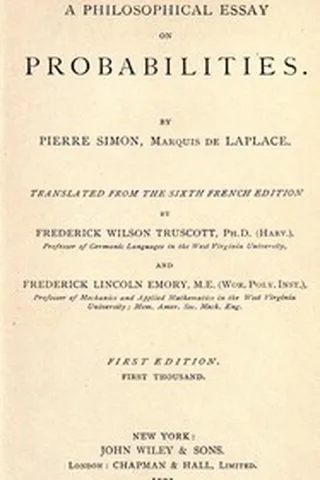
The title page states the edition plainly: translated from the sixth French edition by Frederick Wilson Truscott, professor of Germanic languages at West Virginia University, and Frederick Lincoln Emory, professor of mechanics and applied mathematics, published at New York by John Wiley and Sons in 1902. A transcriber's note records that the errata have been worked into the text.
The contents map the argument. Part One lays down the principles: what probability is, its rules, hope, and the analytical methods behind it. Part Two applies the calculus widely: to games of chance, to natural philosophy, to the moral sciences, to the probability of testimonies, to the decisions of assemblies, to the judgments of tribunals, to tables of mortality and the durations of life and marriage, and to the illusions that beset our estimates. A final chapter gives a historical notice of the calculus down to 1816.
Laplace's own introduction is the best guide to how to read it. The essay, he says, presents the principles and results of his Analytical Theory of Probabilities without the aid of analysis, applied to the most important questions of life, which are for the most part only problems of probability.
Edition: Translated by Frederick Wilson Truscott and Frederick Lincoln Emory. Edition of 1902. Text: Project Gutenberg ebook 58881.
The first chapter
All events, even those which on account of their insignificance do not seem to follow the great laws of nature, are a result of it just as necessarily as the revolutions of the sun. In ignorance of the ties which unite such events to the entire system of the universe, they have been made to depend upon final causes or upon hazard, according as they occur and are repeated with regularity, or appear without regard to order; but these imaginary causes have gradually receded with the widening bounds of knowledge and disappear entirely before sound philosophy, which sees in them only the expression of our ignorance of the true causes.
Present events are connected with preceding ones by a tie based upon the evident principle that a thing cannot occur without a cause which produces it. This axiom, known by the name of the principle of sufficient reason, extends even to actions which are considered indifferent; the freest will is unable without a determinative motive to give them birth; if we assume two positions with exactly similar circumstances and find that the will is active in the one and inactive in the other, we say that its choice is an effect without a cause. It is then, says Leibnitz, the blind chance of the Epicureans. The contrary opinion is an illusion of the mind, which, losing sight of the evasive reasons of the choice of the will in indifferent things, believes that choice is determined of itself and without motives.
We ought then to regard the present state of the universe as the effect of its anterior state and as the cause of the one which is to follow. Given for one instant an intelligence which could comprehend all the forces by which nature is animated and the respective situation of the beings who compose it--an intelligence sufficiently vast to submit these data to analysis--it would embrace in the same formula the movements of the greatest bodies of the universe and those of the lightest atom; for it, nothing would be uncertain and the future, as the past, would be present to its eyes. The human mind offers, in the perfection which it has been able to give to astronomy, a feeble idea of this intelligence. Its discoveries in mechanics and geometry, added to that of universal gravity, have enabled it to comprehend in the same analytical expressions the past and future states of the system of the world. Applying the same method to some other objects of its knowledge, it has succeeded in referring to general laws observed phenomena and in foreseeing those which given circumstances ought to produce. All these efforts in the search for truth tend to lead it back continually to the vast intelligence which we have just mentioned, but from which it will always remain infinitely removed. This tendency, peculiar to the human race, is that which renders it superior to animals; and their progress in this respect distinguishes nations and ages and constitutes their true glory.
Let us recall that formerly, and at no remote epoch, an unusual rain or an extreme drought, a comet having in train a very long tail, the eclipses, the aurora borealis, and in general all the unusual phenomena were regarded as so many signs of celestial wrath. Heaven was invoked in order to avert their baneful influence. No one prayed to have the planets and the sun arrested in their courses: observation had soon made apparent the futility of such prayers. But as these phenomena, occurring and disappearing at long intervals, seemed to oppose the order of nature, it was supposed that Heaven, irritated by the crimes of the earth, had created them to announce its vengeance. Thus the long tail of the comet of 1456 spread terror through Europe, already thrown into consternation by the rapid successes of the Turks, who had just overthrown the Lower Empire. This star after four revolutions has excited among us a very different interest. The knowledge of the laws of the system of the world acquired in the interval had dissipated the fears begotten by the ignorance of the true relationship of man to the universe; and Halley, having recognized the identity of this comet with those of the years 1531, 1607, and 1682, announced its next return for the end of the year 1758 or the beginning of the year 1759. The learned world awaited with impatience this return which was to confirm one of the greatest discoveries that have been made in the sciences, and fulfil the prediction of Seneca when he said, in speaking of the revolutions of those stars which fall from an enormous height: "The day will come when, by study pursued through several ages, the things now concealed will appear with evidence; and posterity will be astonished that truths so clear had escaped us." Clairaut then undertook to submit to analysis the perturbations which the comet had experienced by the action of the two great planets, Jupiter and Saturn; after immense calculations he fixed its next passage at the perihelion toward the beginning of April, 1759, which was actually verified by observation. The regularity which astronomy shows us in the movements of the comets doubtless exists also in all phenomena.
The curve described by a simple molecule of air or vapor is regulated in a manner just as certain as the planetary orbits; the only difference between them is that which comes from our ignorance.
Probability is relative, in part to this ignorance, in part to our knowledge. We know that of three or a greater number of events a single one ought to occur; but nothing induces us to believe that one of them will occur rather than the others. In this state of indecision it is impossible for us to announce their occurrence with certainty. It is, however, probable that one of these events, chosen at will, will not occur because we see several cases equally possible which exclude its occurrence, while only a single one favors it.
The theory of chance consists in reducing all the events of the same kind to a certain number of cases equally possible, that is to say, to such as we may be equally undecided about in regard to their existence, and in determining the number of cases favorable to the event whose probability is sought. The ratio of this number to that of all the cases possible is the measure of this probability, which is thus simply a fraction whose numerator is the number of favorable cases and whose denominator is the number of all the cases possible.
The preceding notion of probability supposes that, in increasing in the same ratio the number of favorable cases and that of all the cases possible, the probability remains the same. In order to convince ourselves let us take two urns, A and B, the first containing four white and two black balls, and the second containing only two white balls and one black one. We may imagine the two black balls of the first urn attached by a thread which breaks at the moment when one of them is seized in order to be drawn out, and the four white balls thus forming two similar systems. All the chances which will favor the seizure of one of the balls of the black system will lead to a black ball. If we conceive now that the threads which unite the balls do not break at all, it is clear that the number of possible chances will not change any more than that of the chances favorable to the extraction of the black balls; but two balls will be drawn from the urn at the same time; the probability of drawing a black ball from the urn A will then be the same as at first. But then we have obviously the case of urn B with the single difference that the three balls of this last urn would be replaced by three systems of two balls invariably connected.
When all the cases are favorable to an event the probability changes to certainty and its expression becomes equal to unity. Upon this condition, certainty and probability are comparable, although there may be an essential difference between the two states of the mind when a truth is rigorously demonstrated to it, or when it still perceives a small source of error.
In things which are only probable the difference of the data, which each man has in regard to them, is one of the principal causes of the diversity of opinions which prevail in regard to the same objects. Let us suppose, for example, that we have three urns, A, B, C, one of which contains only black balls while the two others contain only white balls; a ball is to be drawn from the urn C and the probability is demanded that this ball will be black. If we do not know which of the three urns contains black balls only, so that there is no reason to believe that it is C rather than B or A, these three hypotheses will appear equally possible, and since a black ball can be drawn only in the first hypothesis, the probability of drawing it is equal to one third. If it is known that the urn A contains white balls only, the indecision then extends only to the urns B and C, and the probability that the ball drawn from the urn C will be black is one half. Finally this probability changes to certainty if we are assured that the urns A and B contain white balls only.
It is thus that an incident related to a numerous assembly finds various degrees of credence, according to the extent of knowledge of the auditors. If the man who reports it is fully convinced of it and if, by his position and character, he inspires great confidence, his statement, however extraordinary it may be, will have for the auditors who lack information the same degree of probability as an ordinary statement made by the same man, and they will have entire faith in it. But if some one of them knows that the same incident is rejected by other equally trustworthy men, he will be in doubt and the incident will be discredited by the enlightened auditors, who will reject it whether it be in regard to facts well averred or the immutable laws of nature.
It is to the influence of the opinion of those whom the multitude judges best informed and to whom it has been accustomed to give its confidence in regard to the most important matters of life that the propagation of those errors is due which in times of ignorance have covered the face of the earth. Magic and astrology offer us two great examples. These errors inculcated in infancy, adopted without examination, and having for a basis only universal credence, have maintained themselves during a very long time; but at last the progress of science has destroyed them in the minds of enlightened men, whose opinion consequently has caused them to disappear even among the common people, through the power of imitation and habit which had so generally spread them abroad. This power, the richest resource of the moral world, establishes and conserves in a whole nation ideas entirely contrary to those which it upholds elsewhere with the same authority. What indulgence ought we not then to have for opinions different from ours, when this difference often depends only upon the various points of view where circumstances have placed us! Let us enlighten those whom we judge insufficiently instructed; but first let us examine critically our own opinions and weigh with impartiality their respective probabilities.
The difference of opinions depends, however, upon the manner in which the influence of known data is determined. The theory of probabilities holds to considerations so delicate that it is not surprising that with the same data two persons arrive at different results, especially in very complicated questions. Let us examine now the general principles of this theory.
Continue: Chapter 3: The General Principles of the Calculus of Probabilities
Source: Project Gutenberg. French original 1814. Author died 1827. Truscott and Emory translation 1902. Public domain worldwide. Share this book: WhatsApp
 Starvard