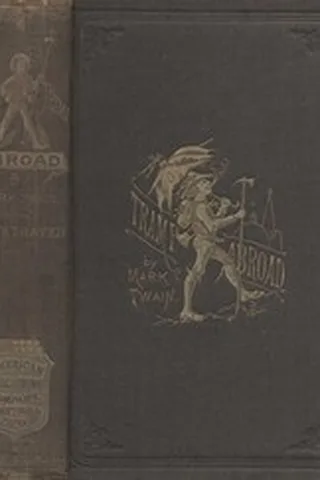

Hello, my name is Finn, and I'm going to help you understand this book.
Here it is, explained like you are 10:
Two friends decide to walk through Europe, and mostly ride, drift and wander instead, which is funnier. Twain watches student duels, floats down the Neckar on a raft, climbs Mont Blanc by telescope, and tells the immortal story of Jim Baker and the blue jays. At the back sit six appendices, including his joyful grumble about the German language, which anyone who has wrestled with German will treasure. Pure holiday reading.
The tramp is mostly a frame for looking. Twain and his friend Harris land in Germany with a plan to walk, and the walking keeps dissolving into trains, boats and tobacco smoke, while Twain records everything a funny man can see: hotel portiers, student corps with their duels and scars, beer, castles, and the eternal comedy of being an American abroad.
Certain chapters have escaped the book and live on their own. Jim Baker's blue jay yarn, told in California dialect inside a Heidelberg chapter, is a small masterpiece of animal logic. The raft journey down the Neckar, the ascent of Mont Blanc accomplished entirely by telescope, and the Chamonix catastrophe of 1870, retold from the victims' notebooks, show Twain swinging between farce and genuine gravity without dropping either.
The six appendices are half the fun, and one of them is immortal: Appendix D, The Awful German Language, his loving, exasperated assault on German grammar, gender and the verb at the end of the sentence. The whole book, text of 1880, is Twain in holiday dress, curious about everything and beholden to nothing.
Mark Twain's 1880 travel book follows two cheerful walkers, Twain and his companion Harris, through Germany, the Alps and Italy, in a journey repeatedly interrupted by trains, rafts and long comic digressions. Student duels at Heidelberg, a raft descent of the Neckar, an ascent of Mont Blanc by telescope and the legend of Jim Baker's blue jays fill its 50 chapters. Six appendices follow, including his famous essay The Awful German Language.
The reader walks into Germany in the late 1870s with two unhurried Americans who have resolved to see Europe on foot and who keep being rescued from the resolution by railways, steamers and rafts. The book's 50 chapters, untitled but many carrying Twain's bracketed subheads, move from Frankfurt and Heidelberg, where the student corps, their duels and the castle fill the early chapters and Jim Baker tells his blue jay yarn, down the Neckar by raft, through the Black Forest, into Switzerland for the Alps, the guides of Chamonix and the telescope ascent of Mont Blanc, and on into Italy for Milan, Venice and the fig leaf question in art. Then the narrative gives way to six appendices, Twain's own and essential: the Portier analyzed, Heidelberg Castle, the college prison, the legends of the castles, the German journals, and, as Appendix D, The Awful German Language, the most quoted comic essay he ever wrote. The text is the book as first published in 1880, complete, appendices included by the author's own design. The illustrations of the first edition are not carried; the words are all Twain's own.
Edition: Text: Project Gutenberg ebook 119.
The first chapter
[The Knighted Knave of Bergen]
One day it occurred to me that it had been many years since the world had been afforded the spectacle of a man adventurous enough to undertake a journey through Europe on foot. After much thought, I decided that I was a person fitted to furnish to mankind this spectacle. So I determined to do it. This was in March, 1878.
I looked about me for the right sort of person to accompany me in the capacity of agent, and finally hired a Mr. Harris for this service.
It was also my purpose to study art while in Europe. Mr. Harris was in sympathy with me in this. He was as much of an enthusiast in art as I was, and not less anxious to learn to paint. I desired to learn the German language; so did Harris.
Toward the middle of April we sailed in the HOLSATIA, Captain Brandt, and had a very pleasant trip, indeed.
After a brief rest at Hamburg, we made preparations for a long pedestrian trip southward in the soft spring weather, but at the last moment we changed the program, for private reasons, and took the express-train.
We made a short halt at Frankfort-on-the-Main, and found it an interesting city. I would have liked to visit the birthplace of Gutenburg, but it could not be done, as no memorandum of the site of the house has been kept. So we spent an hour in the Goethe mansion instead. The city permits this house to belong to private parties, instead of gracing and dignifying herself with the honor of possessing and protecting it.
Frankfort is one of the sixteen cities which have the distinction of being the place where the following incident occurred. Charlemagne, while chasing the Saxons (as HE said), or being chased by them (as THEY said), arrived at the bank of the river at dawn, in a fog. The enemy were either before him or behind him; but in any case he wanted to get across, very badly. He would have given anything for a guide, but none was to be had. Presently he saw a deer, followed by her young, approach the water. He watched her, judging that she would seek a ford, and he was right. She waded over, and the army followed. So a great Frankish victory or defeat was gained or avoided; and in order to commemorate the episode, Charlemagne commanded a city to be built there, which he named Frankfort--the ford of the Franks. None of the other cities where this event happened were named for it. This is good evidence that Frankfort was the first place it occurred at.
Frankfort has another distinction--it is the birthplace of the German alphabet; or at least of the German word for alphabet --BUCHSTABEN. They say that the first movable types were made on birch sticks--BUCHSTABE--hence the name.
I was taught a lesson in political economy in Frankfort. I had brought from home a box containing a thousand very cheap cigars. By way of experiment, I stepped into a little shop in a queer old back street, took four gaily decorated boxes of wax matches and three cigars, and laid down a silver piece worth 48 cents. The man gave me 43 cents change.
In Frankfort everybody wears clean clothes, and I think we noticed that this strange thing was the case in Hamburg, too, and in the villages along the road. Even in the narrowest and poorest and most ancient quarters of Frankfort neat and clean clothes were the rule. The little children of both sexes were nearly always nice enough to take into a body's lap. And as for the uniforms of the soldiers, they were newness and brightness carried to perfection. One could never detect a smirch or a grain of dust upon them. The street-car conductors and drivers wore pretty uniforms which seemed to be just out of the bandbox, and their manners were as fine as their clothes.
In one of the shops I had the luck to stumble upon a book which has charmed me nearly to death. It is entitled THE LEGENDS OF THE RHINE FROM BASLE TO ROTTERDAM, by F. J. Kiefer; translated by L. W. Garnham, B.A.
All tourists MENTION the Rhine legends--in that sort of way which quietly pretends that the mentioner has been familiar with them all his life, and that the reader cannot possibly be ignorant of them--but no tourist ever TELLS them. So this little book fed me in a very hungry place; and I, in my turn, intend to feed my reader, with one or two little lunches from the same larder. I shall not mar Garnham's translation by meddling with its English; for the most toothsome thing about it is its quaint fashion of building English sentences on the German plan--and punctuating them accordingly to no plan at all.
In the chapter devoted to “Legends of Frankfort,” I find the following:
“THE KNAVE OF BERGEN” “In Frankfort at the Romer was a great mask-ball, at the coronation festival, and in the illuminated saloon, the clanging music invited to dance, and splendidly appeared the rich toilets and charms of the ladies, and the festively costumed Princes and Knights. All seemed pleasure, joy, and roguish gaiety, only one of the numerous guests had a gloomy exterior; but exactly the black armor in which he walked about excited general attention, and his tall figure, as well as the noble propriety of his movements, attracted especially the regards of the ladies.
Who the Knight was? Nobody could guess, for his Vizier was well closed, and nothing made him recognizable. Proud and yet modest he advanced to the Empress; bowed on one knee before her seat, and begged for the favor of a waltz with the Queen of the festival. And she allowed his request. With light and graceful steps he danced through the long saloon, with the sovereign who thought never to have found a more dexterous and excellent dancer. But also by the grace of his manner, and fine conversation he knew to win the Queen, and she graciously accorded him a second dance for which he begged, a third, and a fourth, as well as others were not refused him. How all regarded the happy dancer, how many envied him the high favor; how increased curiosity, who the masked knight could be.
“Also the Emperor became more and more excited with curiosity, and with great suspense one awaited the hour, when according to mask-law, each masked guest must make himself known. This moment came, but although all other unmasked; the secret knight still refused to allow his features to be seen, till at last the Queen driven by curiosity, and vexed at the obstinate refusal; commanded him to open his Vizier.
He opened it, and none of the high ladies and knights knew him. But from the crowded spectators, 2 officials advanced, who recognized the black dancer, and horror and terror spread in the saloon, as they said who the supposed knight was. It was the executioner of Bergen. But glowing with rage, the King commanded to seize the criminal and lead him to death, who had ventured to dance, with the queen; so disgraced the Empress, and insulted the crown. The culpable threw himself at the Emperor, and said--
“'Indeed I have heavily sinned against all noble guests assembled here, but most heavily against you my sovereign and my queen. The Queen is insulted by my haughtiness equal to treason, but no punishment even blood, will not be able to wash out the disgrace, which you have suffered by me. Therefore oh King! allow me to propose a remedy, to efface the shame, and to render it as if not done. Draw your sword and knight me, then I will throw down my gauntlet, to everyone who dares to speak disrespectfully of my king.'
“The Emperor was surprised at this bold proposal, however it appeared the wisest to him; 'You are a knave,' he replied after a moment's consideration, 'however your advice is good, and displays prudence, as your offense shows adventurous courage. Well then,' and gave him the knight-stroke 'so I raise you to nobility, who begged for grace for your offense now kneels before me, rise as knight; knavish you have acted, and Knave of Bergen shall you be called henceforth,' and gladly the Black knight rose; three cheers were given in honor of the Emperor, and loud cries of joy testified the approbation with which the Queen danced still once with the Knave of Bergen.”
Source: Project Gutenberg. Published 1880. Author died 1910. Public domain worldwide. Share this book: WhatsApp
 Starvard