
Hello, my name is Finn, and I'm going to help you understand this book.
Here it is, explained like you are 10:
Locke asks where everything in your mind came from. His answer is bold: nothing is born in us. Every idea starts with what your senses show you, or with your mind watching its own work. This shelf holds his whole Essay, all four books, with the two Gutenberg volumes joined together. Book by book he follows ideas, then words, then what we can truly know, and how sure we can be.
Locke tells the story himself in his Epistle to the Reader. Five or six friends, meeting in his room to discuss a subject, found themselves stuck. Locke proposed that before such inquiries they should examine their own abilities, and see what objects the understanding is fitted to deal with. His hasty notes for the next meeting grew over years into this Essay, published in 1690.
Book One clears the ground: neither principles nor ideas are innate. Book Two then traces where ideas do come from: sensation, the senses reporting the world, and reflection, the mind noticing its own operations. From simple ideas the mind builds complex ones, of substances, causes, identity and more. Book Three studies words, and their imperfections and abuses.
Book Four asks what knowledge is, how far it reaches, and what we should do where certainty runs out: judgment and probability must guide assent, each in its proper degree. This shelf holds the complete Essay, all four books, joining the two Project Gutenberg volumes into one. It lasts as the founding book of a patient idea: test claims by experience, and know the limits of your own understanding.
John Locke published An Essay Concerning Humane Understanding in 1690, after friends talking in his room found themselves stuck and agreed to examine the understanding itself first. This shelf holds the complete Essay, all four books, with the two Project Gutenberg volumes combined. Locke argues that no ideas are born in us, traces every idea to sensation and reflection, and then examines words, knowledge and probability.
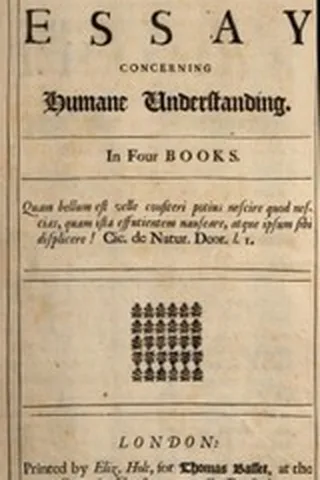
The first volume's title page announces the design: An Essay Concerning Humane Understanding, in four books, printed at London by Eliz. Holt for Thomas Basset in 1690, with a dedicatory epistle to Thomas, Earl of Pembroke. Its contents cover Books One and Two only: neither principles nor ideas are innate, then ideas in general, from simple ideas of sense and reflection to the association of ideas.
The second volume, its title page noting that it is based on the second edition, carries the work home. Book Three, Of Words, treats language in general, the signification and imperfection of words, and their abuse and remedies. Book Four, Of Knowledge and Probability, treats the degrees and extent of knowledge, truth, maxims, our knowledge of the existence of a God and of other things, judgment, probability, the degrees of assent, reason, faith and reason, enthusiasm, and wrong assent, and ends with the division of the sciences.
Scope, stated plainly: Project Gutenberg catalogues the first volume on its own record, but this shelf combines both of its volumes, so the Essay is shelved complete, all four books together. Locke's Epistle to the Reader, with its story of the friends stuck in his room, is the right door in.
Edition: The complete Essay, all four books; the two Project Gutenberg volumes are combined here. Text: Project Gutenberg ebooks 10615 and 10616.
The first chapter
TO THE RIGHT HONOURABLE THOMAS, EARL OF PEMBROKE AND MONTGOMERY, BARON HERBERT OF CARDIFF LORD ROSS, OF KENDAL, PAR, FITZHUGH, MARMION, ST. QUINTIN, AND SHURLAND;
LORD PRESIDENT OF HIS MAJESTY’S MOST HONOURABLE PRIVY COUNCIL; AND LORD LIEUTENANT OF THE COUNTY OF WILTS, AND OF SOUTH WALES.
MY LORD,
This Treatise, which is grown up under your lordship’s eye, and has ventured into the world by your order, does now, by a natural kind of right, come to your lordship for that protection which you several years since promised it. It is not that I think any name, how great soever, set at the beginning of a book, will be able to cover the faults that are to be found in it. Things in print must stand and fall by their own worth, or the reader’s fancy. But there being nothing more to be desired for truth than a fair unprejudiced hearing, nobody is more likely to procure me that than your lordship, who are allowed to have got so intimate an acquaintance with her, in her more retired recesses. Your lordship is known to have so far advanced your speculations in the most abstract and general knowledge of things, beyond the ordinary reach or common methods, that your allowance and approbation of the design of this Treatise will at least preserve it from being condemned without reading, and will prevail to have those parts a little weighed, which might otherwise perhaps be thought to deserve no consideration, for being somewhat out of the common road. The imputation of Novelty is a terrible charge amongst those who judge of men’s heads, as they do of their perukes, by the fashion, and can allow none to be right but the received doctrines. Truth scarce ever yet carried it by vote anywhere at its first appearance: new opinions are always suspected, and usually opposed, without any other reason but because they are not already common. But truth, like gold, is not the less so for being newly brought out of the mine. It is trial and examination must give it price, and not any antique fashion; and though it be not yet current by the public stamp, yet it may, for all that, be as old as nature, and is certainly not the less genuine. Your lordship can give great and convincing instances of this, whenever you please to oblige the public with some of those large and comprehensive discoveries you have made of truths hitherto unknown, unless to some few, from whom your lordship has been pleased not wholly to conceal them. This alone were a sufficient reason, were there no other, why I should dedicate this Essay to your lordship; and its having some little correspondence with some parts of that nobler and vast system of the sciences your lordship has made so new, exact, and instructive a draught of, I think it glory enough, if your lordship permit me to boast, that here and there I have fallen into some thoughts not wholly different from yours. If your lordship think fit that, by your encouragement, this should appear in the world, I hope it may be a reason, some time or other, to lead your lordship further; and you will allow me to say, that you here give the world an earnest of something that, if they can bear with this, will be truly worth their expectation. This, my lord, shows what a present I here make to your lordship; just such as the poor man does to his rich and great neighbour, by whom the basket of flowers or fruit is not ill taken, though he has more plenty of his own growth, and in much greater perfection. Worthless things receive a value when they are made the offerings of respect, esteem, and gratitude: these you have given me so mighty and peculiar reasons to have, in the highest degree, for your lordship, that if they can add a price to what they go along with, proportionable to their own greatness, I can with confidence brag, I here make your lordship the richest present you ever received. This I am sure, I am under the greatest obligations to seek all occasions to acknowledge a long train of favours I have received from your lordship; favours, though great and important in themselves, yet made much more so by the forwardness, concern, and kindness, and other obliging circumstances, that never failed to accompany them. To all this you are pleased to add that which gives yet more weight and relish to all the rest: you vouchsafe to continue me in some degrees of your esteem, and allow me a place in your good thoughts, I had almost said friendship. This, my lord, your words and actions so constantly show on all occasions, even to others when I am absent, that it is not vanity in me to mention what everybody knows: but it would be want of good manners not to acknowledge what so many are witnesses of, and every day tell me I am indebted to your lordship for. I wish they could as easily assist my gratitude, as they convince me of the great and growing engagements it has to your lordship. This I am sure, I should write of the UNDERSTANDING without having any, if I were not extremely sensible of them, and did not lay hold on this opportunity to testify to the world how much I am obliged to be, and how much I am,
MY LORD,
Your Lordship’s most humble and most obedient servant,
JOHN LOCKE
2 Dorset Court, 24th of May, 1689
Source: Project Gutenberg. Published 1690. Author died 1704. Public domain worldwide. Share this book: WhatsApp
 Starvard