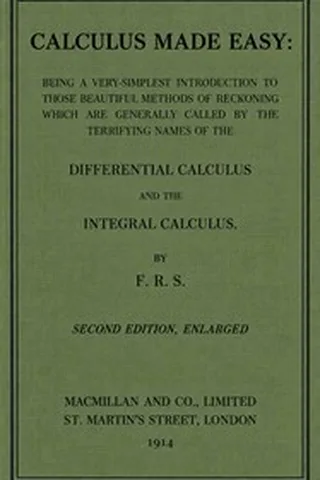

Hello, my name is Finn, and I'm going to help you understand this book.
Here it is, explained like you are 10:
Calculus scares almost everybody, so this kind professor wrote a book with jokes in it. His rule is: what one fool can do, another can. He starts with tiny steps, shows how things grow and change, and builds up the hard ideas slowly, with lots of practice. Math teachers have handed this book to stuck students for over a hundred years, because it works.
Silvanus Phillips Thompson was professor of physics and principal of Finsbury Technical College, and he kept meeting bright students who had been frightened off mathematics by bad teaching. His answer, published in 1910 under the motto 'What one fool can do, another can' (an ancient Simian proverb, he claimed), treats the reader as a sensible person and calculus as a sensible subject.
The method is smallness. A derivative is just how fast something is growing; an integral is just piling up tiny pieces. Thompson starts with the simplest cases, squares, cubes, and roots, adds the rules for products and quotients, climbs to sines, exponentials, and partial differentiation, and finishes with integration and real problems, including true compound interest and the law of organic growth that his readers in biology and economics loved.
A word on our text: Project Gutenberg has no plain text of this book, so we built ours from its HTML edition, turning every formula back into readable characters (powers as x^2, fractions as a/b), which the examples in the chapters show working plainly. The book's diagrams could not be carried into text and are passed over; the words and the mathematics are all here.
Silvanus Thompson, an English engineering professor, thought calculus textbooks were written to frighten students, so in 1910 he wrote one that is funny. His motto, borrowed from an old proverb, is that what one fool can do, another can. Derivatives and integrals are built up from tiny steps and plain examples, and more than a century later this is still the gentlest first book on the subject.
The first chapter
CONSIDERING how many fools can calculate, it is surprising that it should be thought either a difficult or a tedious task for any other fool to learn how to master the same tricks.
Some calculus-tricks are quite easy. Some are enormously difficult. The fools who write the textbooks of advanced mathematics--and they are mostly clever fools-seldom take the trouble to show you how easy the easy calculations are. On the contrary, they seem to desire to impress you with their tremendous cleverness by going about it in the most difficult way.
Being myself a remarkably stupid fellow, I have had to unteach myself the difficulties, and now beg to present to my fellow fools the parts that are not hard. Master these thoroughly, and the rest will follow. What one fool can do, another can.
Continue: Chapter I: To Deliver You From the Preliminary Terrors
Source: Project Gutenberg. Published 1910. Author died 1916. Public domain worldwide. Share this book: WhatsApp
 Starvard