
Hello, my name is Finn, and I'm going to help you understand this book.
Here it is, explained like you are 10:
Dr. Fergusson has a bold plan: fly over Africa in a big balloon, from one side to the other, and see lands no one from his country has seen. His friend Kennedy thinks the plan is mad but comes along, and so does Joe, the brave and funny servant. Up they go. Below them pass rivers, deserts, wild beasts, storms, and people who have never seen a balloon.
Jules Verne was not yet famous when he wrote Five Weeks in a Balloon, published in 1863. It was his first novel, and it made his name. He loved maps, ships, and explorers' reports, and he asked a simple question: what if a man could cross Africa not on foot or by river, but through the sky?
Dr. Fergusson builds a balloon that can rise and sink without losing gas or ballast, and sets out from Zanzibar with Dick Kennedy, a hunter who doubts the whole plan, and Joe, his quick, loyal servant. The trip is a tour of everything explorers had reported and everything Verne could imagine: lake regions, deserts where thirst nearly kills them, a rescue by balloon, gold in the soil, and a final dash to safety.
The book lasts because it mixed two new pleasures: a story that never stops moving, and real geography taught as you fly over it. Verne went on to write many such voyages, under the sea and to the moon, but this first flight is where his whole way of telling stories lifts off.
Jules Verne's first novel, published in 1863, sends Dr. Samuel Fergusson across Africa in a balloon of his own design, with his friend Dick Kennedy and his servant Joe. No European had crossed the continent's unknown middle, so Verne flies over it: storms, rescues, thirst, and gold dust pass beneath the basket. The geography was researched like a report; the adventure invented the Verne voyage.
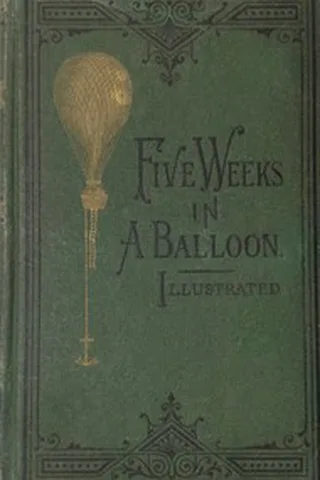
The title page plays the book's founding joke straight: Five Weeks in a Balloon, or, Journeys and Discoveries in Africa by Three Englishmen, compiled in French by Jules Verne from the original notes of Dr. Ferguson, and done into English by William Lackland. This is the Appleton edition of 1869, Lackland's translation of Verne's French original of 1863.
The publishers' note is honest about the mixture: the geography, inhabitants, animals, and features of the countries passed over are described with entire accuracy, while the mode of locomotion is purely imaginary and the adventures fictitious. The note even calls the book, in a measure, a satire on modern books of African travel. Forty four chapters then deliver both halves, fact and invention, at once.
It was Verne's first novel and his first success. Come for the balloon, stay for the map: the Africa below the basket is the real Africa of the explorers' reports.
Edition: Translated by William Lackland. Edition of 1869. Text: Project Gutenberg ebook 3526.
The first chapter
“Five Weeks in a Balloon” is, in a measure, a satire on modern books of African travel. So far as the geography, the inhabitants, the animals, and the features of the countries the travellers pass over are described, it is entirely accurate. It gives, in some particulars, a survey of nearly the whole field of African discovery, and in this way will often serve to refresh the memory of the reader. The mode of locomotion is, of course, purely imaginary, and the incidents and adventures fictitious. The latter are abundantly amusing, and, in view of the wonderful “travellers’ tales” with which we have been entertained by African explorers, they can scarcely be considered extravagant; while the ingenuity and invention of the author will be sure to excite the surprise and the admiration of the reader, who will find M. VERNE as much at home in voyaging through the air as in journeying “Twenty Thousand Leagues under the Seas.”
Source: Project Gutenberg. Published 1863. Author died 1905. Public domain worldwide. Share this book: WhatsApp
 Starvard