
Hello, my name is Finn, and I'm going to help you understand this book.
Here it is, explained like you are 10:
Charles XII became king of Sweden as a teenager, and at once three countries attacked him. He beat them one after another, with daring marches and wild courage, until he pushed too deep into Russia and lost everything at Poltava. Voltaire tells the story fast and bright, like a novel that happens to be true. If you like bold characters, strange turns of fortune, and history that reads easily, start here.
The Everyman edition opens with a tribute: John Burns recalls buying a cheap life of Charles XII as a boy and learning from the king's Spartan endurance to master weakness, weariness, and pain. An introduction and Winifred Todhunter's translator's note follow, placing Voltaire's 1731 French history, the book that first showed Europe he could write narrative as well as verse and plays.
Book One sketches Sweden, the young king's education, and the alliance of Russia, Poland, and Denmark that thought to divide his kingdom. Then the career ignites. Charles defeats Denmark in weeks, crushes a huge Russian army at Narva with a fraction of its numbers, conquers Poland, dictates peace in Saxony, and seems unstoppable. Book Four turns the wheel: the invasion of Russia, the terrible winter, wounds, and destruction at Poltava.
The last books follow Charles into Ottoman exile, his intrigues at Bender, his defiance of a Turkish army with forty servants, his ride home, and his death before Frederikshald in Norway. Complete in eight books, it is history written like a tragedy of character.
Voltaire made his name as a historian with this life of Charles XII, first published in French in 1731 and given here in Winifred Todhunter's Everyman translation, first issued in 1908. The Swedish king, crowned as a boy, beat Denmark, Poland, and Russia, then marched too far and fell at Poltava. Voltaire tells the whole meteoric career briskly and wittily, less a chronicle than a study of glory, obstinacy, and chance.
Before Voltaire's narrative begins, the Everyman edition lets an English statesman testify. John Burns's prefatory note remembers buying a penny life of Charles XII as a boy and taking the king's Spartan hardiness as a lifelong lesson; an unsigned introduction surveys the history's fame and its rivals; and Winifred Todhunter's translator's note explains that hers is a fresh, closer rendering than the loose version of 1734. Book One then opens on Sweden itself, its long winters, hardy people, and recent history under Charles XI, before introducing the boy king and the three powers, Russia, Poland, and Denmark, allied to despoil him, with a character sketch of Peter the Great, the rival who dominates the book's second half. Across eight books the shape is classical rise and fall: the eighteen year old's lightning victories, Narva, the conquest of Poland, peace dictated in Saxony, then the Russian invasion, Poltava, exile at Bender, the ride home, and death in a Norwegian trench. The French original appeared in 1731; Todhunter's translation was first issued in the Everyman edition of 1908, and the history is complete.
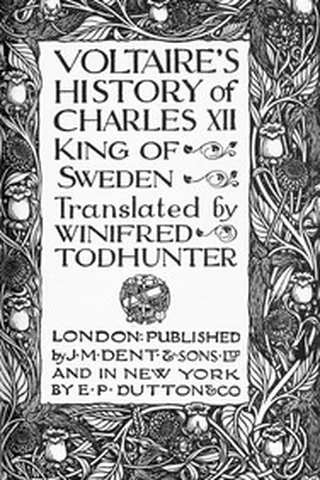
Edition: Translated by Winifred Todhunter. Edition of 1908. Text: Project Gutenberg ebook 73122.
The first chapter
“To Charles the Twelfth of Sweden I owe much of what has stood me in best stead all my life. It was nearly thirty years ago, when but a boy, that I bought his Life for a penny in the New Cut. I took it home and devoured it. It made a great impression on me. Not his wars, but the Spartan heroism of his character. He inspired me with the idea of triumphing over physical weakness, weariness and pain. To inure his body to bear all manner of hardships indifferently, to bathe in ice, or face the torrid rays of the sun, to discipline his physical powers by gymnastics, to despise the niceties of food and drink, to make his body an instrument as of tempered steel, and at the same time to have that body absolutely at the disposition of the mind, that seemed to me conduct worthy of a hero. And so, boylike, I tried to imitate him, and succeeded at least so far as to be happily indifferent to the circumstances of my personal environment.”
JOHN BURNS.
“Och än är det likt det slägte som bor Bland Nordiska fjellar och dalar, Och ännu på Gud och på Stålet det tror, An fädernas kärnspråk det talar.”
“And still as of old are the folk that abide ‘Mid northerly mountain and valley; In God and their weapons they ever confide, To voice of their fathers they rally.”
Source: Project Gutenberg. French original 1731. Author died 1778. Public domain worldwide. Share this book: WhatsApp
 Starvard