
Hello, my name is Finn, and I'm going to help you understand this book.
Here it is, explained like you are 10:
John Brown believed slavery was so wrong that he had to fight it with his own hands. He fought in Kansas, then led a small band of men, Black and white together, in an attack meant to free enslaved people. He was caught, tried, and hanged. Many called him mad. Many called him a hero. This book, by a great Black writer and scholar, tells his life carefully and asks what he truly stood for.
Du Bois begins long before the raid, with Africa and America, then builds the man: born in Connecticut in 1800, raised in Ohio, a tanner, surveyor, and wool merchant who failed in business again and again while his hatred of slavery hardened into a life's plan. Brown raised his large family inside that plan. In Kansas in the 1850s, where settlers fought over whether the territory would be slave or free, he became a guerrilla captain, notorious after the Pottawatomie killings.
The great plan followed: seize Harpers Ferry, arm enslaved people, and draw them into a mountain stronghold. Du Bois traces the secret meetings, the Chatham convention, the money from abolitionist backers, and the Black men who stood with Brown, five of whom joined the raid itself. In October 1859 it failed in two days. Brown's trial and his calm on the gallows that December did what the raid could not.
Published in 1909 in the American Crisis Biographies series, fifty years on, this life stands apart because Du Bois insists Brown worked with Black Americans, not only for them, and treats their inner life as the story's center.
Fifty years after John Brown attacked the federal arsenal at Harpers Ferry and went to the gallows, W. E. B. Du Bois published this biography in 1909. It follows Brown from an Ohio tanyard through bleeding Kansas, the secret meetings and the great plan, to the raid of October 1859 and the scaffold that December. Du Bois asks throughout what Brown meant to the Black Americans he worked with, not merely for.
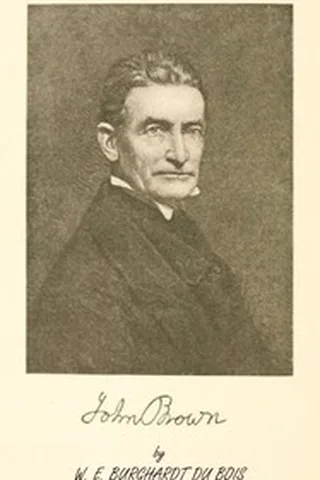
The title page places the book in a series and a moment: American Crisis Biographies, edited by Ellis Paxson Oberholtzer, published at Philadelphia by George W. Jacobs and Company in September 1909, fifty years after Harpers Ferry. Its author is named with his post: W. E. Burghardt Du Bois, Professor of Sociology at Atlanta University, author of The Souls of Black Folk. The book is dedicated to the memory of Elizabeth, and carries a frontispiece portrait of Brown.
Du Bois's preface is candid about method. After Sanborn, Hinton, Connelley, and Redpath, he says, another life needs a new emphasis, and his is this: Brown worked not simply for Black men, he worked with them, as a companion of their daily life. Written records of that intimacy are few, he admits, and he has quoted earlier writers freely.
A chronology, from Brown's birth in Torrington, Connecticut, in 1800 to the legacy, precedes thirteen chapters with titles like The Call of Kansas, The Great Plan, The Black Phalanx, and The Blow. A bibliography and index close a biography built as both record and tribute.
Edition: Edition of 1909. Text: Project Gutenberg ebook 62799.
The first chapter
1800-- John Brown is born in Torrington, Conn., May 9th. Attempted insurrection of slaves under Gabriel in Virginia, in September.
1805-- The family migrates to Ohio.
1812-- John Brown meets a slave boy.
1816-- He joins the church.
1819-- He attends school at Plainfield, Mass.
1819-1825-- John Brown works as a tanner at Hudson, O.
1821-- He marries Dianthe Lusk, June 21st.
1822-- Attempted slave insurrection in South Carolina in June.
1825-1835-- He works as a tanner at Randolph, Pa., and is postmaster.
1831-- Nat Turner’s insurrection, in Virginia, August 21st.
1832-- His first wife dies, August 10th.
1833-- He marries Mary Ann Day, July 11th.
1834-- He outlines his plan for Negro education, November 21st.
1835-1840-- He lives in and near Hudson, O., and speculates in land.
1837-- He loses heavily in the panic.
1839-- He and his family swear blood-feud with slavery.
1840-- He surveys Virginia lands for Oberlin College, and proposes buying 1,000 acres.
1841-- John Brown begins sheep-farming.
1842-- He goes into bankruptcy.
1843-- He loses four children in September.
1844-- He forms the firm of “Perkins and Brown, wool-merchants.”
1845-51-- He is in charge of the Perkins and Brown warehouse, Springfield, O.
1846-- Gerrit Smith offers Adirondack farms to Negroes, August 1st.
1847-- Frederick Douglass visits Brown and hears his plan for a slave raid.
1849-- He goes to Europe to sell wool, and visits France and Germany, August and September.
1849-- First removal of his family to North Elba, N. Y.
1850-- The new Fugitive Slave Law is passed.
1851-1854-- Winding up of the wool business.
1851-- He founds the League of Gileadites, January 15th.
1854-- Kansas and Nebraska Bill becomes a law, May 30th. Five sons start for Kansas in October.
1855-- John Brown at the Syracuse convention of Abolitionists in June. He starts for Kansas with a sixth son and his son-in-law in September. Two sons take part in Big Springs convention in September. John Brown arrives in Kansas, October 6th. He helps to defend Lawrence in December.
1856-- He attends a mass meeting at Osawatomie in April. He visits Buford’s camp in May. The sacking of Lawrence, May 21st. The Pottawatomie murders, May 23-26th. Arrest of two sons, May 28th. Battle of Black Jack, June 2d. Goes to Iowa with his wounded son-in-law and joins Lane’s army, July and August. Joins in attacks to rid Lawrence of surrounding forts, August. Battle of Osawatomie, August 30th. Missouri’s last invasion of Kansas, September 15th. Geary arrives and induces Brown to leave Kansas, September. Brown starts for the East with his sons, September 20th.
1857-- John Brown is in Boston in January. He attends the New York meeting of the National Kansas Committee, in January. Before the Massachusetts legislature in February. Tours New England to raise money, March and April. Contracts for 1,000 pikes in Connecticut.
1857-- He starts West, May. He is at Tabor, I., August and September. He founds a military school in Iowa, December.
1858-- John Brown returns to the East, January. He is at Frederick Douglass’s house, February. He reveals his plan to Sanborn in February. He is in Canada, April. Forbes’ disclosures, May. Chatham convention, May 8-10th. Hamilton’s massacre in Kansas, May 19th. Plans postponed, May 20th. John Brown starts West, June 3d. He arrives in Kansas, June 25th. He is in South Kansas, coöperating with Montgomery, July-December. The raid into Missouri for slaves, December 20th.
1859-- John Brown starts with fugitives for Canada, January 20th. He arrives in Canada, March 12th. He speaks in Cleveland, March 23d. Last visit of John Brown to the East, April and May. He starts for Harper’s Ferry, June. He and three companions arrive at Harper’s Ferry, July 3d. He gathers twenty-two men and munitions, June-October. He starts on the foray, Sunday, October 16th at 8 P. M. The town and arsenal are captured, Monday, October 17th at 4 A. M. Gathering of the militia, Monday, October 17th at 7 A. M. to 12 M. Brown’s party is hemmed in, Monday, October 17th at 12 M. He withdraws to the engine-house, Monday, October 17th at 12 M. Kagi’s party is killed and captured, Monday, October 17th at 3 P. M. Lee and 100 marines arrive, Monday, October 17th at 12 P. M. Brown is captured, Tuesday, October 18th at 8 A. M.
1859-- Preliminary examination, October 25th. Trial at Charleston (then Virginia, now West Virginia), October 27th-November 4th. Forty days in prison, October 16th-December 2d. Execution of John Brown at Charleston, December 2d. Burial of John Brown at North Elba, N. Y., December 8th.
Source: Project Gutenberg. Published 1909. Author died 1963. Public domain worldwide. Share this book: WhatsApp
 Starvard