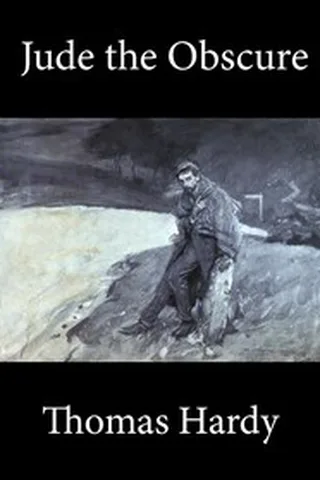

Hello, my name is Finn, and I'm going to help you understand this book.
Here it is, explained like you are 10:
Jude is a poor country boy who loves books. He works as a stonemason, studies alone at night, and dreams of one day entering the great university at Christminster. But the gates stay shut to boys like him. A hasty marriage, then a deep love for his cousin Sue, bring him hope and heartbreak in turn. Hardy tells his story gently and sadly, and you will root for Jude to the end.
Thomas Hardy grew up in Dorset, trained as an architect, and wrote the Wessex novels that made him famous. Jude the Obscure, published in 1895, was his last novel. Its reception was so hostile, with reviewers attacking its treatment of marriage and religion, that Hardy gave up novel writing and turned to poetry for the rest of his life.
Jude Fawley is an orphaned village boy whose schoolmaster points him toward Christminster, the university city that glows in the distance like a promised land. Jude works as a stonemason restoring churches while studying alone, but a tricked marriage to Arabella Donn, and later a university that advises him to stay in his trade, block his path. His great love is his cousin Sue Bridehead, clever and restless, and their life together outside marriage brings both freedom and ruin.
Hardy is on Jude's side from first page to last, and against the rules that crush him: class snobbery, rigid marriage law, and fearful convention. The novel is painful to read in places, and deliberately so. It remains his most daring book, and the argument it started about who deserves an education has never really ended.
Thomas Hardy, the Wessex novelist who had already shocked readers with Tess of the d'Urbervilles, published Jude the Obscure in 1895, his last novel. Jude Fawley, a village stonemason who teaches himself Latin and Greek, dreams of studying at Christminster, Hardy's Oxford, but class, poverty, and two unhappy unions close every door. With his cousin Sue Bridehead he defies convention and pays dearly. It offers a bleak, compassionate tragedy.
Jude the Obscure was published in 1895, Hardy's last novel, issued first in a shortened magazine version and then in book form as he had written it, as his preface explains. The narrative is organised in six parts, each headed At a place: Marygreen, Christminster, Melchester, Shaston, Aldbrickham, and Christminster again, following its hero's movements across Wessex.
The opening part shows Jude as a boy at Marygreen, encouraged by the departing schoolmaster Phillotson, then working as a stonemason and studying by night. His marriage to Arabella, his unrequited welcome at Christminster, his meeting with his cousin Sue Bridehead, and their unconventional household carry the middle parts, as work, children, poverty, and public disapproval press ever harder on them both.
Hardy called the book a tragedy of unfulfilled aims, and the preface asks readers of full age to take its treatment of marriage, ambition, and faith seriously. Read it knowing the ending is hard: its power lies in how completely Jude's hopes are understood before they are destroyed.
Edition: Text: Project Gutenberg ebook 153.
The first chapter
The schoolmaster was leaving the village, and everybody seemed sorry. The miller at Cresscombe lent him the small white tilted cart and horse to carry his goods to the city of his destination, about twenty miles off, such a vehicle proving of quite sufficient size for the departing teacher’s effects. For the schoolhouse had been partly furnished by the managers, and the only cumbersome article possessed by the master, in addition to the packing-case of books, was a cottage piano that he had bought at an auction during the year in which he thought of learning instrumental music. But the enthusiasm having waned he had never acquired any skill in playing, and the purchased article had been a perpetual trouble to him ever since in moving house.
The rector had gone away for the day, being a man who disliked the sight of changes. He did not mean to return till the evening, when the new school-teacher would have arrived and settled in, and everything would be smooth again.
The blacksmith, the farm bailiff, and the schoolmaster himself were standing in perplexed attitudes in the parlour before the instrument. The master had remarked that even if he got it into the cart he should not know what to do with it on his arrival at Christminster, the city he was bound for, since he was only going into temporary lodgings just at first.
A little boy of eleven, who had been thoughtfully assisting in the packing, joined the group of men, and as they rubbed their chins he spoke up, blushing at the sound of his own voice: “Aunt have got a great fuel-house, and it could be put there, perhaps, till you’ve found a place to settle in, sir.”
“A proper good notion,” said the blacksmith.
It was decided that a deputation should wait on the boy’s aunt--an old maiden resident--and ask her if she would house the piano till Mr. Phillotson should send for it. The smith and the bailiff started to see about the practicability of the suggested shelter, and the boy and the schoolmaster were left standing alone.
“Sorry I am going, Jude?” asked the latter kindly.
Tears rose into the boy’s eyes, for he was not among the regular day scholars, who came unromantically close to the schoolmaster’s life, but one who had attended the night school only during the present teacher’s term of office. The regular scholars, if the truth must be told, stood at the present moment afar off, like certain historic disciples, indisposed to any enthusiastic volunteering of aid.
The boy awkwardly opened the book he held in his hand, which Mr. Phillotson had bestowed on him as a parting gift, and admitted that he was sorry.
“So am I,” said Mr. Phillotson.
“Why do you go, sir?” asked the boy.
“Ah--that would be a long story. You wouldn’t understand my reasons, Jude. You will, perhaps, when you are older.”
“I think I should now, sir.”
“Well--don’t speak of this everywhere. You know what a university is, and a university degree? It is the necessary hallmark of a man who wants to do anything in teaching. My scheme, or dream, is to be a university graduate, and then to be ordained. By going to live at Christminster, or near it, I shall be at headquarters, so to speak, and if my scheme is practicable at all, I consider that being on the spot will afford me a better chance of carrying it out than I should have elsewhere.”
The smith and his companion returned. Old Miss Fawley’s fuel-house was dry, and eminently practicable; and she seemed willing to give the instrument standing-room there. It was accordingly left in the school till the evening, when more hands would be available for removing it; and the schoolmaster gave a final glance round.
The boy Jude assisted in loading some small articles, and at nine o’clock Mr. Phillotson mounted beside his box of books and other impedimenta, and bade his friends good-bye.
“I shan’t forget you, Jude,” he said, smiling, as the cart moved off. “Be a good boy, remember; and be kind to animals and birds, and read all you can. And if ever you come to Christminster remember you hunt me out for old acquaintance’ sake.”
The cart creaked across the green, and disappeared round the corner by the rectory-house. The boy returned to the draw-well at the edge of the greensward, where he had left his buckets when he went to help his patron and teacher in the loading. There was a quiver in his lip now and after opening the well-cover to begin lowering the bucket he paused and leant with his forehead and arms against the framework, his face wearing the fixity of a thoughtful child’s who has felt the pricks of life somewhat before his time. The well into which he was looking was as ancient as the village itself, and from his present position appeared as a long circular perspective ending in a shining disk of quivering water at a distance of a hundred feet down. There was a lining of green moss near the top, and nearer still the hart’s-tongue fern.
He said to himself, in the melodramatic tones of a whimsical boy, that the schoolmaster had drawn at that well scores of times on a morning like this, and would never draw there any more. “I’ve seen him look down into it, when he was tired with his drawing, just as I do now, and when he rested a bit before carrying the buckets home! But he was too clever to bide here any longer--a small sleepy place like this!”
A tear rolled from his eye into the depths of the well. The morning was a little foggy, and the boy’s breathing unfurled itself as a thicker fog upon the still and heavy air. His thoughts were interrupted by a sudden outcry:
“Bring on that water, will ye, you idle young harlican!”
It came from an old woman who had emerged from her door towards the garden gate of a green-thatched cottage not far off. The boy quickly waved a signal of assent, drew the water with what was a great effort for one of his stature, landed and emptied the big bucket into his own pair of smaller ones, and pausing a moment for breath, started with them across the patch of clammy greensward whereon the well stood--nearly in the centre of the little village, or rather hamlet of Marygreen.
It was as old-fashioned as it was small, and it rested in the lap of an undulating upland adjoining the North Wessex downs. Old as it was, however, the well-shaft was probably the only relic of the local history that remained absolutely unchanged. Many of the thatched and dormered dwelling-houses had been pulled down of late years, and many trees felled on the green. Above all, the original church, hump-backed, wood-turreted, and quaintly hipped, had been taken down, and either cracked up into heaps of road-metal in the lane, or utilized as pig-sty walls, garden seats, guard-stones to fences, and rockeries in the flower-beds of the neighbourhood. In place of it a tall new building of modern Gothic design, unfamiliar to English eyes, had been erected on a new piece of ground by a certain obliterator of historic records who had run down from London and back in a day. The site whereon so long had stood the ancient temple to the Christian divinities was not even recorded on the green and level grass-plot that had immemorially been the churchyard, the obliterated graves being commemorated by eighteen-penny cast-iron crosses warranted to last five years.
Source: Project Gutenberg. Published 1895. Author died 1928. Public domain worldwide. Share this book: WhatsApp
 Starvard