
Hello, my name is Finn, and I'm going to help you understand this book.
Here it is, explained like you are 10:
Thomas Hobbes lived through civil war in England, and he wanted to know how people can live together without tearing each other apart. His answer is a powerful ruler, a Leviathan, created when everyone agrees to obey one authority in exchange for safety. Hobbes writes boldly about fear, power, and human nature, and not everyone likes his conclusions. That is exactly why people still argue with this book nearly four centuries later.
Thomas Hobbes wrote Leviathan during and just after the English Civil War, much of it in exile in Paris, and published it in 1651. He had watched a kingdom tear itself apart over religion and authority, and he set out to build politics as rigorously as geometry: begin with human beings as they are, then deduce the only kind of commonwealth that can keep them from destroying one another.
The book's forty seven chapters fall into four parts. Of Man examines the senses, imagination, speech, reason and passions, concluding that life without government would be solitary, poor, nasty, brutish and short. Of Commonwealth designs the sovereign created by covenant, its rights, laws and dangers. Two further parts, on a Christian commonwealth and the kingdom of darkness, wrestle scripture and church power into his system, often daringly.
Monarchists and parliamentarians both found things to hate in it, which tells you how original it is. Hobbes writes in mighty, concrete English, full of machines, bodies and balances. Anyone who wants to understand the modern state, social contract theory, or the fear that underlies politics should grapple with Leviathan itself.
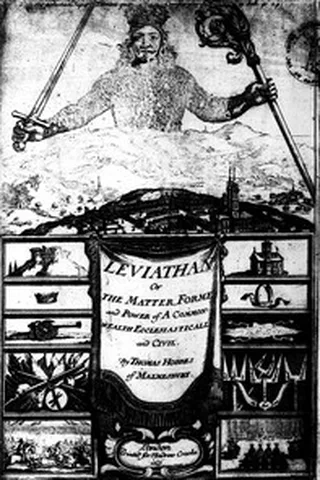
Thomas Hobbes, an English philosopher who had fled civil war to Paris, published Leviathan in 1651 to explain why human beings need a sovereign power. Its forty seven chapters move from human nature and speech through the commonwealth by covenant to a Christian commonwealth and the kingdom of darkness. It offers modern political philosophy's great foundation stone: fearful, logical, and written in mighty English prose.
Hobbes published Leviathan in 1651, in the aftermath of civil war, and dedicated it to Francis Godolphin in the epistle that opens this text. His question is the sharpest in political philosophy: why do men who want peace keep making war, and what authority could end the quarrel for good? The book answers in 47 chapters across four parts, plus a review and conclusion.
Part I, Of Man, starts from sense, imagination, speech and reason, works through the passions, and arrives at the natural condition of mankind, where life without a common power is solitary, poor, nasty, brutish and short. Part II, Of Common-wealth, builds the remedy: covenant, sovereignty by institution, the rights and office of the sovereign, civil law, crimes and punishments, and the causes that dissolve a commonwealth. Parts III and IV, on a Christian commonwealth and the kingdom of darkness, take the argument into scripture, the church and the misinterpretations by which, Hobbes argues, spiritual darkness serves worldly power.
The prose, dense and magnificent, rewards slow reading. Take Part I chapter XIII and Part II chapter XVII first if you want the core before the whole.
Edition: Edition of 1651. Text: Project Gutenberg ebook 3207.
The first chapter
TO MY MOST HONOR’D FRIEND Mr. FRANCIS GODOLPHIN of GODOLPHIN
HONOR’D SIR.
Your most worthy Brother Mr SIDNEY GODOLPHIN, when he lived, was pleas’d to think my studies something, and otherwise to oblige me, as you know, with reall testimonies of his good opinion, great in themselves, and the greater for the worthinesse of his person. For there is not any vertue that disposeth a man, either to the service of God, or to the service of his Country, to Civill Society, or private Friendship, that did not manifestly appear in his conversation, not as acquired by necessity, or affected upon occasion, but inhaerent, and shining in a generous constitution of his nature. Therefore in honour and gratitude to him, and with devotion to your selfe, I humbly Dedicate unto you this my discourse of Common-wealth. I know not how the world will receive it, nor how it may reflect on those that shall seem to favour it. For in a way beset with those that contend on one side for too great Liberty, and on the other side for too much Authority, ’tis hard to passe between the points of both unwounded. But yet, me thinks, the endeavour to advance the Civill Power, should not be by the Civill Power condemned; nor private men, by reprehending it, declare they think that Power too great. Besides, I speak not of the men, but (in the Abstract) of the Seat of Power, (like to those simple and unpartiall creatures in the Roman Capitol, that with their noyse defended those within it, not because they were they, but there) offending none, I think, but those without, or such within (if there be any such) as favour them. That which perhaps may most offend, are certain Texts of Holy Scripture, alledged by me to other purpose than ordinarily they use to be by others. But I have done it with due submission, and also (in order to my Subject) necessarily; for they are the Outworks of the Enemy, from whence they impugne the Civill Power. If notwithstanding this, you find my labour generally decryed, you may be pleased to excuse your selfe, and say that I am a man that love my own opinions, and think all true I say, that I honoured your Brother, and honour you, and have presum’d on that, to assume the Title (without your knowledge) of being, as I am,
Sir,
Your most humble, and most obedient servant, Thomas Hobbes.
Paris APRILL 15/25 1651.
Source: Project Gutenberg. Published 1651. Author died 1679. Public domain worldwide. Share this book: WhatsApp
 Starvard