
Hello, my name is Finn, and I'm going to help you understand this book.
Here it is, explained like you are 10:
Gregor Mendel was a quiet monk who grew peas in his garden and counted them, year after year. He found a clear pattern in how plants pass traits to their young. Most people ignored him. Then William Bateson, a scientist in England, read his work and wrote this book to defend him. Best of all, Mendel's own papers are inside, in English, so you can read his pea experiments for yourself.
Gregor Mendel, an Augustinian friar at Brünn, spent years crossing pea plants and counting their offspring: tall and short, round seeds and wrinkled, yellow and green. In papers published in the 1860s he showed that traits do not simply blend. They pass down in separate units, some dominant and some recessive, in ratios a reader can check. Then the papers were forgotten for more than thirty years.
Around 1900 Mendel's work was rediscovered after long neglect. William Bateson, a Cambridge biologist, became its champion in England. When Professor Weldon attacked Mendel's findings in the journal Biometrika, Bateson answered with this book of 1902, following the criticism point by point and showing where it misread the records.
What makes the volume special is that Bateson does not ask you to take his word for it. The book opens with his introduction to the problems of heredity, and then prints Mendel's own papers in translation, both the great paper on plant hybrids and a later, shorter one. The defence and the evidence sit side by side, and modern genetics begins on these pages.
In 1902 the biologist William Bateson published a defence of a monk whose pea experiments had been ignored for decades. Gregor Mendel had found clear patterns in how traits pass from parent plants to offspring, and Bateson saw a new science being born. This book argues Mendel's case, introduces his principles, answers a sharp critic, and, best of all, prints Mendel's own papers in translation, so readers can judge the evidence for themselves.
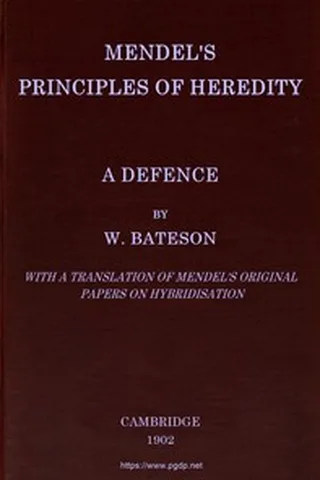
The title page of the Cambridge University Press edition of 1902 is precise about what this book is: Mendel's Principles of Heredity, A Defence, by W. Bateson, M.A., F.R.S., with a translation of Mendel's original papers on hybridisation. Mendel's portrait fronts the volume, captioned Gregor Mendel, Abbot of Brünn, born 1822, died 1884, from a photograph supplied by his successor as abbot.
Bateson's preface explains the emergency. Mendel's work had been rediscovered two years earlier, and Professor Weldon's criticism in Biometrika threatened, Bateson feared, to convince younger researchers that Mendel had been exposed before they had read him. So Bateson obtained the Royal Horticultural Society's permission to reprint and modify the translation of Mendel's great paper published in its Journal, added a translation of Mendel's later, minor paper, and reprinted his own 1900 lecture to the Society as an introduction.
The contents map the whole: the introduction on the problems of heredity, Mendel's Experiments in Plant Hybridisation, his experiments with Hieracium, and then the Defence itself, answering Weldon point by point. Mendel's own papers are inside, in full, which is the heart of this edition.
Edition: William Bateson's Defence (1902). The volume also carries Mendel's own papers in translation, and they are shelved with it. Text: Project Gutenberg ebook 69362.
The first chapter
By Gregor Mendel.
(Read at the Meetings of the 8th February and 8th March, 1865.)
Experience of artificial fertilisation, such as is effected with ornamental plants in order to obtain new variations in colour, has led to the experiments which will here be discussed. The striking regularity with which the same hybrid forms always reappeared whenever fertilisation took place between the same species induced further experiments to be undertaken, the object of which was to follow up the developments of the hybrids in their progeny.
To this object numerous careful observers, such as Kölreuter, Gärtner, Herbert, Lecoq, Wichura and others, have devoted a part of their lives with inexhaustible perseverance. Gärtner especially, in his work “Die Bastarderzeugung im Pflanzenreiche” (The Production of Hybrids in the Vegetable Kingdom), has recorded very valuable observations; and quite recently Wichura published the results of some profound investigations into the hybrids of the Willow. That, so far, no generally applicable law governing the formation and development of hybrids has been successfully formulated can hardly be wondered at by anyone who is acquainted with the extent of the task, and can appreciate the difficulties with which experiments of this class have to contend. A final decision can only be arrived at when we shall have before us the results of detailed experiments made on plants belonging to the most diverse orders.
Those who survey the work done in this department will arrive at the conviction that among all the numerous experiments made, not one has been carried out to such an extent and in such a way as to make it possible to determine the number of different forms under which the offspring of hybrids appear, or to arrange these forms with certainty according to their separate generations, or to definitely ascertain their statistical relations.
It requires indeed some courage to undertake a labour of such far-reaching extent; it appears, however, to be the only right way by which we can finally reach the solution of a question the importance of which cannot be over-estimated in connection with the history of the evolution of organic forms.
The paper now presented records the results of such a detailed experiment. This experiment was practically confined to a small plant group, and is now, after eight years’ pursuit, concluded in all essentials. Whether the plan upon which the separate experiments were conducted and carried out was the best suited to attain the desired end is left to the friendly decision of the reader.
The value and utility of any experiment are determined by the fitness of the material to the purpose for which it is used, and thus in the case before us it cannot be immaterial what plants are subjected to experiment and in what manner such experiments are conducted.
The selection of the plant group which shall serve for experiments of this kind must be made with all possible care if it be desired to avoid from the outset every risk of questionable results.
The experimental plants must necessarily--
1. Possess constant differentiating characters.
2. The hybrids of such plants must, during the flowering period, be protected from the influence of all foreign pollen, or be easily capable of such protection.
The hybrids and their offspring should suffer no marked disturbance in their fertility in the successive generations.
Accidental impregnation by foreign pollen, if it occurred during the experiments and were not recognized, would lead to entirely erroneous conclusions. Reduced fertility or entire sterility of certain forms, such as occurs in the offspring of many hybrids, would render the experiments very difficult or entirely frustrate them. In order to discover the relations in which the hybrid forms stand towards each other and also towards their progenitors it appears to be necessary that all members of the series developed in each successive generation should be, without exception, subjected to observation.
At the very outset special attention was devoted to the Leguminosæ on account of their peculiar floral structure. Experiments which were made with several members of this family led to the result that the genus Pisum was found to possess the necessary conditions.
Some thoroughly distinct forms of this genus possess characters which are constant, and easily and certainly recognisable, and when their hybrids are mutually crossed they yield perfectly fertile progeny. Furthermore, a disturbance through foreign pollen cannot easily occur, since the fertilising organs are closely packed inside the keel and the anther bursts within the bud, so that the stigma becomes covered with pollen even before the flower opens. This circumstance is of especial importance. As additional advantages worth mentioning, there may be cited the easy culture of these plants in the open ground and in pots, and also their relatively short period of growth. Artificial fertilisation is certainly a somewhat elaborate process, but nearly always succeeds. For this purpose the bud is opened before it is perfectly developed, the keel is removed, and each stamen carefully extracted by means of forceps, after which the stigma can at once be dusted over with the foreign pollen.
In all, thirty-four more or less distinct varieties of Peas were obtained from several seedsmen and subjected to a two years’ trial. In the case of one variety there were remarked, among a larger number of plants all alike, a few forms which were markedly different. These, however, did not vary in the following year, and agreed entirely with another variety obtained from the same seedsmen; the seeds were therefore doubtless merely accidentally mixed. All the other varieties yielded perfectly constant and similar offspring; at any rate, no essential difference was observed during two trial years. For fertilisation twenty-two of these were selected and cultivated during the whole period of the experiments. They remained constant without any exception.
Their systematic classification is difficult and uncertain. If we adopt the strictest definition of a species, according to which only those individuals belong to a species which under precisely the same circumstances display precisely similar characters, no two of these varieties could be referred to one species. According to the opinion of experts, however, the majority belong to the species Pisum sativum; while the rest are regarded and classed, some as sub-species of P. sativum, and some as independent species, such as P. quadratum, P. saccharatum, and P. umbellatum. The positions, however, which may be assigned to them in a classificatory system are quite immaterial for the purposes of the experiments in question. It has so far been found to be just as impossible to draw a sharp line between the hybrids of species and varieties as between species and varieties themselves.
If two plants which differ constantly in one or several characters be crossed, numerous experiments have demonstrated that the common characters are transmitted unchanged to the hybrids and their progeny; but each pair of differentiating characters, on the other hand, unite in the hybrid to form a new character, which in the progeny of the hybrid is usually variable. The object of the experiment was to observe these variations in the case of each pair of differentiating characters, and to deduce the law according to which they appear in the successive generations. The experiment resolves itself therefore into just as many separate experiments as there are constantly differentiating characters presented in the experimental plants.
The various forms of Peas selected for crossing showed differences in the length and colour of the stem; in the size and form of the leaves; in the position, colour, and size of the flowers; in the length of the flower stalk; in the colour, form, and size of the pods; in the form and size of the seeds; and in the colour of the seed-coats and the albumen [cotyledons]. Some of the characters noted do not permit of a sharp and certain separation, since the difference is of a “more or less” nature, which is often difficult to define. Such characters could not be utilised for the separate experiments; these could only be confined to characters which stand out clearly and definitely in the plants. Lastly, the result must show whether they, in their entirety, observe a regular behaviour in their hybrid unions, and whether from these facts any conclusion can be come to regarding those characters which possess a subordinate significance in the type.
The characters which were selected for experiment relate:
1. To the difference in the form of the ripe seeds. These are either round or roundish, the wrinkling, when such occurs on the surface, being always only shallow; or they are irregularly angular and deeply wrinkled (P. quadratum).
2. To the difference in the colour of the seed albumen (endosperm). The albumen of the ripe seeds is either pale yellow, bright yellow and orange coloured, or it possesses a more or less intense green tint. This difference of colour is easily seen in the seeds as their coats are transparent.
3. To the difference in the colour of the seed-coat. This is either white, with which character white flowers are constantly correlated; or it is grey, grey-brown, leather-brown, with or without violet spotting, in which case the colour of the standards is violet, that of the wings purple, and the stem in the axils of the leaves is of a reddish tint. The grey seed-coats become dark brown in boiling water.
4. To the difference in the form of the ripe pods. These are either simply inflated, never contracted in places; or they are deeply constricted between the seeds and more or less wrinkled (P. saccharatum).
5. To the difference in the colour of the unripe pods. They are either light to dark green, or vividly yellow, in which colouring the stalks, leaf-veins, and calyx participate.
6. To the difference in the position of the flowers. They are either axial, that is, distributed along the main stem; or they are terminal, that is, bunched at the top of the stem and arranged almost in a false umbel; in this case the upper part of the stem is more or less widened in section (P. umbellatum).
7. To the difference in the length of the stem. The length of the stem is very various in some forms; it is, however, a constant character for each, in so far that healthy plants, grown in the same soil, are only subject to unimportant variations in this character.
In experiments with this character, in order to be able to discriminate with certainty, the long axis of 6-7 ft. was always crossed with the short one of 3/4 ft. to 1-1/2 ft.
Each two of the differentiating characters enumerated above were united by cross-fertilisation. There were made for the
1st trial 60 fertilisations on 15 plants. 2nd " 58 " " 10 " 3rd " 35 " " 10 " 4th " 40 " " 10 " 5th " 23 " " 5 " 6th " 34 " " 10 " 7th " 37 " " 10 "
From a larger number of plants of the same variety only the most vigorous were chosen for fertilisation. Weakly plants always afford uncertain results, because even in the first generation of hybrids, and still more so in the subsequent ones, many of the offspring either entirely fail to flower or only form a few and inferior seeds.
Furthermore, in all the experiments reciprocal crossings were effected in such a way that each of the two varieties which in one set of fertilisations served as seed-bearers in the other set were used as pollen plants.
The plants were grown in garden beds, a few also in pots, and were maintained in their naturally upright position by means of sticks, branches of trees, and strings stretched between. For each experiment a number of pot plants were placed during the blooming period in a greenhouse, to serve as control plants for the main experiment in the open as regards possible disturbance by insects. Among the insects which visit Peas the beetle Bruchus pisi might be detrimental to the experiments should it appear in numbers. The female of this species is known to lay the eggs in the flower, and in so doing opens the keel; upon the tarsi of one specimen, which was caught in a flower, some pollen grains could clearly be seen under a lens. Mention must also be made of a circumstance which possibly might lead to the introduction of foreign pollen. It occurs, for instance, in some rare cases that certain parts of an otherwise quite normally developed flower wither, resulting in a partial exposure of the fertilising organs. A defective development of the keel has also been observed, owing to which the stigma and anthers remained partially uncovered. It also sometimes happens that the pollen does not reach full perfection. In this event there occurs a gradual lengthening of the pistil during the blooming period, until the stigmatic tip protrudes at the point of the keel. This remarkable appearance has also been observed in hybrids of Phaseolus and Lathyrus.
The risk of false impregnation by foreign pollen is, however, a very slight one with Pisum, and is quite incapable of disturbing the general result. Among more than 10,000 plants which were carefully examined there were only a very few cases where an indubitable false impregnation had occurred. Since in the greenhouse such a case was never remarked, it may well be supposed that Bruchus pisi, and possibly also the described abnormalities in the floral structure, were to blame.
Experiments which in previous years were made with ornamental plants have already afforded evidence that the hybrids, as a rule, are not exactly intermediate between the parental species. With some of the more striking characters, those, for instance, which relate to the form and size of the leaves, the pubescence of the several parts, &c., the intermediate, indeed, was nearly always to be seen; in other cases, however, one of the two parental characters was so preponderant that it was difficult, or quite impossible, to detect the other in the hybrid.
This is precisely the case with the Pea hybrids. In the case of each of the seven crosses the hybrid-character resembles that of one of the parental forms so closely that the other either escapes observation completely or cannot be detected with certainty. This circumstance is of great importance in the determination and classification of the forms under which the offspring of the hybrids appear. Henceforth in this paper those characters which are transmitted entire, or almost unchanged in the hybridisation, and therefore in themselves constitute the characters of the hybrid, are termed the dominant, and those which become latent in the process recessive. The expression “recessive” has been chosen because the characters thereby designated withdraw or entirely disappear in the hybrids, but nevertheless reappear unchanged in their progeny, as will be demonstrated later on.
It was furthermore shown by the whole of the experiments that it is perfectly immaterial whether the dominant character belong to the seed-bearer or to the pollen parent; the form of the hybrid remains identical in both cases. This interesting fact was also emphasised by Gärtner, with the remark that even the most practised expert is not in a position to determine in a hybrid which of the two parental species was the seed or the pollen plant.
Of the differentiating characters which were used in the experiments the following are dominant:
1. The round or roundish form of the seed with or without shallow depressions.
2. The yellow colouring of the seed albumen [cotyledons].
3. The grey, grey-brown, or leather-brown colour of the seed-coat, in connection with violet-red blossoms and reddish spots in the leaf axils.
4. The simply inflated form of the pod.
5. The green colouring of the unripe pod in connection with the same colour in the stems, the leaf-veins and the calyx.
6. The distribution of the flowers along the stem.
7. The greater length of stem.
With regard to this last character it must be stated that the longer of the two parental stems is usually exceeded by the hybrid, which is possibly only attributable to the greater luxuriance which appears in all parts of plants when stems of very different length are crossed. Thus, for instance, in repeated experiments, stems of 1 ft. and 6 ft. in length yielded without exception hybrids which varied in length between 6 ft. and 7-1/2 ft.
The hybrid seeds in the experiments with seed-coat are often more spotted, and the spots sometimes coalesce into small bluish-violet patches. The spotting also frequently appears even when it is absent as a parental character.
The hybrid forms of the seed-shape and of the albumen are developed immediately after the artificial fertilisation by the mere influence of the foreign pollen. They can, therefore, be observed even in the first year of experiment, whilst all the other characters naturally only appear in the following year in such plants as have been raised from the crossed seed.
In this generation there reappear, together with the dominant characters, also the recessive ones with their full peculiarities, and this occurs in the definitely expressed average proportion of three to one, so that among each four plants of this generation three display the dominant character and one the recessive. This relates without exception to all the characters which were embraced in the experiments. The angular wrinkled form of the seed, the green colour of the albumen, the white colour of the seed-coats and the flowers, the constrictions of the pods, the yellow colour of the unripe pod, of the stalk of the calyx, and of the leaf venation, the umbel-like form of the inflorescence, and the dwarfed stem, all reappear in the numerical proportion given without any essential alteration. Transitional forms were not observed in any experiment.
Once the hybrids resulting from reciprocal crosses are fully formed, they present no appreciable difference in their subsequent development, and consequently the results [of the reciprocal crosses] can be reckoned together in each experiment. The relative numbers which were obtained for each pair of differentiating characters are as follows:
Expt. 1. Form of seed.--From 253 hybrids 7,324 seeds were obtained in the second trial year. Among them were 5,474 round or roundish ones and 1,850 angular wrinkled ones. Therefrom the ratio 2·96 to 1 is deduced.
Expt. 2. Colour of albumen.--258 plants yielded 8,023 seeds, 6,022 yellow, and 2,001 green; their ratio, therefore, is as 3·01 to 1.
In these two experiments each pod yielded usually both kinds of seed. In well-developed pods which contained on the average six to nine seeds, it often occurred that all the seeds were round (Expt. 1) or all yellow (Expt. 2); on the other hand there were never observed more than five angular or five green ones in one pod. It appears to make no difference whether the pods are developed early or later in the hybrid or whether they spring from the main axis or from a lateral one. In some few plants only a few seeds developed in the first formed pods, and these possessed exclusively one of the two characters, but in the subsequently developed pods the normal proportions were maintained nevertheless.
As in separate pods, so did the distribution of the characters vary in separate plants. By way of illustration the first ten individuals from both series of experiments may serve.
Experiment 1. Experiment 2. Form of Seed. Colour of Albumen. Plants. Round. Angular. Yellow. Green.
1 45 12 25 11 2 27 8 32 7 3 24 7 14 5 4 19 10 70 27 5 32 11 24 13 6 26 6 20 6 7 88 24 32 13 8 22 10 44 9 9 28 6 50 14 10 25 7 44 18
As extremes in the distribution of the two seed characters in one plant, there were observed in Expt. 1 an instance of 43 round and only 2 angular, and another of 14 round and 15 angular seeds. In Expt. 2 there was a case of 32 yellow and only 1 green seed, but also one of 20 yellow and 19 green.
These two experiments are important for the determination of the average ratios, because with a smaller number of experimental plants they show that very considerable fluctuations may occur. In counting the seeds, also, especially in Expt. 2, some care is requisite, since in some of the seeds of many plants the green colour of the albumen is less developed, and at first may be easily overlooked. The cause of the partial disappearance of the green colouring has no connection with the hybrid-character of the plants, as it likewise occurs in the parental variety. This peculiarity is also confined to the individual and is not inherited by the offspring. In luxuriant plants this appearance was frequently noted. Seeds which are damaged by insects during their development often vary in colour and form, but, with a little practice in sorting, errors are easily avoided. It is almost superfluous to mention that the pods must remain on the plants until they are thoroughly ripened and have become dried, since it is only then that the shape and colour of the seed are fully developed.
Expt. 3. Colour of the seed-coats.--Among 929 plants 705 bore violet-red flowers and grey-brown seed-coats; 224 had white flowers and white seed-coats, giving the proportion 3·15 to 1.
Expt. 4. Form of pods.--Of 1,181 plants 882 had them simply inflated, and in 299 they were constricted. Resulting ratio, 2·95 to 1.
Expt. 5. Colour of the unripe pods.--The number of trial plants was 580, of which 428 had green pods and 152 yellow ones. Consequently these stand in the ratio 2·82 to 1.
Expt. 6. Position of flowers.--Among 858 cases 651 blossoms were axial and 207 terminal. Ratio, 3·14 to 1.
Expt. 7. Length of stem.--Out of 1,064 plants, in 787 cases the stem was long, and in 277 short. Hence a mutual ratio of 2·84 to 1. In this experiment the dwarfed plants were carefully lifted and transferred to a special bed. This precaution was necessary, as otherwise they would have perished through being overgrown by their tall relatives. Even in their quite young state they can be easily picked out by their compact growth and thick dark-green foliage.
If now the results of the whole of the experiments be brought together, there is found, as between the number of forms with the dominant and recessive characters, an average ratio of 2·98 to 1, or 3 to 1.
The dominant character can have here a double signification--viz. that of a parental-character, or a hybrid-character. In which of the two significations it appears in each separate case can only be determined by the following generation. As a parental character it must pass over unchanged to the whole of the offspring; as a hybrid-character, on the other hand, it must observe the same behaviour as in the first generation.
Source: Project Gutenberg. Published 1902. Bateson died 1926. Mendel's papers published 1866; Mendel died 1884. Public domain worldwide. Share this book: WhatsApp
 Starvard