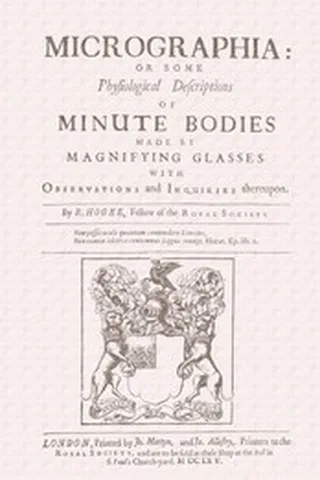

Hello, my name is Finn, and I'm going to help you understand this book.
Here it is, explained like you are 10:
Robert Hooke looked through a microscope when microscopes were brand new, and he saw a hidden world. A flea looked like a monster in armor. A piece of cork was full of tiny boxes, and he called them cells, a word scientists still use. He made huge, beautiful drawings of everything he saw and put them in this book. It was the first time most people ever saw the world of the very small.
Hooke was curator of experiments for the young Royal Society in London, expected to demonstrate something new at every meeting. King Charles II took an interest in microscopic wonders, and the Society sponsored Hooke's book as a showcase of the new instrument. Published in 1665, the year of the Great Plague, Micrographia was printed in a large, handsome format with engravings from Hooke's own drawings.
Its observations move from man made objects, needle points, printed dots, and woven cloth, to natural marvels: insects, feathers, sponges, snowflakes, and plants. The famous plate of the flea unfolds to a startling size, and the cork section introduces the word cell for its box like pores. Hooke also speculates about light, fossils, and gravity, sometimes reaching ideas far ahead of his evidence.
Micrographia created a sensation, was read by Samuel Pepys late into the night, and taught Europe to imagine the microscopic realm. Modern biology still uses Hooke's coinage every day. Readers who love science history, beautiful plates, or the feeling of a new world opening will find this seventeenth century bestseller surprisingly alive.
Robert Hooke, the Royal Society's tireless experimenter, published Micrographia in 1665, the first great book of microscope observations. Its fold out plates reveal a flea, a louse, snowflakes, cork, and the point of a needle as landscapes from an unknown world, and Hooke coined the word cell from what he saw. The book offers the shock of the very small, drawn and described by a brilliant, restless mind.
Micrographia, published in 1665 under the Royal Society's sponsorship, was the first bestselling work of microscopy and one of the great illustrated books of science. Robert Hooke, the Society's curator of experiments and one of the most inventive minds of the century, had been directed to show what the new instrument could do. He showed a universe.
The book has lasted for its plates as much as its words: the flea as an armored giant across a fold out sheet, the louse gripping a human hair, cork sliced thin to reveal the honeycomb of pores Hooke named cells, a term biology has never given back. Between observations he ranges over light, combustion, fossils, and the Moon, wrong in places, prescient in others, always reaching. Pepys sat up until two in the morning with it and called it the most ingenious book he had ever read.
A first reader should seek an edition that reproduces the plates at full size, since the images are the argument. The prose is vigorous early scientific English, easier than it looks. Read the preface, then wander the observations as Hooke's first readers did, in wonder.
Edition: First edition, 1665. Text: Project Gutenberg ebook 15491.
The first chapter
TO THE
KING.
SIR,
I Do here most humbly lay this small Present at Your Majesties Royal feet. And though it comes accompany’d with two disadvantages, the meanness of the Author, and of the Subject; yet in both I am incouraged by the greatness of your Mercy and your Knowledge. By the one I am taught, that you can forgive the most presumptuous Offendors: And by the other, that you will not esteem the least work of Nature, or Art, unworthy your Observation. Amidst the many felicities that have accompani’d your Majesties happy Restauration and Government, it is none of the least considerable that Philosophy and Experimental Learning have prosper’d under your Royal Patronage. And as the calm prosperity of your Reign has given us the leisure to follow these Studies of quiet and retirement, so it is just, that the Fruits of them should, by way of acknowledgement, be return’d to your Majesty. There are, Sir, several other of your Subjects, of your Royal Society, now busie about Nobler matters: The Improvement of Manufactures and Agriculture, the Increase of Commerce, the Advantage of Navigation: In all which they are assisted by your Majesties Incouragement and Example. Amidst all those greater Designs, I here presume to bring in that which is more proportionable to the smalness of my Abilities, and to offer some of the least of all visible things, to that Mighty King, that has establisht an Empire over the best of all Invisible things of this World, the Minds of Men.
Your Majesties most humble and most obedient Subject and Servant,
ROBERT HOOKE.
Source: Project Gutenberg. Published 1665. Author died 1703. Public domain worldwide. Share this book: WhatsApp
 Starvard