
Hello, my name is Finn, and I'm going to help you understand this book.
Here it is, explained like you are 10:
Nicholas Nickleby is a kind young man whose father has just died, leaving the family with almost nothing. His uncle Ralph pretends to help, but really he wants to use them. Nicholas is sent to a terrible school in Yorkshire, where the master, Mr Squeers, starves and beats his pupils. Nicholas stands up for a suffering boy named Smike, and his brave sister Kate must face dangers of her own in London.
Charles Dickens wrote Nicholas Nickleby as his third novel, published in monthly parts in 1838 to 1839, when he was still in his twenties. He had visited Yorkshire's cheap boarding schools, where unwanted boys were sent and neglected, and he went home determined to expose them. His preface insists that Squeers and his school are softened pictures of a real evil, not inventions.
Nicholas, his mother, and his sister Kate are left poor when his father dies, and they appeal to his uncle Ralph Nickleby, a hard hearted moneylender. Ralph sends Nicholas to assist Wackford Squeers at Dotheboys Hall. Nicholas befriends the half starved drudge Smike, thrashes Squeers for beating him, and escapes with Smike to London. There Kate faces Ralph's scheming friends, while Nicholas finds honest work and kind protectors, and the family's fortunes slowly turn.
This is early Dickens at full stretch: a cruel school, a stage company, kind Cheeryble brothers, villains, rescues, and a great deal of laughter between the tears. It is long, and happily so. Readers who like a big hearted story where decency fights back will feel at home here from the first chapters onward.
Charles Dickens, twenty six and newly famous from The Pickwick Papers, published Nicholas Nickleby in monthly parts in 1838 to 1839. When Nicholas's father dies ruined, the family falls on the mercy of his uncle Ralph, a cold London moneylender who sends Nicholas to teach at Dotheboys Hall in Yorkshire. There Nicholas defends the beaten boy Smike and takes on schoolmaster Squeers. It offers Dickens at his most warm hearted and indignant.
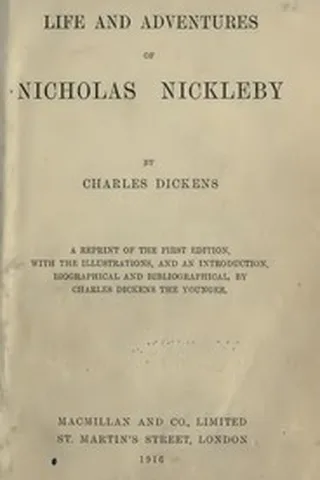
Nicholas Nickleby appeared in monthly parts in 1838 to 1839 and was Dickens's third novel, following The Pickwick Papers and Oliver Twist. Dickens's prefaces, carried at the front, explain his Yorkshire journey, his attack on the cheap boarding schools, and his note that two of its characters were drawn from life.
The story opens with the Nickleby family's history and Ralph Nickleby's London world, then sends Nicholas to Dotheboys Hall, whose advertisement promises every branch of learning for twenty guineas a year with no extras and no holidays. His rescue of Smike, his sister Kate's trials in millinery and in company Ralph keeps, and his time with a travelling theatre company fill the broad middle of the book.
Expect the full early Dickens mixture: melodrama and comedy, righteous anger at cruelty to children, and a large, vivid cast held together by Nicholas's decency. The Yorkshire chapters remain its most famous, and they earn their fame honestly.
Edition: Text: Project Gutenberg ebook 967.
The first chapter
There once lived, in a sequestered part of the county of Devonshire, one Mr. Godfrey Nickleby: a worthy gentleman, who, taking it into his head rather late in life that he must get married, and not being young enough or rich enough to aspire to the hand of a lady of fortune, had wedded an old flame out of mere attachment, who in her turn had taken him for the same reason. Thus two people who cannot afford to play cards for money, sometimes sit down to a quiet game for love.
Some ill-conditioned persons who sneer at the life-matrimonial, may perhaps suggest, in this place, that the good couple would be better likened to two principals in a sparring match, who, when fortune is low and backers scarce, will chivalrously set to, for the mere pleasure of the buffeting; and in one respect indeed this comparison would hold good; for, as the adventurous pair of the Fives’ Court will afterwards send round a hat, and trust to the bounty of the lookers-on for the means of regaling themselves, so Mr. Godfrey Nickleby and HIS partner, the honeymoon being over, looked out wistfully into the world, relying in no inconsiderable degree upon chance for the improvement of their means. Mr. Nickleby’s income, at the period of his marriage, fluctuated between sixty and eighty pounds PER ANNUM.
There are people enough in the world, Heaven knows! and even in London (where Mr. Nickleby dwelt in those days) but few complaints prevail, of the population being scanty. It is extraordinary how long a man may look among the crowd without discovering the face of a friend, but it is no less true. Mr. Nickleby looked, and looked, till his eyes became sore as his heart, but no friend appeared; and when, growing tired of the search, he turned his eyes homeward, he saw very little there to relieve his weary vision. A painter who has gazed too long upon some glaring colour, refreshes his dazzled sight by looking upon a darker and more sombre tint; but everything that met Mr. Nickleby’s gaze wore so black and gloomy a hue, that he would have been beyond description refreshed by the very reverse of the contrast.
At length, after five years, when Mrs. Nickleby had presented her husband with a couple of sons, and that embarrassed gentleman, impressed with the necessity of making some provision for his family, was seriously revolving in his mind a little commercial speculation of insuring his life next quarter-day, and then falling from the top of the Monument by accident, there came, one morning, by the general post, a black-bordered letter to inform him how his uncle, Mr. Ralph Nickleby, was dead, and had left him the bulk of his little property, amounting in all to five thousand pounds sterling.
As the deceased had taken no further notice of his nephew in his lifetime, than sending to his eldest boy (who had been christened after him, on desperate speculation) a silver spoon in a morocco case, which, as he had not too much to eat with it, seemed a kind of satire upon his having been born without that useful article of plate in his mouth, Mr. Godfrey Nickleby could, at first, scarcely believe the tidings thus conveyed to him. On examination, however, they turned out to be strictly correct. The amiable old gentleman, it seemed, had intended to leave the whole to the Royal Humane Society, and had indeed executed a will to that effect; but the Institution, having been unfortunate enough, a few months before, to save the life of a poor relation to whom he paid a weekly allowance of three shillings and sixpence, he had, in a fit of very natural exasperation, revoked the bequest in a codicil, and left it all to Mr. Godfrey Nickleby; with a special mention of his indignation, not only against the society for saving the poor relation’s life, but against the poor relation also, for allowing himself to be saved.
With a portion of this property Mr. Godfrey Nickleby purchased a small farm, near Dawlish in Devonshire, whither he retired with his wife and two children, to live upon the best interest he could get for the rest of his money, and the little produce he could raise from his land. The two prospered so well together that, when he died, some fifteen years after this period, and some five after his wife, he was enabled to leave, to his eldest son, Ralph, three thousand pounds in cash, and to his youngest son, Nicholas, one thousand and the farm, which was as small a landed estate as one would desire to see.
These two brothers had been brought up together in a school at Exeter; and, being accustomed to go home once a week, had often heard, from their mother’s lips, long accounts of their father’s sufferings in his days of poverty, and of their deceased uncle’s importance in his days of affluence: which recitals produced a very different impression on the two: for, while the younger, who was of a timid and retiring disposition, gleaned from thence nothing but forewarnings to shun the great world and attach himself to the quiet routine of a country life, Ralph, the elder, deduced from the often-repeated tale the two great morals that riches are the only true source of happiness and power, and that it is lawful and just to compass their acquisition by all means short of felony. ‘And,’ reasoned Ralph with himself, ‘if no good came of my uncle’s money when he was alive, a great deal of good came of it after he was dead, inasmuch as my father has got it now, and is saving it up for me, which is a highly virtuous purpose; and, going back to the old gentleman, good DID come of it to him too, for he had the pleasure of thinking of it all his life long, and of being envied and courted by all his family besides.’ And Ralph always wound up these mental soliloquies by arriving at the conclusion, that there was nothing like money.
Not confining himself to theory, or permitting his faculties to rust, even at that early age, in mere abstract speculations, this promising lad commenced usurer on a limited scale at school; putting out at good interest a small capital of slate-pencil and marbles, and gradually extending his operations until they aspired to the copper coinage of this realm, in which he speculated to considerable advantage. Nor did he trouble his borrowers with abstract calculations of figures, or references to ready-reckoners; his simple rule of interest being all comprised in the one golden sentence, ‘two-pence for every half-penny,’ which greatly simplified the accounts, and which, as a familiar precept, more easily acquired and retained in the memory than any known rule of arithmetic, cannot be too strongly recommended to the notice of capitalists, both large and small, and more especially of money-brokers and bill-discounters. Indeed, to do these gentlemen justice, many of them are to this day in the frequent habit of adopting it, with eminent success.
In like manner, did young Ralph Nickleby avoid all those minute and intricate calculations of odd days, which nobody who has worked sums in simple-interest can fail to have found most embarrassing, by establishing the one general rule that all sums of principal and interest should be paid on pocket-money day, that is to say, on Saturday: and that whether a loan were contracted on the Monday, or on the Friday, the amount of interest should be, in both cases, the same. Indeed he argued, and with great show of reason, that it ought to be rather more for one day than for five, inasmuch as the borrower might in the former case be very fairly presumed to be in great extremity, otherwise he would not borrow at all with such odds against him. This fact is interesting, as illustrating the secret connection and sympathy which always exist between great minds. Though Master Ralph Nickleby was not at that time aware of it, the class of gentlemen before alluded to, proceed on just the same principle in all their transactions.
From what we have said of this young gentleman, and the natural admiration the reader will immediately conceive of his character, it may perhaps be inferred that he is to be the hero of the work which we shall presently begin. To set this point at rest, for once and for ever, we hasten to undeceive them, and stride to its commencement.
On the death of his father, Ralph Nickleby, who had been some time before placed in a mercantile house in London, applied himself passionately to his old pursuit of money-getting, in which he speedily became so buried and absorbed, that he quite forgot his brother for many years; and if, at times, a recollection of his old playfellow broke upon him through the haze in which he lived--for gold conjures up a mist about a man, more destructive of all his old senses and lulling to his feelings than the fumes of charcoal--it brought along with it a companion thought, that if they were intimate he would want to borrow money of him. So, Mr. Ralph Nickleby shrugged his shoulders, and said things were better as they were.
As for Nicholas, he lived a single man on the patrimonial estate until he grew tired of living alone, and then he took to wife the daughter of a neighbouring gentleman with a dower of one thousand pounds. This good lady bore him two children, a son and a daughter, and when the son was about nineteen, and the daughter fourteen, as near as we can guess--impartial records of young ladies’ ages being, before the passing of the new act, nowhere preserved in the registries of this country--Mr Nickleby looked about him for the means of repairing his capital, now sadly reduced by this increase in his family, and the expenses of their education.
‘Speculate with it,’ said Mrs. Nickleby.
‘Spec--u--late, my dear?’ said Mr. Nickleby, as though in doubt.
‘Why not?’ asked Mrs. Nickleby.
‘Because, my dear, if we SHOULD lose it,’ rejoined Mr. Nickleby, who was a slow and time-taking speaker, ‘if we SHOULD lose it, we shall no longer be able to live, my dear.’
‘Fiddle,’ said Mrs. Nickleby.
‘I am not altogether sure of that, my dear,’ said Mr. Nickleby.
‘There’s Nicholas,’ pursued the lady, ‘quite a young man--it’s time he was in the way of doing something for himself; and Kate too, poor girl, without a penny in the world. Think of your brother! Would he be what he is, if he hadn’t speculated?’
‘That’s true,’ replied Mr. Nickleby. ‘Very good, my dear. Yes. I WILL speculate, my dear.’
Speculation is a round game; the players see little or nothing of their cards at first starting; gains MAY be great--and so may losses. The run of luck went against Mr. Nickleby. A mania prevailed, a bubble burst, four stock-brokers took villa residences at Florence, four hundred nobodies were ruined, and among them Mr. Nickleby.
‘The very house I live in,’ sighed the poor gentleman, ‘may be taken from me tomorrow. Not an article of my old furniture, but will be sold to strangers!’
The last reflection hurt him so much, that he took at once to his bed; apparently resolved to keep that, at all events.
‘Cheer up, sir!’ said the apothecary.
‘You mustn’t let yourself be cast down, sir,’ said the nurse.
‘Such things happen every day,’ remarked the lawyer.
‘And it is very sinful to rebel against them,’ whispered the clergyman.
‘And what no man with a family ought to do,’ added the neighbours.
Mr. Nickleby shook his head, and motioning them all out of the room, embraced his wife and children, and having pressed them by turns to his languidly beating heart, sunk exhausted on his pillow. They were concerned to find that his reason went astray after this; for he babbled, for a long time, about the generosity and goodness of his brother, and the merry old times when they were at school together. This fit of wandering past, he solemnly commended them to One who never deserted the widow or her fatherless children, and, smiling gently on them, turned upon his face, and observed, that he thought he could fall asleep.
Source: Project Gutenberg. Published 1838-1839. Author died 1870. Public domain worldwide. Share this book: WhatsApp
 Starvard