
Hello, my name is Finn, and I'm going to help you understand this book.
Here it is, explained like you are 10:
Long ago, doctors mostly repeated what old books said about the body. William Harvey watched living hearts, tied off veins, and counted how much blood the heart sends out. In this book, in Robert Willis's translation from the Latin, he shows that the blood does not ebb and flow like a tide. It goes round in a circle, out through the arteries and back through the veins, with the heart as its pump. Modern medicine starts here.
The editor's introduction in this Everyman's Library edition explains the world Harvey worked in. For centuries, learned medicine treated Galen and Aristotle as authorities not to be questioned, and held strange ideas: that arteries carried air or spirits, that blood was made fresh in the liver and used up in the body, that it seeped through invisible holes in the wall of the heart. Harvey, trained at Padua, decided to look for himself.
His little book, published at Frankfurt in 1628 and given here in Robert Willis's translation from the Latin, builds its case step by step. He watches hearts beating in living animals, ties vessels, works out how much blood one heart sends out in an hour, far more than the body could possibly make or consume, and concludes that the same blood must go round and round, driven by the heart's beat.
It is a short book, about a hundred pages, and readers ever since have praised its clearness. The introduction calls it one of the most beautiful books in physiology. Modern medicine, the editor argues, dates from this discovery, as navigation dates from the compass.
William Harvey published his short treatise on the heart and blood at Frankfurt in 1628, and medicine changed direction. Working from dissection and experiment rather than ancient authority, he argued that the heart is a pump, that blood leaves it through the arteries, returns through the veins, and moves in a circle. This Everyman's Library text, titled The Circulation of the Blood, gives Robert Willis's translation from the Latin, with an editor's introduction by E. A. Parkyn.
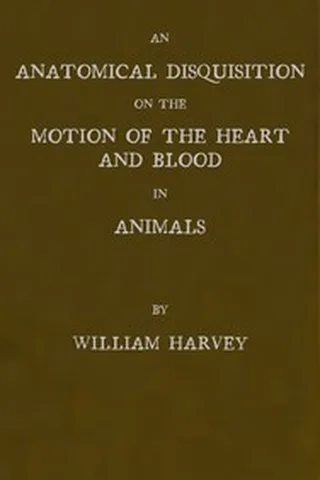
This text is the Everyman's Library volume, edited by Ernest Rhys and published by J. M. Dent in London and E. P. Dutton in New York, where Harvey's treatise appears under the library title The Circulation of the Blood, with an introduction by E. A. Parkyn. The original title page, reproduced inside, gives the work its full name, An Anatomical Disquisition on the Motion of the Heart and Blood in Animals, and its credentials: by William Harvey, translated from the Latin by Robert Willis.
Parkyn's introduction, an added item in this edition, frames the discovery historically. Ancient authority, he argues, had frozen inquiry, and Harvey, like his Padua contemporary Galileo, appealed from books to observed fact. He then states the discovery exactly: blood passes from the heart into the arteries, returns by the veins, and moves in a double circle, the lesser through the lungs and the greater through the body.
The contents then give Harvey's own dedication, his introduction, and seventeen chapters of close argument. Scope, stated plainly: the complete 1628 treatise, in Willis's translation, with Parkyn's editorial introduction, and the spelling of the original preserved.
Edition: Translated by Robert Willis. Edition of 1906. Text: Project Gutenberg ebook 67065.
The first chapter
When I first gave my mind to vivisections, as a means of discovering the motions and uses of the heart, and sought to discover these from actual inspection, and not from the writings of others, I found the task so truly arduous, so full of difficulties, that I was almost tempted to think, with Fracastorius, that the motion of the heart was only to be comprehended by God. For I could neither rightly perceive at first when the systole and when the diastole took place, nor when and where dilatation and contraction occurred, by reason of the rapidity of the motion, which in many animals is accomplished in the twinkling of an eye, coming and going like a flash of lightning; so that the systole presented itself to me now from this point, now from that; the diastole the same; and then everything was reversed, the motions occurring, as it seemed, variously and confusedly together. My mind was therefore greatly unsettled, nor did I know what I should myself conclude, nor what believe from others; I was not surprised that Andreas Laurentius should have said that the motion of the heart was as perplexing as the flux and reflux of Euripus had appeared to Aristotle.
At length, and by using greater and daily diligence, having frequent recourse to vivisections, employing a variety of animals for the purpose, and collating numerous observations, I thought that I had attained to the truth, that I should extricate myself and escape from this labyrinth, and that I had discovered what I so much desired, both the motion and the use of the heart and arteries; since which time I have not hesitated to expose my views upon these subjects, not only in private to my friends, but also in public, in my anatomical lectures, after the manner of the Academy of old.
These views, as usual, pleased some more, others less; some chid and calumniated me, and laid it to me as a crime that I had dared to depart from the precepts and opinion of all anatomists; others desired further explanations of the novelties, which they said were both worthy of consideration, and might perchance be found of signal use. At length, yielding to the requests of my friends, that all might be made participators in my labours, and partly moved by the envy of others, who receiving my views with uncandid minds and understanding them indifferently, have essayed to traduce me publicly, I have been moved to commit these things to the press, in order that all may be enabled to form an opinion both of me and my labours. This step I take all the more willingly, seeing that Hieronymus Fabricius of Aquapendente, although he has accurately and learnedly delineated almost every one of the several parts of animals in a special work, has left the heart alone untouched. Finally, if any use or benefit to this department of the republic of letters should accrue from my labours, it will, perhaps, be allowed that I have not lived idly, and, as the old man in the comedy says:
For never yet has any one attained To such perfection, but that time, and place, And use, have brought addition to his knowledge; Or made correction, or admonished him, That he was ignorant of much which he Had thought he knew; or led him to reject What he had once esteemed of highest price.
So will it, perchance, be found with reference to the heart at this time; or others, at least, starting from hence, the way pointed out to them, advancing under the guidance of a happier genius, may make occasion to proceed more fortunately, and to inquire more accurately.
Continue: Chapter 2: Of the Motions of the Heart, as Seen in the Dissection of Living Animals
Source: Project Gutenberg. Published in Latin 1628. Author died 1657. Willis translation 1847. Public domain worldwide. Share this book: WhatsApp
 Starvard