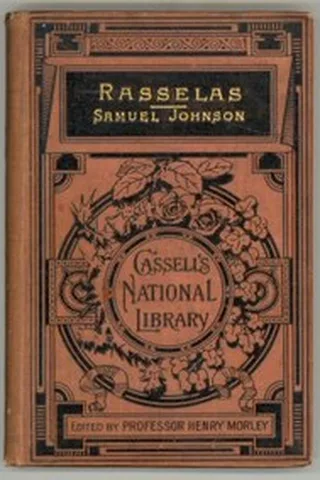

Hello, my name is Finn, and I'm going to help you understand this book.
Here it is, explained like you are 10:
Rasselas is a prince who has everything. He lives in a lovely valley where servants meet his every wish, and still he is restless and sad. So he slips out into the wide world with his sister and a wise friend to watch how other people live, rich and poor, married and single, old and young, hoping to find the happy life. Johnson asks a big question in a short, graceful story: what really makes a life good?
The Happy Valley is a paradise with walls. Abyssinian princes and princesses are kept there in soft luxury, guarded by mountains, entertained by singers and artists, and fed on pleasures that never change. Rasselas, the king's son, finds that a life with nothing to wish for leaves the mind hungry, and at twenty six he is sighing over the days that pass without difference, envying even the animals, who are born and die without regret.
With the poet Imlac, who has seen the wider world and settled in the valley, Rasselas digs a secret way out through the mountain. His sister Nekayah, who has watched their digging, insists on coming too. In Cairo and beyond, the three study the choice of life: shepherds and hermits, the rich and the learned, marriages happy and unhappy, an astronomer who believes he controls the weather, and the pyramids, which Imlac calls a monument to the insufficiency of human enjoyments.
Samuel Johnson wrote the tale in 1759, in the evenings of one week, the introduction here says, to pay the debts of his mother's funeral. Transcribed from the Cassell edition of 1889, it remains short, grave, funny, and quietly unconsoled.
Prince Rasselas lives in the Happy Valley of Abyssinia, where every want is supplied and no one is allowed to leave. Bored by perfect ease, he escapes with his sister Nekayah and the wise Imlac to see how people actually live, and to make what Johnson calls the choice of life. Samuel Johnson published this short, searching tale in 1759. The text here is transcribed from the Cassell and Company edition of 1889.
This text is transcribed from the 1889 Cassell and Company edition, in Cassell's National Library, and it arrives with a substantial introduction that tells the book's famous story before the tale begins. Samuel Johnson was fifty in 1759, author of the Dictionary, honoured, and still poor. His mother died that January, aged ninety, leaving small debts and burial costs. To pay them, the introduction says, he wrote Rasselas in the evenings of one week, sent it to press while writing, and earned a hundred pounds, with twenty five more for a second edition.
The introduction also explains the choice of Abyssinia: Johnson's early work on Father Lobo's Voyage to Abyssinia, and the fashion for Eastern tales as moral essays, prompted the setting, and it reads the tale as Johnson's answer to his age's growing doubt about whether happiness is possible in this life at all. Johnson's view, it argues, is that this world is a place of education for the world to come.
Only then does the tale open, with the sons and daughters of Abyssinia shut up in the Happy Valley. Read the introduction for the circumstances, and the tale itself for the argument.
Edition: Transcribed from the Cassell & Company edition of 1889; first published 1759. Text: Project Gutenberg ebook 652.
The first chapter
YE who listen with credulity to the whispers of fancy, and pursue with eagerness the phantoms of hope; who expect that age will perform the promises of youth, and that the deficiencies of the present day will be supplied by the morrow, attend to the history of Rasselas, Prince of Abyssinia.
Rasselas was the fourth son of the mighty Emperor in whose dominions the father of waters begins his course--whose bounty pours down the streams of plenty, and scatters over the world the harvests of Egypt.
According to the custom which has descended from age to age among the monarchs of the torrid zone, Rasselas was confined in a private palace, with the other sons and daughters of Abyssinian royalty, till the order of succession should call him to the throne.
The place which the wisdom or policy of antiquity had destined for the residence of the Abyssinian princes was a spacious valley in the kingdom of Amhara, surrounded on every side by mountains, of which the summits overhang the middle part. The only passage by which it could be entered was a cavern that passed under a rock, of which it had long been disputed whether it was the work of nature or of human industry. The outlet of the cavern was concealed by a thick wood, and the mouth which opened into the valley was closed with gates of iron, forged by the artificers of ancient days, so massive that no man, without the help of engines, could open or shut them.
From the mountains on every side rivulets descended that filled all the valley with verdure and fertility, and formed a lake in the middle, inhabited by fish of every species, and frequented by every fowl whom nature has taught to dip the wing in water. This lake discharged its superfluities by a stream, which entered a dark cleft of the mountain on the northern side, and fell with dreadful noise from precipice to precipice till it was heard no more.
The sides of the mountains were covered with trees, the banks of the brooks were diversified with flowers; every blast shook spices from the rocks, and every month dropped fruits upon the ground. All animals that bite the grass or browse the shrubs, whether wild or tame, wandered in this extensive circuit, secured from beasts of prey by the mountains which confined them. On one part were flocks and herds feeding in the pastures, on another all the beasts of chase frisking in the lawns, the sprightly kid was bounding on the rocks, the subtle monkey frolicking in the trees, and the solemn elephant reposing in the shade. All the diversities of the world were brought together, the blessings of nature were collected, and its evils extracted and excluded.
The valley, wide and fruitful, supplied its inhabitants with all the necessaries of life, and all delights and superfluities were added at the annual visit which the Emperor paid his children, when the iron gate was opened to the sound of music, and during eight days every one that resided in the valley was required to propose whatever might contribute to make seclusion pleasant, to fill up the vacancies of attention, and lessen the tediousness of time. Every desire was immediately granted. All the artificers of pleasure were called to gladden the festivity; the musicians exerted the power of harmony, and the dancers showed their activity before the princes, in hopes that they should pass their lives in blissful captivity, to which those only were admitted whose performance was thought able to add novelty to luxury. Such was the appearance of security and delight which this retirement afforded, that they to whom it was new always desired that it might be perpetual; and as those on whom the iron gate had once closed were never suffered to return, the effect of longer experience could not be known. Thus every year produced new scenes of delight, and new competitors for imprisonment.
The palace stood on an eminence, raised about thirty paces above the surface of the lake. It was divided into many squares or courts, built with greater or less magnificence according to the rank of those for whom they were designed. The roofs were turned into arches of massive stone, joined by a cement that grew harder by time, and the building stood from century to century, deriding the solstitial rains and equinoctial hurricanes, without need of reparation.
This house, which was so large as to be fully known to none but some ancient officers, who successively inherited the secrets of the place, was built as if Suspicion herself had dictated the plan. To every room there was an open and secret passage; every square had a communication with the rest, either from the upper storeys by private galleries, or by subterraneous passages from the lower apartments. Many of the columns had unsuspected cavities, in which a long race of monarchs had deposited their treasures. They then closed up the opening with marble, which was never to be removed but in the utmost exigences of the kingdom, and recorded their accumulations in a book, which was itself concealed in a tower, not entered but by the Emperor, attended by the prince who stood next in succession.
Continue: Chapter 2: The Discontent of Rasselas in the Happy Valley
Source: Project Gutenberg. Published 1759. Author died 1784. Public domain worldwide. Share this book: WhatsApp
 Starvard