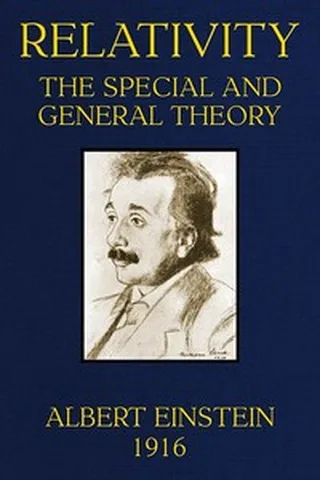

Hello, my name is Finn, and I'm going to help you understand this book.
Here it is, explained like you are 10:
Albert Einstein had a wild idea: time and space are not the same for everyone. If you move very fast, your clock ticks differently from a friend standing still, and nothing can go faster than light. Later he said gravity is really the bending of space itself. In this little book Einstein explains it himself with trains and clocks. It will bend your brain, in the best way.
By 1916 Einstein had completed his general theory of relativity, the work of a decade that began with his miracle year of 1905. Friends and readers kept asking what the theory actually meant, and publishers wanted an account from Einstein himself. He wrote this book for curious lay readers, promising no mathematics beyond a little algebra and a lot of patience.
The first part explains special relativity through thought experiments with trains, lightning, and synchronized clocks, showing why simultaneity depends on the observer. The second part turns to gravity, presenting it not as a force but as the curvature of space and time around matter. Einstein walks through the reasoning step by step, pausing to answer objections a thoughtful reader would raise.
Popular science is often written by interpreters, which makes this little book special: it is the founder speaking in his own voice. The details have been refined since 1916, but the path into the ideas remains clear. Patient readers, students, and anyone curious about how the universe really works will find it a short, demanding classic.
Albert Einstein wrote this short book in 1916 to explain his special and general theories of relativity to readers willing to think but without advanced mathematics. Using trains, clocks, and light beams, he shows how measurements of time and space depend on motion, and how gravity bends the path of light. It offers the master's own popular account of ideas that remade physics and our picture of the universe.
Einstein published this book in 1916, a year after completing general relativity, because the questions would not stop: what did it mean that time could run differently for different observers, and that gravity was geometry? Written for the general reader with, as he put it, a fair amount of patience and power of thought, it remains the most direct route into relativity from its creator.
Its lasting value is the method as much as the results. Einstein builds everything from scenes a reader can picture: lightning striking a railway embankment, a chest accelerating through space, light bending near the sun, a prediction confirmed by eclipse photographs a few years after he wrote. Special relativity occupies the first half; the general theory, still new and startling, the second.
A first reader should not expect mathematics free reading throughout: a few formulas appear, though the arguments are mostly verbal. Read slowly and reread freely. In barely a hundred pages, the ground under everyday ideas of space and time quietly gives way.
Edition: Translated by Robert W. Lawson, 1920. Text: Project Gutenberg ebook 5001.
The first chapter
In your schooldays most of you who read this book made acquaintance with the noble building of Euclid’s geometry, and you remember--perhaps with more respect than love--the magnificent structure, on the lofty staircase of which you were chased about for uncounted hours by conscientious teachers. By reason of our past experience, you would certainly regard everyone with disdain who should pronounce even the most out-of-the-way proposition of this science to be untrue. But perhaps this feeling of proud certainty would leave you immediately if some one were to ask you: “What, then, do you mean by the assertion that these propositions are true?” Let us proceed to give this question a little consideration.
Geometry sets out form certain conceptions such as “plane,” “point,” and “straight line,” with which we are able to associate more or less definite ideas, and from certain simple propositions (axioms) which, in virtue of these ideas, we are inclined to accept as “true.” Then, on the basis of a logical process, the justification of which we feel ourselves compelled to admit, all remaining propositions are shown to follow from those axioms, i.e. they are proven. A proposition is then correct (“true”) when it has been derived in the recognised manner from the axioms. The question of “truth” of the individual geometrical propositions is thus reduced to one of the “truth” of the axioms. Now it has long been known that the last question is not only unanswerable by the methods of geometry, but that it is in itself entirely without meaning. We cannot ask whether it is true that only one straight line goes through two points. We can only say that Euclidean geometry deals with things called “straight lines,” to each of which is ascribed the property of being uniquely determined by two points situated on it. The concept “true” does not tally with the assertions of pure geometry, because by the word “true” we are eventually in the habit of designating always the correspondence with a “real” object; geometry, however, is not concerned with the relation of the ideas involved in it to objects of experience, but only with the logical connection of these ideas among themselves.
It is not difficult to understand why, in spite of this, we feel constrained to call the propositions of geometry “true.” Geometrical ideas correspond to more or less exact objects in nature, and these last are undoubtedly the exclusive cause of the genesis of those ideas. Geometry ought to refrain from such a course, in order to give to its structure the largest possible logical unity. The practice, for example, of seeing in a “distance” two marked positions on a practically rigid body is something which is lodged deeply in our habit of thought. We are accustomed further to regard three points as being situated on a straight line, if their apparent positions can be made to coincide for observation with one eye, under suitable choice of our place of observation.
If, in pursuance of our habit of thought, we now supplement the propositions of Euclidean geometry by the single proposition that two points on a practically rigid body always correspond to the same distance (line-interval), independently of any changes in position to which we may subject the body, the propositions of Euclidean geometry then resolve themselves into propositions on the possible relative position of practically rigid bodies. Geometry which has been supplemented in this way is then to be treated as a branch of physics. We can now legitimately ask as to the “truth” of geometrical propositions interpreted in this way, since we are justified in asking whether these propositions are satisfied for those real things we have associated with the geometrical ideas. In less exact terms we can express this by saying that by the “truth” of a geometrical proposition in this sense we understand its validity for a construction with rule and compasses.
Of course the conviction of the “truth” of geometrical propositions in this sense is founded exclusively on rather incomplete experience. For the present we shall assume the “truth” of the geometrical propositions, then at a later stage (in the general theory of relativity) we shall see that this “truth” is limited, and we shall consider the extent of its limitation.
Source: Project Gutenberg. Published 1916 in German. Author died 1955. Public domain in the US. Share this book: WhatsApp
 Starvard