
Hello, my name is Finn, and I'm going to help you understand this book.
Here it is, explained like you are 10:
Julian of Norwich was very ill, expecting to die, when she had a series of vivid visions of Christ suffering on the cross. She recovered, thought about what she had seen for years, and wrote this book about a loving God who keeps us safe. Her most famous words are simple: all shall be well. Grace Warrack's edition keeps her old English warmth while making it readable. It is quiet, kind, and deeply comforting.
Grace Warrack's 1901 edition begins with careful notes on the manuscripts, then her introduction presents the Lady Julian: an anchoress who lived in a cell attached to St Julian's church in Norwich, giving counsel to visitors through a window. The revelations themselves came earlier, in May 1373, when Julian, thirty years old and believing she was dying, received sixteen showings over hours of intense vision.
The long text, all 86 chapters, is the fruit of years of reflection on those showings. Julian returns again and again to the Passion, not to dwell on pain but on love: God as our mother, sin as something that shall somehow be made well, and the famous assurance that all shall be well, and all shall be well, and all manner of thing shall be well. She argues gently with her own doubts, and the argument is the book.
Warrack edited the text from the British Museum manuscript, keeping Julian's voice warm and strange while making it readable. This is the full long version, far richer than the short account Julian also left, and it rewards unhurried reading.
In May 1373, a young woman in Norwich, later known as Julian, lay near death and received sixteen showings, or revelations, of divine love centered on the suffering of Christ. She spent years pondering them, and this long text, all 86 chapters in Grace Warrack's 1901 edition from the British Museum manuscript, is her mature account. Gentle, searching, and quietly radical, it is the first known English book by a woman.
Warrack's edition opens as careful scholarship before it opens as devotion. Her notes compare the two surviving manuscripts, Paris and the British Museum's Sloane manuscript, from which this text is edited; a note distinguishes the Lady Julian of St Julian's, Norwich, from another anchoress of the same name; and her three part introduction considers the lady, the manner of the book, and its theme. Then Julian herself begins, listing the sixteen showings and telling how, as a young woman, she had asked God for three gifts: a vivid memory of the Passion, a bodily sickness at thirty that would bring her to death's door, and three wounds of contrition, compassion, and longing. In May 1373 the sickness came, a priest held a cross before her failing eyes, and the showings began. What follows is the long text, all 86 chapters, in which Julian turns those hours over and over for years, drawing out her theology of a courteous, mothering, all loving God, and it ends, after the scribe's postscript, in her settled conclusion that love was our Lord's meaning. Methuen published Warrack's edition in 1901.
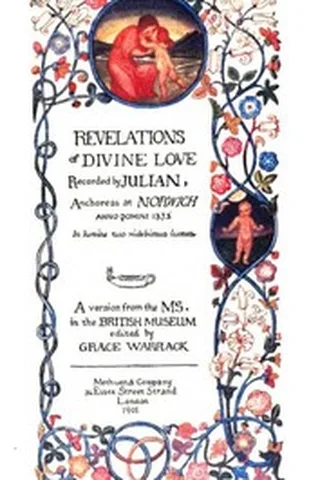
Edition: Edited by Grace Warrack (Methuen, 1901) from the British Museum manuscript: the long text of the revelations of 1373, all eighty-six chapters. Text: Project Gutenberg ebook 52958.
The first chapter
This English book exists in two Manuscripts: No. 30 of the Bibliothèque Nationale, Paris (Bibliotheca Bigotiana, 388), and No. 2499 Sloane, in the British Museum.
The Paris Manuscript is of the Sixteenth Century, the Sloane is in a Seventeenth Century handwriting; the English of the Fourteenth Century seems to be on the whole well preserved in both, especially perhaps in the later Manuscript, which must have been copied from one of mixed East Anglian and northern dialects. This manuscript has no title-page, and nothing is known as to its history. Delisle's catalogue of the Biblioth. Bigot. (1877) gives no particulars as to the acquisition of No. 388. The two versions may be compared in these sentences:--
Chap. II., Paris MS.: "This revelation was made to a Symple creature unlettyrde leving in deadly flesh the yer of our Lord a thousande and thre hundered and lxxiii the xiii Daie of May."
Sloane: "These Revelations were shewed to a simple creature that cowde no letter the yeere of our Lord 1373 the xiij day of may."
Chap. LI., Paris MS.: "The colour of his face was feyer brown whygt with full semely countenaunce. his eyen were blakke most feyer and semely shewyng full of lovely pytte and within hym an heyward long and brode all full of endlesse hevynlynes. And the lovely lokyng that he lokyd on his servant contynually. And namely in his fallyng ÷ me thought it myght melt oure hartys for love. and brek them on twoo for Joy."
Sloane: "The color of his face was faire browne, with ful semely features, his eyen were blak most faire and semely shewand ful of lovely pety and within him an heyward long and brode all full of endles hevyns, and the lovely lokeing that he loked upon his servant continuly and namely in his fallyng me thowte it myte molten our herts for love & bresten hem on to for joy."
The Sloane MS. does not mention the writer of the book, but the copyist of the Paris version has, after the Deo Gratias with which it ends, added or transcribed these words: Explicit liber Revelationem Julyane anatorite [sic] Norwyche cujus anime propicietur Deus.
Blomefield, in his History of Norfolk (iv. p. 81), speaks of "an old vellum Manuscript, 36 pages of which contained an account of the visions, etc.," of the Lady Julian, anchoress at St. Julian's, Norwich, and quotes the title written by a contemporary: "Here es a Vision shewed by the godenes of God to a devoute Woman: and her name is Julian, that is recluse at Noryche, and yett is on life, Anno Domini mccccxlii. In the whilke Vision er fulle many comfortabyll words, and greatly styrrande to alle they that desyres to be Crystes Looverse"--greatly stirring to all that desire to be lovers of Christ. This Manuscript, possibly containing the writing of Julian herself, was in the possession of the Rev. Francis Peck (1692-1743). The original MSS. of that antiquarian writer went to Sir Thomas Cave, and ultimately to the British Museum, but his general library was sold in 1758 to Mr T. Payne (of Payne & Foss), bookseller, Strand, and this old Manuscript of the "Revelations," which has been sought for in vain in the catalogues of public collections, may perhaps have been bought and sold by him. It may be extant in some private library.
Tersteegen, who, in his Auserlesene Beschreibungen Heiliger Seelen, gives a long extract from Julian's book (vol. iii. p. 252, 3rd ed. 1784), mentions in his preface that he had seen "in the Library of the late Poiret" an old Manuscript of these Revelations. Pierre Poiret, author of several works on mystical theology, died in 1719 near Leyden, but the Manuscript has not found its way to the University there.
Poiret himself refers thus to Julian and her book in his Catalogus Auctorum Mysticorum, giving to her name the asterisk denoting greatness: "Julianae Matris Anachoretae, Revelationes de Amore Dei. Anglice. Theodidactae, profundae, ecstaticae." (Theologiae Pacificae itemque Mysticae, p. 336. Amsterdam, 1702.)
The earliest printed edition of Julian's book was prepared by the Benedictine Serenus de Cressy, and published in 1670 by permission of his ecclesiastical Superior, the Abbot of Lambspring, under the title of Sixteen Revelations of Divine Love. It agrees with the Manuscript now in Paris, but the readings that differ from the Sloane Manuscript are very few and are quite unimportant. This version of de Cressy's is in Seventeenth Century English with some archaic words, which are explained on the side margins; it was re-printed in 1843. A modernised version taken from the Sloane MS. was published, with a preface, by Henry Collins in 1877 (T. Richardson & Sons).
These three, the only printed editions, are now all of great rarity.
For the following version, the editor having transcribed the Sloane MS., divided its continuous lines into paragraphs, supplied to many words capital letters, and while following as far as possible the significance of the commas and occasional full stops of the original, endeavoured to make the meaning clearer by a more varied punctuation. As the book is designed for general use, modern spelling has been adopted, and most words entirely obsolete in speech have been rendered in modern English, though a few that seemed of special significance or charm have been retained. Archaic forms of construction have been almost invariably left as they are, without regard to modern grammatical usage. Occasionally a word has been underlined for the sake of clearness or as a help in preserving the measure of the original language, which in a modern version must lose a little in rhythm, by altered pronunciation and by the dropping of the termination "en" from verbs in the infinitive. Here and there a clause has been put within parentheses. The very few changes made in words that might have any bearing on theological or philosophical questions, any historical or personal significance in the presentment of Julian's view, are noted on the margin and in the Glossary. Where prepositions are used in a sense now obscure they have generally been left as they are (e.g., of for by or with), or have been added to rather than altered (e.g., for is rendered by the archaic but intelligible for that, rather than by because, and of is amplified by words in square brackets, as [by virtue] of, [out] of rather than changed into through or from). The editor has desired to follow the rule of never omitting a word from the Manuscript, and of enclosing within square brackets the very few words added. It may be seen that these words do not alter the sense of the passage, but are interpolated with a view to bringing it out more clearly, in insignificant references (e.g. "in this [Shewing]"), and once or twice in a passage of special obscurity (see chap. xlv).
Source: Project Gutenberg. Revelations recorded 1373; author died c. 1416. Warrack edition 1901. Public domain worldwide. Share this book: WhatsApp
 Starvard