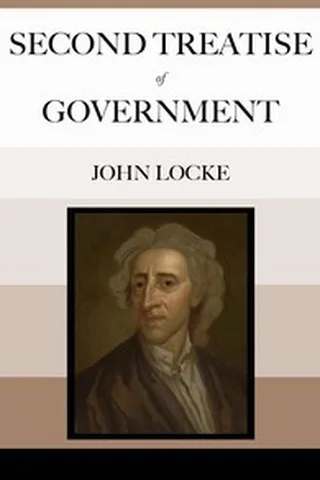

Hello, my name is Finn, and I'm going to help you understand this book.
Here it is, explained like you are 10:
Where does a government's right to rule come from? John Locke said it comes from the people, who give up some freedom in exchange for protection of their lives, liberty, and property. This is his famous Second Treatise, the one that argues rulers who break that trust can be resisted. Locke's ideas helped shape America and modern democracy. His language is old fashioned in places, but his argument still feels fresh and bold.
John Locke published his Two Treatises of Government anonymously in 1689, in the wake of England's Glorious Revolution, and only acknowledged the work near the end of his life. The famous one is the second, and that treatise alone is the text here. Where the first book patiently demolished the doctrine that kings rule by divine fatherly right, the second builds Locke's own account from the ground up.
Nineteen chapters begin in the state of nature, where people are free, equal and bound by natural law, and proceed through property, which arises when a person mixes labor with the world, to the forming of political society by consent. Locke explains legislative and executive power, the trust the people place in government, and the hard final questions: what happens when rulers break that trust, and who shall judge? His answer helped justify a revolution and shape several more.
The American founding generation read Locke closely, and his phrases surface in their documents. The prose is plain, lawyerly and unhurried. Readers interested in democracy, rights, or why governments may rightly be resisted will find the source itself here.
John Locke, the English philosopher who had lived through revolution and exile, published his Two Treatises of Government in 1689 to justify resistance to tyranny. This text carries only the Second Treatise, Locke's own preface and its nineteen chapters arguing that government rests on consent and exists to protect life, liberty, and property. It offers the founding argument of liberal politics, calm, systematic, and enormously influential.
The file on this page contains only the Second Treatise. Locke's Preface survives, referring back to a foregoing discourse against Sir Robert Filmer, but the First Treatise is not present in this text at all, and readers should not go looking for it here. What they get is the work that made Locke's political reputation, complete in nineteen chapters.
Chapter I recapitulates the argument against patriarchal divine right, and then the treatise builds its own case in order: the state of nature, the state of war, slavery, and the celebrated chapter Of Property, where labor mixing with the common earth makes things one's own. Paternal power, political society and its beginnings and ends follow, then the forms of a commonwealth, the extent and subordination of its legislative, executive and federative powers, prerogative, conquest, usurpation and tyranny, and a final chapter on the dissolution of government.
Published anonymously in 1689 as a justification of the Glorious Revolution, it became the classic statement of government by consent and of a people's right to judge its rulers. Its order is its strength: each chapter answers the objection the last one raised.
Edition: Edition of 1764. Text: Project Gutenberg ebook 7370.
The first chapter
Sect. 1. It having been shewn in the foregoing discourse,
(1). That Adam had not, either by natural right of fatherhood, or by positive donation from God, any such authority over his children, or dominion over the world, as is pretended:
(2). That if he had, his heirs, yet, had no right to it:
(3). That if his heirs had, there being no law of nature nor positive law of God that determines which is the right heir in all cases that may arise, the right of succession, and consequently of bearing rule, could not have been certainly determined:
(4). That if even that had been determined, yet the knowledge of which is the eldest line of Adam’s posterity, being so long since utterly lost, that in the races of mankind and families of the world, there remains not to one above another, the least pretence to be the eldest house, and to have the right of inheritance:
All these premises having, as I think, been clearly made out, it is impossible that the rulers now on earth should make any benefit, or derive any the least shadow of authority from that, which is held to be the fountain of all power, Adam’s private dominion and paternal jurisdiction; so that he that will not give just occasion to think that all government in the world is the product only of force and violence, and that men live together by no other rules but that of beasts, where the strongest carries it, and so lay a foundation for perpetual disorder and mischief, tumult, sedition and rebellion, (things that the followers of that hypothesis so loudly cry out against) must of necessity find out another rise of government, another original of political power, and another way of designing and knowing the persons that have it, than what Sir Robert Filmer hath taught us.
Sect. 2. To this purpose, I think it may not be amiss, to set down what I take to be political power; that the power of a MAGISTRATE over a subject may be distinguished from that of a FATHER over his children, a MASTER over his servant, a HUSBAND over his wife, and a LORD over his slave. All which distinct powers happening sometimes together in the same man, if he be considered under these different relations, it may help us to distinguish these powers one from wealth, a father of a family, and a captain of a galley.
Sect. 3. POLITICAL POWER, then, I take to be a RIGHT of making laws with penalties of death, and consequently all less penalties, for the regulating and preserving of property, and of employing the force of the community, in the execution of such laws, and in the defence of the commonwealth from foreign injury; and all this only for the public good.
Source: Project Gutenberg. Published 1689. Author died 1704. Public domain worldwide. Share this book: WhatsApp
 Starvard