
Hello, my name is Finn, and I'm going to help you understand this book.
Here it is, explained like you are 10:
Ida B. Wells was a teacher and newspaper writer in Memphis. When three of her friends, good men who owned a grocery store, were killed by a mob, she began to look closely at lynching and print the truth. Her paper was smashed for what she wrote, and she had to leave the South. In this short, brave book she uses facts and names to show that the excuses for lynching were lies.
Wells begins with the crime that made her an exile. In 1892 her friends Thomas Moss, Calvin McDowell, and Will Stewart, whose People's Grocery competed with a white store, were lynched in Memphis. When her Free Speech editorial challenged the old lie used to excuse such murders, a mob wrecked her office. She was in the North, was warned she would be killed if she returned, and published from exile.
The pamphlet then does patient, furious work. Wells prints names, dates, and newspaper reports, many from white Southern papers themselves. She shows that most lynching victims were not even accused of the crime always alleged, that accusations often covered business success or personal grudges, and that no legal defense was permitted. Her remedies: boycott, leave for the West, arm for lawful self defense, and tell the truth until the nation acts.
Ida B. Wells published Southern Horrors in 1892 under the name Ida B. Wells, funded by Black women of New York and Brooklyn, with a letter from Frederick Douglass It founded a lifelong campaign and a method, reporting against racial terror, that journalism still learns from.
In March 1892 three friends of Ida B. Wells, Memphis grocers, were lynched, and Wells began printing the facts about lynching that white newspapers would not. When her editorial challenged the usual excuse, a mob destroyed her paper, the Free Speech, and she fled north. Southern Horrors, published that year under the name Ida B. Wells, examines case after case, dismantles the excuses, and urges Black Americans to defend themselves, boycott, and migrate.
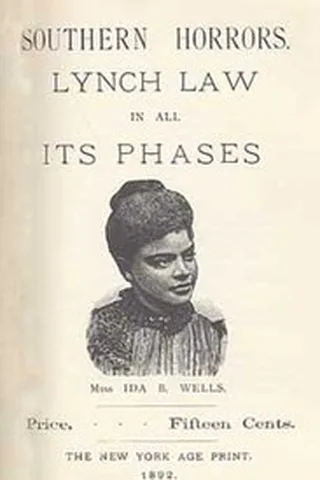
The front matter of this pamphlet is a record of its making. Southern Horrors: Lynch Law in All Its Phases carries the dates 1892, 1893, 1894 and the name Ida B. Wells, as she published then. Her preface, signed from New York City on October 26, 1892, explains that most of these pages first appeared in the New York Age of June 25, 1892, explaining the editorial that Memphis whites used to justify destroying her paper, the Free Speech.
The pamphlet is gratefully dedicated to the Afro American women of New York and Brooklyn, whose effort at Lyric Hall on October 5, 1892 made its publication possible. It then prints a letter from Frederick Douglass, dated Cedar Hill, October 25, 1892, thanking her: there has been no word equal to it in convincing power, he writes, and praises her cool, painstaking fidelity to facts left naked to speak for themselves.
Only then does the argument begin, with The Offense and the Memphis editorial of May 21, 1892 in full. Read it as Wells built it: testimony first, then evidence.
Edition: Edition of 1892. Text: Project Gutenberg ebook 14975.
The first chapter
Dear Miss Wells:
Let me give you thanks for your faithful paper on the lynch abomination now generally practiced against colored people in the South. There has been no word equal to it in convincing power. I have spoken, but my word is feeble in comparison. You give us what you know and testify from actual knowledge. You have dealt with the facts with cool, painstaking fidelity and left those naked and uncontradicted facts to speak for themselves.
Brave woman! you have done your people and mine a service which can neither be weighed nor measured. If American conscience were only half alive, if the American church and clergy were only half christianized, if American moral sensibility were not hardened by persistent infliction of outrage and crime against colored people, a scream of horror, shame and indignation would rise to Heaven wherever your pamphlet shall be read.
But alas! even crime has power to reproduce itself and create conditions favorable to its own existence. It sometimes seems we are deserted by earth and Heaven yet we must still think, speak and work, and trust in the power of a merciful God for final deliverance.
Very truly and gratefully yours, FREDERICK DOUGLASS Cedar Hill, Anacostia, D.C., Oct. 25, 1892
Source: Project Gutenberg. Published 1892. Author died 1931. Public domain worldwide. Share this book: WhatsApp
 Starvard