
Hello, my name is Finn, and I'm going to help you understand this book.
Here it is, explained like you are 10:
Three boys are shipwrecked on a sunny island in the great Pacific Ocean. Ralph tells the story. Jack is tall and strong, and Peterkin is small and funny. They have almost nothing, but they learn to fish, build a boat, and make a home under the palm trees. Then danger comes, in the shape of pirates and fierce storms. It is one of the first and best island adventure stories ever written for boys.
Ralph Rover narrates, looking back at the boy he was. At fifteen he sails for the South Seas with Jack Martin, eighteen, tall and fearless, and Peterkin Gay, thirteen, small, merry, and endlessly inventive. A hurricane drives their ship onto a reef, and the three wash ashore on an uninhabited coral island with a telescope, an axe, and little else. What follows is the pleasure at the heart of the book: learning an island completely, its lagoons, breadfruit, sharks, and wonders.
The idyll darkens, as it must. Ralph is captured by pirates, escapes, and returns to find war among the island peoples and the arrival of missionaries changing everything. Ballantyne keeps the pace brisk and the natural detail exact: he had lived in wild country in Canada and wrote about work, weather, and the sea like a man who had done and seen them.
Published in 1857, The Coral Island taught generations of boys what an island story should feel like, and later writers kept answering it, most famously when Golding inverted its confidence in Lord of the Flies. Read it first, and you read the original: sunny, earnest, and still genuinely exciting.
Ralph Rover, fifteen and hungry for the South Seas, sails on the Arrow with stout Jack Martin and comic Peterkin Gay, and a storm leaves the three boys alone on a coral island in the Pacific. They build, hunt, dive, and explore, then face pirates and island warfare. R. M. Ballantyne published the tale in 1857, and for a century it set the pattern for every boys' island adventure that followed.
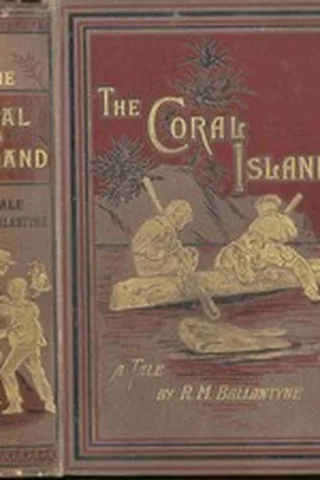
The full title is The Coral Island: A Tale of the Pacific Ocean, and the title page credits Robert Michael Ballantyne, already known for Hudson's Bay and The Young Fur Traders, with illustrations by Dalziel. This copy was printed by Thomas Nelson and Sons in 1884, nearly three decades after the tale first appeared in 1857, a measure of how steadily it kept selling to the boys it addresses.
The preface is signed not by Ballantyne but by his narrator, Ralph Rover: I was a boy when I went through the wonderful adventures herein set down. Ralph presents the book specially to boys, hoping they gain information, pleasure, profit, and unbounded amusement, and he warns any reader who loves to be melancholy and morose to shut the book and put it away, since it is not meant for him.
Chapter One then starts Ralph's own beginning: a roving family of sea captains, a birth in an Atlantic storm, and the tales of coral islands that fired him until, at fifteen, he resolved to sail for the South Seas. The wreck, and the island, follow quickly.
Edition: Edition of 1884. Text: Project Gutenberg ebook 646.
The first chapter
The beginning--My early life and character--I thirst for adventure in foreign lands and go to sea.
Roving has always been, and still is, my ruling passion, the joy of my heart, the very sunshine of my existence. In childhood, in boyhood, and in man's estate, I have been a rover; not a mere rambler among the woody glens and upon the hill-tops of my own native land, but an enthusiastic rover throughout the length and breadth of the wide wide world.
It was a wild, black night of howling storm, the night in which I was born on the foaming bosom of the broad Atlantic Ocean. My father was a sea-captain; my grandfather was a sea-captain; my great-grandfather had been a marine. Nobody could tell positively what occupation his father had followed; but my dear mother used to assert that he had been a midshipman, whose grandfather, on the mother's side, had been an admiral in the royal navy. At anyrate we knew that, as far back as our family could be traced, it had been intimately connected with the great watery waste. Indeed this was the case on both sides of the house; for my mother always went to sea with my father on his long voyages, and so spent the greater part of her life upon the water.
Thus it was, I suppose, that I came to inherit a roving disposition. Soon after I was born, my father, being old, retired from a seafaring life, purchased a small cottage in a fishing village on the west coast of England, and settled down to spend the evening of his life on the shores of that sea which had for so many years been his home. It was not long after this that I began to show the roving spirit that dwelt within me. For some time past my infant legs had been gaining strength, so that I came to be dissatisfied with rubbing the skin off my chubby knees by walking on them, and made many attempts to stand up and walk like a man; all of which attempts, however, resulted in my sitting down violently and in sudden surprise. One day I took advantage of my dear mother's absence to make another effort; and, to my joy, I actually succeeded in reaching the doorstep, over which I tumbled into a pool of muddy water that lay before my father's cottage door. Ah, how vividly I remember the horror of my poor mother when she found me sweltering in the mud amongst a group of cackling ducks, and the tenderness with which she stripped off my dripping clothes and washed my dirty little body! From this time forth my rambles became more frequent, and, as I grew older, more distant, until at last I had wandered far and near on the shore and in the woods around our humble dwelling, and did not rest content until my father bound me apprentice to a coasting vessel, and let me go to sea.
For some years I was happy in visiting the sea-ports, and in coasting along the shores of my native land. My Christian name was Ralph, and my comrades added to this the name of Rover, in consequence of the passion which I always evinced for travelling. Rover was not my real name, but as I never received any other I came at last to answer to it as naturally as to my proper name; and, as it is not a bad one, I see no good reason why I should not introduce myself to the reader as Ralph Rover. My shipmates were kind, good-natured fellows, and they and I got on very well together. They did, indeed, very frequently make game of and banter me, but not unkindly; and I overheard them sometimes saying that Ralph Rover was a "queer, old-fashioned fellow." This, I must confess, surprised me much, and I pondered the saying long, but could come at no satisfactory conclusion as to that wherein my old-fashionedness lay. It is true I was a quiet lad, and seldom spoke except when spoken to. Moreover, I never could understand the jokes of my companions even when they were explained to me: which dulness in apprehension occasioned me much grief; however, I tried to make up for it by smiling and looking pleased when I observed that they were laughing at some witticism which I had failed to detect. I was also very fond of inquiring into the nature of things and their causes, and often fell into fits of abstraction while thus engaged in my mind. But in all this I saw nothing that did not seem to be exceedingly natural, and could by no means understand why my comrades should call me "an old-fashioned fellow."
Now, while engaged in the coasting trade, I fell in with many seamen who had travelled to almost every quarter of the globe; and I freely confess that my heart glowed ardently within me as they recounted their wild adventures in foreign lands,--the dreadful storms they had weathered, the appalling dangers they had escaped, the wonderful creatures they had seen both on the land and in the sea, and the interesting lands and strange people they had visited. But of all the places of which they told me, none captivated and charmed my imagination so much as the Coral Islands of the Southern Seas. They told me of thousands of beautiful fertile islands that had been formed by a small creature called the coral insect, where summer reigned nearly all the year round,--where the trees were laden with a constant harvest of luxuriant fruit,--where the climate was almost perpetually delightful,--yet where, strange to say, men were wild, bloodthirsty savages, excepting in those favoured isles to which the gospel of our Saviour had been conveyed. These exciting accounts had so great an effect upon my mind, that, when I reached the age of fifteen, I resolved to make a voyage to the South Seas.
I had no little difficulty at first in prevailing on my dear parents to let me go; but when I urged on my father that he would never have become a great captain had he remained in the coasting trade, he saw the truth of what I said, and gave his consent. My dear mother, seeing that my father had made up his mind, no longer offered opposition to my wishes. "But oh, Ralph," she said, on the day I bade her adieu, "come back soon to us, my dear boy, for we are getting old now, Ralph, and may not have many years to live."
I will not take up my reader's time with a minute account of all that occurred before I took my final leave of my dear parents. Suffice it to say, that my father placed me under the charge of an old mess-mate of his own, a merchant captain, who was on the point of sailing to the South Seas in his own ship, the Arrow. My mother gave me her blessing and a small Bible; and her last request was, that I would never forget to read a chapter every day, and say my prayers; which I promised, with tears in my eyes, that I would certainly do.
Soon afterwards I went on board the Arrow, which was a fine large ship, and set sail for the islands of the Pacific Ocean.
Source: Project Gutenberg. Published 1857. Author died 1894. Public domain worldwide. Share this book: WhatsApp
 Starvard