
Hello, my name is Finn, and I'm going to help you understand this book.
Here it is, explained like you are 10:
Marco Polo was a teenager from Venice who sailed and rode all the way to China with his father and uncle. He worked for the great ruler Kublai Khan and saw cities, animals, and inventions Europe had never heard of. Later, captured in a war, he told his whole adventure to another prisoner who wrote it down. His book made Europeans dream about the rich and wonderful East.
The Polo family were Venetian merchants, and Marco's father and uncle had already reached China once before he joined them. Their second journey, begun in 1271, took years across deserts and mountains. Marco served Kublai Khan for seventeen years, traveled on missions through his empire, and finally escorted a princess by sea toward Persia before reaching home.
This first volume follows the outward road and introduces the Khan's court, his capital, his paper money, and the organization of his vast realm. Marco describes provinces, products, customs, and animals, mixing careful merchant's observation with tales he heard from others. Some numbers sound exaggerated, yet many details once doubted, like money printed on bark paper, proved to be true.
Few travel books have shaped the world's imagination like this one; Columbus carried a copy on his voyages. Readers still enjoy the sense of wonder as a young European encounters an older, larger civilization. Anyone who loves journeys, maps, and first meetings between distant worlds will find this volume a delight.
Marco Polo left Venice as a teenager in 1271, traveled the Silk Road with his father and uncle, and spent years in the service of Kublai Khan before returning by sea. Dictated to a fellow prisoner in Genoa around 1298, his book amazed Europe with reports of China's cities, money, and marvels. This first volume offers the road east and the wonders of the Khan's empire.
Around 1298, in a Genoese prison, Marco Polo dictated his travels to Rustichello of Pisa, a writer of romances. The merchant behind the dictation had left Venice at seventeen, crossed Asia on the Silk Road, and spent seventeen years serving Kublai Khan. This first volume covers the journey east and the geography and government of the Khan's China as Polo presented it to astonished Europeans.
The book has lasted because it was, for centuries, Europe's fullest window on East Asia: its cities, revenues, paper currency, coal, and postal relays described by a man chiefly interested in trade. Skeptics called him Il Milione for his tall numbers, and scholars still debate what he saw himself. Yet the core account has been vindicated often enough that the marvels and the bookkeeping belong in the same reading.
A first reader should expect a catalogue as much as a story, organized place by place, with the personal adventure mostly in the frame. This is the first of two volumes. Read it as a merchant's report from a world Europe barely knew existed.
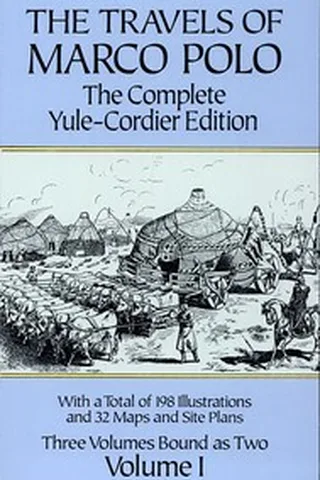
Edition: Translated by Henry Yule. Yule and Cordier third edition, 1903, Volume I only. Text: Project Gutenberg ebook 10636.
The first chapter
Great Princes, Emperors, and Kings, Dukes and Marquises, Counts, Knights, and Burgesses! and People of all degrees who desire to get knowledge of the various races of mankind and of the diversities of the sundry regions of the World, take this Book and cause it to be read to you. For ye shall find therein all kinds of wonderful things, and the divers histories of the Great Hermenia, and of Persia, and of the Land of the Tartars, and of India, and of many another country of which our Book doth speak, particularly and in regular succession, according to the description of Messer Marco Polo, a wise and noble citizen of Venice, as he saw them with his own eyes. Some things indeed there be therein which he beheld not; but these he heard from men of credit and veracity. And we shall set down things seen as seen, and things heard as heard only, so that no jot of falsehood may mar the truth of our Book, and that all who shall read it or hear it read may put full faith in the truth of all its contents.
For let me tell you that since our Lord God did mould with his hands our first Father Adam, even until this day, never hath there been Christian, or Pagan, or Tartar, or Indian, or any man of any nation, who in his own person hath had so much knowledge and experience of the divers parts of the World and its Wonders as hath had this Messer Marco! And for that reason he bethought himself that it would be a very great pity did he not cause to be put in writing all the great marvels that he had seen, or on sure information heard of, so that other people who had not these advantages might, by his Book, get such knowledge. And I may tell you that in acquiring this knowledge he spent in those various parts of the World good six-and-twenty years. Now, being thereafter an inmate of the Prison at Genoa, he caused Messer Rusticiano of Pisa, who was in the said Prison likewise, to reduce the whole to writing; and this befell in the year 1298 from the birth of Jesus.
Source: Project Gutenberg. Author died 1324. Henry Yule translation, published 1871. Public domain worldwide. Share this book: WhatsApp
 Starvard