
Hello, my name is Finn, and I'm going to help you understand this book.
Here it is, explained like you are 10:
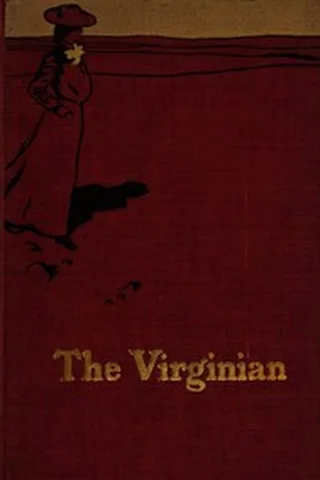
A young man from the East goes west to Wyoming, and there he meets a cowboy everyone calls the Virginian. He is quiet, polite, and kind to the schoolteacher he loves. But he lives by a strict code, and when a bad man tests him, he does not back down. This is the book that set the pattern for cowboy stories ever since: the wide land, the fair fight, and the soft spoken hero.
Owen Wister knew the Wyoming cattle country of the 1870s and 1880s at first hand, and by 1902 it was already vanishing. He wrote The Virginian to keep it. His narrator, a tenderfoot from the East, arrives green and watches the best man he has ever met: a tall Virginian working as a cowboy and ranch foreman, nameless through most of the book.
The Virginian courts Molly Wood, a schoolteacher from Vermont who thinks cowboys rough and finds this one reading Shakespeare and Browning. Around the love story runs harder matter: cattle rustling, a lynching that the hero defends with sorrow, and his enemy Trampas, whose public insult forces the famous showdown. When you call me that, smile, the Virginian says, in the scene every Western since has echoed.
Wister set the pattern: the quiet hero, the code of honor, the fair fight, the wide empty land. Cowboys on screen still wear his shape. The book itself remains fresh, funny, tender, and sad for a world already gone.
Owen Wister published The Virginian in 1902, and the Western has walked in its boots ever since. A tenderfoot narrator from the East goes to Wyoming and watches a quiet, courteous cowboy: his courtship of schoolteacher Molly Wood, his patience, his code, and his showdown with the cattle thief Trampas. Its famous answer, inviting an insult to be repeated with a smile, became American legend at once.
The dedication is to Theodore Roosevelt, in intimate terms: some of these pages you have seen, some you have praised, one stands new written because you blamed it. The note To the Reader that follows gives the book its full title, The Virginian: A Horseman of the Plains, and insists on a point early reviewers missed: this book is historical, quite as much as any colonial romance.
Wyoming between 1874 and 1890, Wister argues, was a colony as wild as Virginia a hundred years earlier, with scantier population and the same primitive joys and dangers. Yet it is a vanished world: revisit the sage brush today, he writes, and you will wait in vain for the horseman with his pasturing thousands to gallop out of the silence.
Read it, then, as he asks: a faithful picture of a day and a generation, not a costume tale. The Virginian himself, Molly Wood, and Trampas all belong to that real, brief Wyoming.
Edition: Text: Project Gutenberg ebook 1298.
The first chapter
Certain of the newspapers, when this book was first announced, made a mistake most natural upon seeing the sub-title as it then stood, A TALE OF SUNDRY ADVENTURES. “This sounds like a historical novel,” said one of them, meaning (I take it) a colonial romance. As it now stands, the title will scarce lead to such interpretation; yet none the less is this book historical--quite as much so as any colonial romance. Indeed, when you look at the root of the matter, it is a colonial romance. For Wyoming between 1874 and 1890 was a colony as wild as was Virginia one hundred years earlier. As wild, with a scantier population, and the same primitive joys and dangers. There were, to be sure, not so many Chippendale settees.
We know quite well the common understanding of the term “historical novel.” HUGH WYNNE exactly fits it. But SILAS LAPHAM is a novel as perfectly historical as is Hugh Wynne, for it pictures an era and personifies a type. It matters not that in the one we find George Washington and in the other none save imaginary figures; else THE SCARLET LETTER were not historical. Nor does it matter that Dr. Mitchell did not live in the time of which he wrote, while Mr. Howells saw many Silas Laphams with his own eyes; else UNCLE TOM’S CABIN were not historical. Any narrative which presents faithfully a day and a generation is of necessity historical; and this one presents Wyoming between 1874 and 1890. Had you left New York or San Francisco at ten o’clock this morning, by noon the day after to-morrow you could step out at Cheyenne. There you would stand at the heart of the world that is the subject of my picture, yet you would look around you in vain for the reality. It is a vanished world. No journeys, save those which memory can take, will bring you to it now. The mountains are there, far and shining, and the sunlight, and the infinite earth, and the air that seems forever the true fountain of youth, but where is the buffalo, and the wild antelope, and where the horseman with his pasturing thousands? So like its old self does the sage-brush seem when revisited, that you wait for the horseman to appear.
But he will never come again. He rides in his historic yesterday. You will no more see him gallop out of the unchanging silence than you will see Columbus on the unchanging sea come sailing from Palos with his caravels.
And yet the horseman is still so near our day that in some chapters of this book, which were published separate at the close of the nineteenth century, the present tense was used. It is true no longer. In those chapters it has been changed, and verbs like “is” and “have” now read “was” and “had.” Time has flowed faster than my ink.
What is become of the horseman, the cow-puncher, the last romantic figure upon our soil? For he was romantic. Whatever he did, he did with his might. The bread that he earned was earned hard, the wages that he squandered were squandered hard,--half a year’s pay sometimes gone in a night,--“blown in,” as he expressed it, or “blowed in,” to be perfectly accurate. Well, he will be here among us always, invisible, waiting his chance to live and play as he would like. His wild kind has been among us always, since the beginning: a young man with his temptations, a hero without wings.
The cow-puncher’s ungoverned hours did not unman him. If he gave his word, he kept it; Wall Street would have found him behind the times. Nor did he talk lewdly to women; Newport would have thought him old-fashioned. He and his brief epoch make a complete picture, for in themselves they were as complete as the pioneers of the land or the explorers of the sea. A transition has followed the horseman of the plains; a shapeless state, a condition of men and manners as unlovely as is that moment in the year when winter is gone and spring not come, and the face of Nature is ugly. I shall not dwell upon it here. Those who have seen it know well what I mean. Such transition was inevitable. Let us give thanks that it is but a transition, and not a finality.
Sometimes readers inquire, Did I know the Virginian? As well, I hope, as a father should know his son. And sometimes it is asked, Was such and such a thing true? Now to this I have the best answer in the world. Once a cow-puncher listened patiently while I read him a manuscript. It concerned an event upon an Indian reservation. “Was that the Crow reservation?” he inquired at the finish. I told him that it was no real reservation and no real event; and his face expressed displeasure. “Why,” he demanded, “do you waste your time writing what never happened, when you know so many things that did happen?”
And I could no more help telling him that this was the highest compliment ever paid me than I have been able to help telling you about it here!
CHARLESTON, S.C., March 31st, 1902
Source: Project Gutenberg. Published 1902. Author died 1938. Public domain worldwide. Share this book: WhatsApp
 Starvard