Starvard University · Anxiety
Understand anxiety and turn the volume down. Twelve plain-English lessons on calming your body, working with your thoughts, and knowing when to get help. You are not broken. Your alarm is just loud.

The whole course in brief
The twelve lessons
Lesson 1
Anxiety is not a malfunction. It is a protection system doing its job too enthusiastically. Your brain's threat detector cannot tell the difference between a saber-toothed tiger and an awkward email, so it fires the same alarm for both: racing heart, shallow breath, spiraling thoughts. The system is working. The calibration is off.
This reframe matters because fighting anxiety as an enemy makes it worse. What you resist, persists. When you treat the alarm as information ("my body thinks there is danger; let me check"), you stay in charge. When you treat it as a catastrophe ("something is terribly wrong with me"), the alarm gets louder. Anxiety about anxiety is the real trap.
You are not broken, weak, or crazy. Anxiety is one of the most common human experiences, and the people who manage it well are not the ones who never feel it. They are the ones who learned how the alarm works and how to turn the volume down. That is exactly what this course teaches.
Lesson 2
When anxiety spikes, do not start with your thoughts. Start with your body. The alarm lives in your nervous system, and your nervous system listens to physical signals faster than to reasoning. Trying to think your way out of a racing heart is like yelling at a smoke detector. Deal with the smoke first.
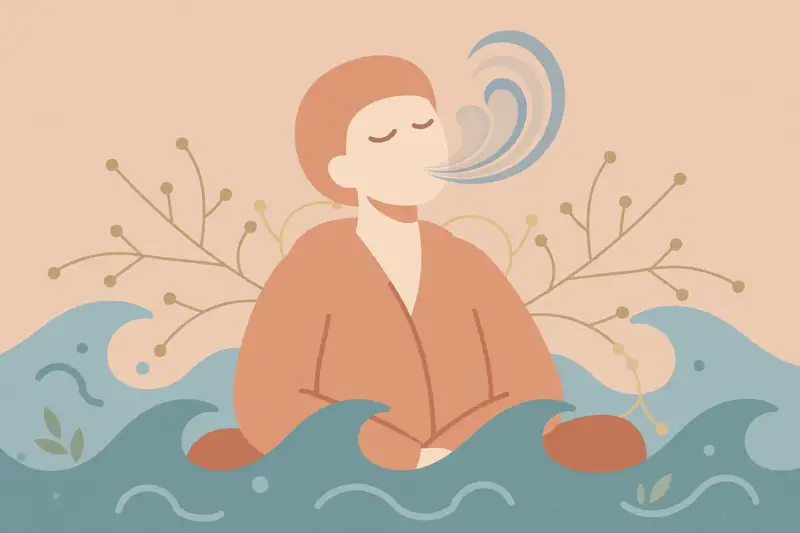
Breathing is the fastest lever. Slow the exhale: breathe in for four counts, out for six to eight. The long exhale activates your parasympathetic nervous system, the brake pedal to anxiety's gas. Two minutes of this measurably lowers heart rate. It feels too simple to work. It works anyway.
Movement and cold are the other levers. A brisk ten-minute walk metabolizes stress hormones. Cold water on your face or a cold shower triggers the dive reflex and resets an escalating nervous system. These are not folk remedies. They are physiology. Body first, thoughts second, always.
Lesson 3
Anxious thinking follows recognizable patterns, and naming them takes away half their power. Catastrophizing: jumping to the worst outcome. Mind reading: assuming you know what others think. Fortune telling: predicting the future with total confidence and zero evidence. All-or-nothing: one mistake means total failure. Learn the greatest hits and you will start catching them in real time.
The technique is simple: catch it, check it, challenge it. Catch the thought: "I am catastrophizing about the presentation." Check the evidence: "What actually happened last time? What would I tell a friend thinking this?" Challenge it with a balanced version: "It might go badly, but probably it will be fine, and either way I will survive." You are not forcing positivity. You are demanding accuracy.
Write the spirals down. Anxious thoughts are terrifying in your head and often silly on paper. Journaling externalizes them, which lets your rational brain examine what your emotional brain generated. Ten minutes of writing can deflate a worry that felt enormous at 2am. The paper holds it so your mind can let go.
Lesson 4
Avoidance feels like relief, but it is anxiety's favorite food. Every time you dodge the thing you fear, your brain learns "that was dangerous, good thing we escaped," and the fear grows. The presentation you skipped, the call you did not make, the party you bailed on: each avoidance makes the next one harder. The way out is through, in small doses.
Gradual exposure is the most effective anxiety technique ever studied. Make a ladder: list the feared thing in steps from mildly uncomfortable to terrifying. Start at the bottom rung and stay until the anxiety drops by half. Then climb one rung. Your brain learns through experience, not argument, that the feared thing is survivable. Each rung rewires the alarm.
Go slow enough to succeed. The goal is not white-knuckling through terror. It is repeated, manageable contact that teaches safety. If a rung is too high, split it into smaller steps. Progress is progress: the person who makes the phone call after dreading it for a month has done real therapeutic work. Celebrate the rungs.

Lesson 5
Worry loves to colonize your whole day: background dread from morning to night, accomplishing nothing. The fix is counterintuitive: schedule it. Fifteen minutes a day, same time, same place, dedicated to worrying on purpose. Write down every worry, brainstorm next actions for the solvable ones, and accept the unsolvable ones. Then close the notebook.
When worries pop up outside worry time, note them and defer: "I will worry about that at 5:30." This sounds absurd. It works remarkably well, because your brain stops looping once it trusts the worry has an appointment. The loop exists because your brain fears forgetting. The appointment removes the fear.
During worry time, sort ruthlessly. Solvable worries get action plans with dates. Unsolvable worries get acceptance practice: "I cannot control this, and worrying rehearses pain without preventing it." Most people discover that eighty percent of their worry is either solvable (so solve it) or unsolvable (so release it). The schedule reveals this. The background dread never does.
Lesson 6
Before you analyze your anxiety psychologically, check the inputs. Poor sleep, excess caffeine, and regular alcohol are anxiety fuel, and they are far more powerful than most people realize. One bad night of sleep measurably increases next-day anxiety. Four coffees mimic a panic attack's physiology. Evening drinking fragments sleep and rebounds as morning dread.
Run the two-week experiment. Sleep seven to nine hours consistently. Cap caffeine at one to two morning cups. Cut alcohol to near zero. Most people who do this report their anxiety dropping by a third or more without any other intervention. Not because their problems vanished, but because their nervous system stopped being chemically provoked.
Think of it as lowering the waterline. Life will still bring real stressors, but you will meet them with a calm baseline instead of an already-flooded system. The inputs are the cheapest, fastest anxiety intervention available. Fix them first, then see what anxiety remains. There will be less than you expect.
Lesson 7
Rumination is worry's obsessive cousin: replaying the past on loop, rehearsing conversations, re-litigating mistakes. It feels like problem-solving but solves nothing. The test is simple: has this loop produced any new insight in the last ten minutes? If not, you are not thinking. You are spinning.
Use the two-minute rule. When you catch a loop, ask: "Is there an action I can take in the next two minutes?" If yes, take it: send the apology text, write the email, make the list. Action dissolves rumination because the brain stops rehearsing what the body is doing. If no action exists, park it: write it down for worry time and redirect your attention deliberately.
Redirection needs a target. Your brain cannot just "stop thinking." Give it something absorbing: a walk, a puzzle, cooking, calling a friend, twenty push-ups. Physical and social activities work best because they engage different brain systems. The loop loses its grip when your attention has somewhere better to go. Practice the redirect like a skill, because it is one.
Lesson 8
A panic attack feels like dying, but it is not dangerous. It is your alarm system at maximum volume: adrenaline flood, racing heart, short breath, dizziness, a sense of unreality. Terrifying, but harmless and time-limited. Panic always peaks, usually within ten minutes, and then passes. Knowing this removes the fear of the fear, which is half the battle.
The playbook: do not fight it. Fighting panic ("stop, stop, calm down") adds a second layer of alarm. Instead, ride it: "This is panic. It is uncomfortable, not dangerous. It will peak and pass." Slow your exhale. Ground yourself: name five things you see, four you hear, three you can touch. Cold water on your face helps. Remind yourself you have survived every previous one.
Afterward, do not reorganize your life around avoiding the next one. That is how panic disorder grows: the fear of panic becomes worse than panic itself. Instead, note what happened, note that you survived, and keep living normally. If attacks recur, this is exactly what therapy treats most successfully. You do not have to white-knuckle this alone.

Lesson 9
Anxiety thrives in secrecy. The worry you never voice grows unchecked because it never meets reality testing. Telling someone, a friend, a partner, a family member, does two things: it externalizes the spiral, and it lets another brain check your math. "Does this sound reasonable to you?" is a powerful question.
Choose the right person: someone calm, kind, and honest, not someone who catastrophizes with you. Tell them what helps: "I do not need you to fix it, I just need you to listen" or "tell me honestly if I am spiraling." People want to help but often do not know how. Give them the script.
If anxiety is a regular feature of your life, consider telling people proactively, not just in crisis. "I deal with anxiety. Sometimes I need to step out and breathe. It is not about you." This removes the shame performance and lets people support you well. Secrets keep you isolated. Honesty builds the support system that makes everything easier.
Lesson 10
Waiting until you feel calm to act is anxiety's cleverest trap, because the calm never comes first. The calm comes after. Confidence is not the absence of anxiety. It is the memory of acting despite it, accumulated over time. Every brave action, taken while scared, teaches your brain that fear and functioning can coexist.
Shrink the action until it is doable scared. Terrified of the presentation? Rehearse one slide. Dreading the call? Write the opening sentence. The first step is allowed to be tiny. Tiny steps taken beat giant plans postponed. Momentum is the antidote to paralysis, and momentum starts embarrassingly small.
Collect evidence of your own courage. Keep a note of things you did while anxious: the meeting, the trip, the hard conversation. Review it when the next fear arrives. Your history of acting scared is the most convincing argument against the voice that says you cannot. You have done it before. The record proves it.
Lesson 11
Anxiety wants to shrink your life: skip the trip, avoid the people, play it safe. Values point the other way: toward connection, growth, contribution, adventure. When anxiety and values conflict, let values drive. You will feel anxious and do the meaningful thing anyway, and afterward the meaning remains while the anxiety fades.
Get clear on your values with a simple question: "What kind of person do I want to be?" Kind, brave, present, generous, growing. Then let those answers guide decisions anxiety wants to make for you. The anxious choice is avoidance. The values choice is engagement. Choose engagement often enough and your life gets bigger instead of smaller.
This is the heart of acceptance-based approaches to anxiety: you stop trying to eliminate the feeling and start building the life, with the feeling along for the ride. Anxiety becomes a passenger, not the driver. Passengers can be loud. They still do not get to choose the destination.
Lesson 12
Everything in this course helps, and sometimes it is not enough. That is not failure. That is information. Get professional help if anxiety regularly disrupts your sleep, work, or relationships; if you avoid important parts of life; if panic recurs; or if you just feel stuck despite real effort. These are the standard, sensible thresholds.
Therapy for anxiety is among the most effective treatments in all of medicine. Cognitive behavioral therapy teaches exactly these skills with a guide, tailored to you. It is practical, time-limited, and it works. Medication helps many people too, especially when anxiety has a strong biological component. There is no moral hierarchy here. Tools are tools.
Asking for help is the strong move, not the weak one. It takes more courage to sit in a therapist's office than to white-knuckle another year. If cost is a barrier, look into community clinics, sliding-scale therapists, and reputable workbooks that teach the same methods. You would not refuse a cast for a broken arm. Do not refuse help for a miscalibrated alarm.
Graduation
Anxiety is an alarm, not an enemy. Calm the body first. Question the thoughts. Stop feeding avoidance. Schedule the worry. Fix sleep, caffeine, and alcohol. Park the rumination loops. Ride out panic. Tell someone. Act while anxious. Let values drive. And get help when you need it, without shame. The volume goes down. The life gets bigger.
Keep learning
This course is part of Starvard University, striving for greatness.
A note on accuracy: Much of what you read at Starvard was created with help from AI agents, working alongside people. We check what we can, but we cannot guarantee that everything here is true, current, or complete. If something really matters, your health, your money, a grade, a job, please verify it with a trusted source before you rely on it.