Starvard University · Fishing
Catch dinner, find patience. Learn the gear, the knots, and the water-reading that turn a quiet morning into a full stringer.

The whole course in brief
Twelve lessons, one goal: catch your first fish, then many more.
The twelve lessons
Lesson 1
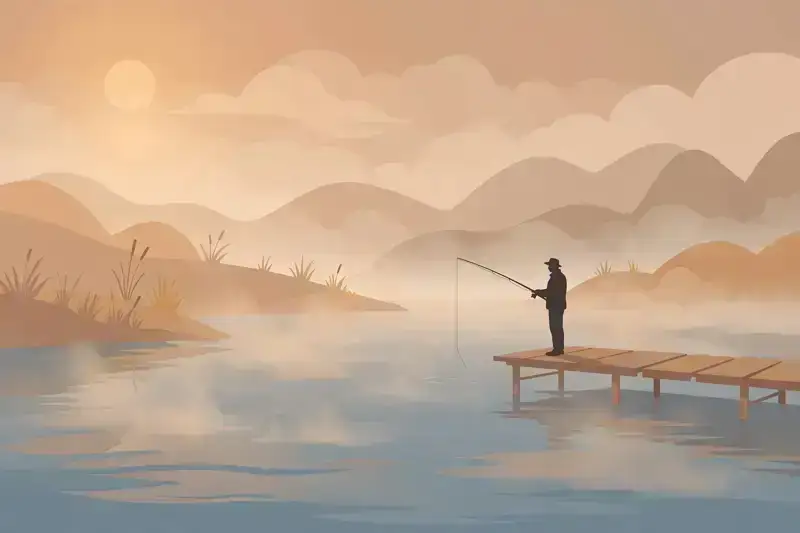
Fishing is two hobbies in one: the pursuit, which is strategic and endlessly learnable, and the waiting, which is meditative in a way few modern activities are. You stand by water, phone away, watching light move, and every so often something thrilling happens. It is the rare pastime that is both exciting and restful.
It is also practical. A skilled angler feeds people. And the learning curve is kind: your first bluegill on a worm under a bobber can happen within an hour of picking up a rod, while mastery takes a lifetime. Few pursuits hand you joy that fast and depth that deep.
Lesson 2
The beginner workhorse is a spinning combo: a 6 to 7 foot medium-power spinning rod with a matching reel, spooled with 8-pound monofilament line. Spinning gear is forgiving to cast, versatile enough for most freshwater species, and cheap. A decent combo costs $50 to $100 and will catch fish for years.
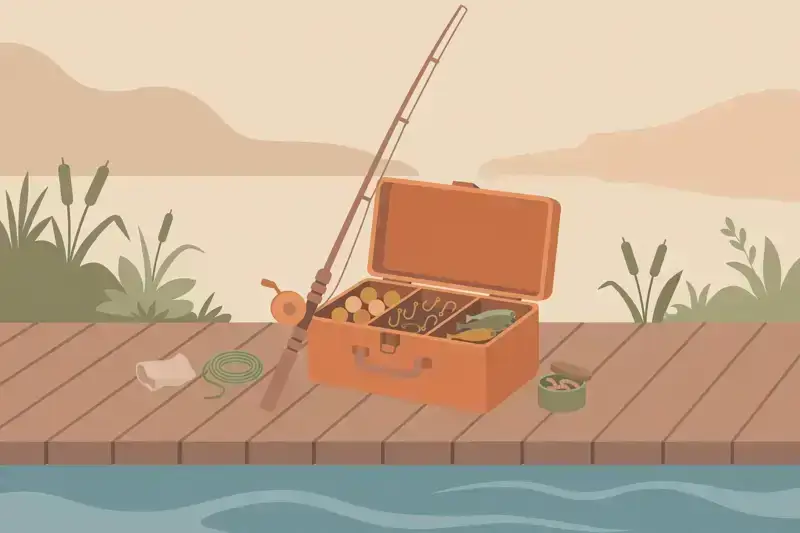
Understand the parts. The rod's power (light to heavy) is its backbone; medium handles most situations. The reel's drag is a slipping clutch that lets big fish pull line without breaking it; set it to about a third of your line's strength. Monofilament is stretchy and forgiving, perfect for learning. Add a small tackle box with hooks, sinkers, bobbers, and a few lures, and you are fishing.
Lesson 3
Knots are where fish are lost, so learn them well. The improved clinch knot ties your hook or lure to the line: thread, twist five times, back through the loop, tighten. It is the workhorse knot for terminal tackle. The Palomar knot is even stronger and simpler for hooks and lures: double the line through the eye, tie an overhand, pass the loop over the hook.
The third is a line-to-line connection for joining leader to main line, like the double uni knot. Practice knots at home until you can tie them without looking. A knot tied well holds near the line's full strength; a knot tied badly is a decoration. Test every knot with a firm pull before you cast.
Lesson 4
Live bait, worms, minnows, crickets, is the great equalizer. It smells and moves like food because it is food, and it catches fish when nothing else will. A worm under a bobber is the oldest and most reliable presentation in freshwater fishing. Never be embarrassed to fish bait; guides do it when it matters.
Lures are artificial imitations you work through the water: spinners, crankbaits, soft plastics, jigs. They require technique but cover water faster and target bigger, aggressive fish. Start with an inline spinner and a soft plastic worm on a jig head; those two lures catch nearly everything that swims in fresh water. Match the hatch: if fish are eating small minnows, throw something minnow-sized.
Lesson 5
Fish relate to structure and current. In lakes, fish hold near anything different: weed edges, drop-offs, fallen trees, docks, points. Cast to the edges of structure, not the middle of nowhere. In rivers, fish face upstream in current breaks behind rocks and logs, waiting for food to come to them. The seam where fast water meets slow water is prime real estate.
Light and temperature matter too. Fish feed most actively in low light, dawn and dusk, and on overcast days. In summer heat, they go deep or find shade; in spring and fall, they move shallow. Ninety percent of the fish are in ten percent of the water. Your job is to find the ten percent.
Lesson 6
The overhead cast with spinning gear: hold the rod with your index finger trapping the line against the rod, open the bail, swing the rod back to about two o'clock, then forward smoothly, releasing your finger at about ten o'clock. The lure's weight loads the rod like a spring. Smooth beats hard; muscling it kills accuracy.
Accuracy matters more than distance. Most fish are caught within 30 feet of the angler. Practice hitting a target in the yard: a bucket at twenty feet is a perfect drill. Learn the sidearm cast for low trajectories under trees, and the flip cast for dropping a bait quietly next to cover. Quiet entries catch more fish than long casts.
Lesson 7
When you feel the bite, set the hook with a firm upward lift of the rod, not a wild jerk. The goal is to drive the hook point home. With circle hooks, used in much bait fishing, do not set at all; just reel steadily and the hook sets itself in the corner of the mouth.
Then keep the line tight. A slack line is how fish throw hooks. Keep the rod tip up, let the drag do its work on runs, and reel steadily. When the fish is close, use a net or wet your hands to land it; lip-grip bass by the lower jaw, support big fish horizontally, and never squeeze. The fight is the fun part. Enjoy it, then handle the fish like you plan to release it even if you do not.
Lesson 8
Start with the willing biters. Bluegill and other panfish are abundant, aggressive, and perfect for learning; a worm under a bobber near weeds will find them. Largemouth bass are the glamour species: they hit lures hard, fight well, and live in every warm lake and pond in America. Fish soft plastics and spinners around cover.
Trout are the cold-water prize: they demand lighter line, smaller offerings, and stealthier approaches in clear streams. Catfish are the night shift: they feed by smell in warm, murky water, and stink bait or cut bait on the bottom finds them after dark. Crappie school around brush piles and bite tiny jigs. Learn one species well before chasing the next.
Lesson 9
Releasing fish well is a skill. Wet your hands before touching any fish; dry hands strip the protective slime coat. Minimize air time: unhook quickly, and if you want a photo, have the camera ready before you lift the fish. Support the fish horizontally, never hang a big fish vertically by the jaw.
Use barbless hooks or pinch your barbs; they come out faster and injure less. If a fish is hooked deep, cut the line rather than digging; hooks rust out and the fish survives far better than after surgery. Revive tired fish by holding them upright in the water, moving them gently forward until they kick away on their own. Released well, a fish can be caught again. That is the whole point.
Lesson 10
You need a fishing license in nearly every state, and they are cheap, usually $20 to $50 a year, funding the conservation that keeps fisheries alive. Buy online before you go; wardens do check, and the fine dwarfs the license cost. Some waters need extra stamps, like trout or salmon stamps.
Know the local rules: size limits (release fish under or over certain lengths), bag limits (how many you can keep), seasons, and bait restrictions. These rules are why there are still fish to catch. Ignorance is not a defense, and the regulations booklet, usually free with the license, is genuinely worth reading for your waters.
Lesson 11
Saltwater is a bigger, stronger version of the same game. The gear scales up: heavier rods, corrosion-resistant reels, stronger line. Rinse everything with fresh water after every trip or the salt will destroy it. Fish the tides: moving water means feeding fish, and the hour around tide changes is prime.
Start from shore or a pier. Surf fishing with cut bait, pier fishing for whatever cruises by, and inshore flats for redfish and speckled trout are all beginner-accessible. Learn the local baitfish and match them. And respect the ocean: watch the weather, know your limits, and never turn your back on the surf. The fish will be there tomorrow.

Lesson 12
Spring is the beginner's best season: fish move shallow to spawn, feed aggressively, and forgive mistakes. Fish local ponds and small lakes first; they are full of willing bluegill and bass. Go at dawn or dusk, keep a simple log of what worked, and fish the same water repeatedly until you understand it.
Graduation
You know the setup, the knots, bait and lures, how to read water, cast, set the hook, handle fish, and stay legal. That is a complete angling education. Now comes the best part: quiet mornings, the tap-tap of a bite, and the oldest thrill in the book.
Keep learning
This course is part of Starvard University, striving for greatness.
A note on accuracy: Much of what you read at Starvard was created with help from AI agents, working alongside people. We check what we can, but we cannot guarantee that everything here is true, current, or complete. If something really matters, your health, your money, a grade, a job, please verify it with a trusted source before you rely on it.