Starvard University · Hiking 101
Get outside, go up things, come back happy. Everything a beginner needs: the gear that matters, the safety that matters more, and how to pick your first trails.

The whole course in brief
The twelve lessons
Lesson 1
Hiking is walking with better scenery and a destination. It asks almost nothing of you to start: legs, lungs, and a trailhead within driving distance. Yet it delivers what expensive vacations promise and rarely provide, which is the feeling of being fully present somewhere beautiful.
The research on time outdoors is almost embarrassingly positive. Even twenty minutes in nature lowers cortisol, the stress hormone, measurably. Longer hikes improve sleep, creativity, and mood for days afterward. There is a reason the phrase "touch grass" became advice: your nervous system was built for green and blue, not gray and glowing.
And hiking scales with you forever. Today it is a two-mile loop at the local open space. In a year it could be a fourteen-thousand-foot summit. The trail does not care how fast you go or what you look like. It only asks that you show up.
Lesson 2
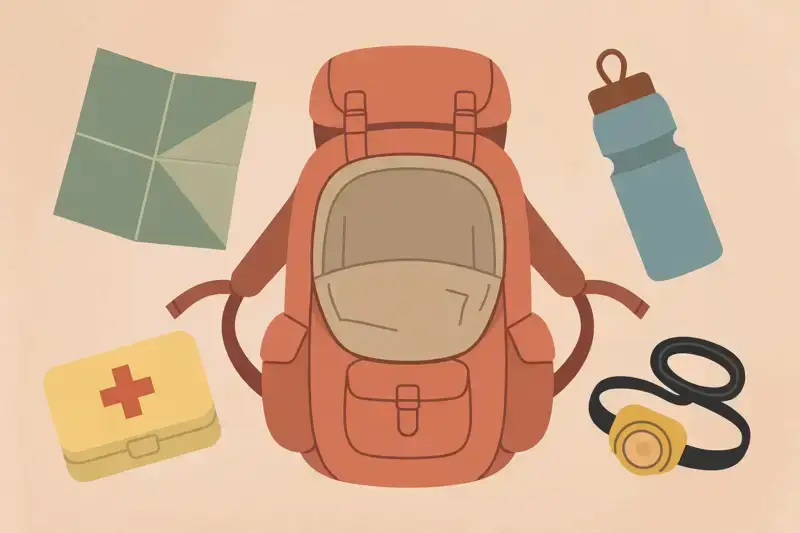
Every hiker carries the ten essentials, a list developed by mountaineers and adopted by every park service on earth. They sound like overkill until the day they are not. One: navigation (map, compass, or a charged phone with offline maps). Two: a headlamp, because hikes run long. Three: sun protection. Four: a first aid kit. Five: a knife or multi-tool.
Six: a way to start fire, like a lighter in a dry bag. Seven: emergency shelter, even just a lightweight space blanket. Eight: extra food beyond what you planned to eat. Nine: extra water, plus a filter or purification tablets. Ten: extra clothes, because weather changes and sweat gets cold.
For a beginner day hike, this all fits in a small daypack and weighs a few pounds. Pack it every time, even for the trail you have done ten times. The essentials are not for the hike you planned; they are for the hike that happens instead.
Lesson 3
Your feet are the entire vehicle, so treat them like it. For beginner trails, you do not need mountaineering boots. Trail runners or light hiking shoes with good tread handle most day hikes beautifully, and they need almost no break-in. Full leather boots are for heavy packs and rough terrain, not for your first ten hikes.
Whatever you choose, buy them in the afternoon when your feet are slightly swollen, wear the socks you will hike in, and walk around the store for ten minutes. Toes should not touch the front on a downhill slope; there should be a thumb's width of space. Break them in with a few neighborhood walks before any real trail.
Blisters are the number one hike-ruiner and they are almost entirely preventable. Moisture-wicking socks (wool or synthetic, never cotton), shoes that fit, and lacing snugly at the ankle. At the first hot spot, stop and cover it with moleskin or tape immediately. Do not hike through a hot spot hoping it improves. It will not.
Lesson 4
Trails have a language, and it is written in blazes, cairns, and footprints. Blazes are the painted marks on trees and rocks, usually one color per trail; follow them, and when you have not seen one for a few minutes, stop and backtrack to the last one. Cairns are stacked-rock markers used above treeline. The most worn path is usually, but not always, the right one.
Learn to read a trail description before you go: distance, elevation gain, and difficulty rating. A useful rule of thumb is that 1,000 feet of elevation gain feels like adding about a mile of flat distance to your legs. A "moderate" five-miler with 2,000 feet of climbing is a serious morning, not a stroll.
Trail apps with GPS tracks and recent trip reports are worth their weight in gold. Download the map offline before you leave service, read the last few trip reports for conditions, and check the photos so you recognize the trailhead and key junctions.
Lesson 5
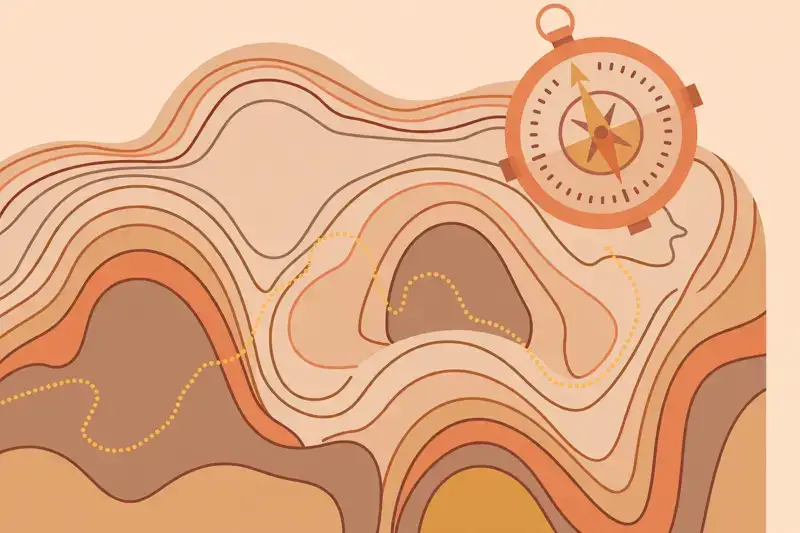
Getting lost is the most common hiking emergency, and it is almost always preventable. The foundation is simple: know where you are on the map at all times. Check your position at every junction, every half hour, and every time the trail does something unexpected. Navigation is a habit, not a rescue skill.
Learn the two tools that never run out of battery: a paper map and a compass. A map tells you the terrain, a compass tells you direction, and together they answer the only question that matters, which is where you are. Take ten minutes to learn to orient a map to north and take a bearing; that tiny skill covers most situations.
Your phone is a wonderful secondary tool and a terrible primary one. Batteries die, screens break, and service vanishes exactly where you need it. Use the phone's GPS with downloaded offline maps, keep it in airplane mode to save battery, and carry the paper map as the backup that cannot fail.
Lesson 6
Mountains manufacture weather. A sunny trailhead can become a thunderstorm by 2 p.m., which is why the classic alpine rule is simple: summit early, descend by noon. Check the forecast the night before and again in the morning, and learn to read the sky: tall building clouds before noon mean get down.
Lightning is the real danger above treeline. If you hear thunder less than thirty seconds after the flash, you are close enough to be struck. Get below treeline, away from lone trees and ridgelines, and wait it out. Crouching on your pack with feet together is the last-resort position, not a plan.
Turning back is the most advanced skill in hiking. The summit will be there next weekend; your safety margin might not be. Set a turnaround time before you start and honor it no matter how close the top looks. Every experienced hiker has a story about the day they turned around. The inexperienced ones sometimes do not.
Lesson 7
Beginners hike too fast on the flat and die on the climb. The fix is to start embarrassingly slow and find a rhythm you could hold all day. On uphills, take short steps and settle into a pace where you can breathe through your nose. If you are gasping, you are racing, and the mountain always wins races.
The rest step is the mountaineer's secret: on steep sections, pause for one full breath with each step, locking the downhill knee straight for a micro-rest. It looks slow and feels sustainable. Combined with switchbacks, which trade distance for gentleness, even big climbs become a meditation instead of a sufferfest.
On downhills, shorten your stride, keep your knees soft, and let gravity do the work without pounding. Trekking poles are worth trying: they take meaningful load off your knees on descents and help your balance on uneven ground. Your fifty-year-old knees will thank your thirty-year-old self.
Lesson 8
There is nothing like earning a view. The last push to a summit or overlook is where hiking pays its dividends, and the feeling of standing somewhere you reached on foot never gets old. Savor it: eat the good snack you saved, take the photo, sit for ten minutes and do nothing.
But the summit is the halfway point, and most hiking accidents happen on the descent, when legs are tired and attention fades. Eat and drink at the top, re-lace your boots snugly for the downhill, and start down while you still feel good. Descending on empty legs is how ankles get rolled.
Altitude deserves respect. Above about 8,000 feet, the air thins noticeably; headaches, nausea, and unusual fatigue are signs to descend, not push. Hydrate more than usual, go slower than feels necessary, and give yourself a day or two to acclimate if you have come from sea level.
Lesson 9
Seeing wild animals is a highlight, not a hazard, as long as you follow the rules. The big one: never feed wildlife, ever. Fed animals become aggressive animals, and a fed bear is a dead bear. Store food properly, pack out every scrap, and admire from a distance.
In bear country, make noise on blind corners, carry bear spray where recommended, and know the drill: for black bears, make yourself big and loud; for grizzlies, avoid surprising them and play dead only in an actual attack. In mountain lion territory, keep kids close, do not run, and face the animal. Moose are the ones people underestimate: give them enormous space.
Smaller encounters need respect too. Give rattlesnakes a wide berth and watch where you put hands and feet on rocky trails. Check for ticks after hikes in grassy areas. The goal is always the same: observe, appreciate, and leave every animal exactly as wild as you found it.
Lesson 10
Leave No Trace is seven principles that boil down to one idea: leave the place as good as you found it. Plan ahead, travel on durable surfaces (stay on the trail, even through mud), dispose of waste properly, leave what you find, minimize campfire impact, respect wildlife, and be considerate of other visitors.
The practical version: pack out everything you packed in, including apple cores and pistachio shells, which do not belong in that ecosystem. Go to the bathroom at least 200 feet from trails and water. Do not carve, stack, or pocket souvenirs. If a fire ring is not established and fires are not clearly allowed, skip the fire.
Yield the trail to uphill hikers, keep noise down, and keep dogs leashed where required. The wilderness feels wild because millions of people before you left it alone. Your job is to be invisible.
Lesson 11
Hiking with others is the best way to start: built-in navigation help, shared gear, and someone to notice if you twist an ankle. Groups are safer, more social, and more forgiving of mistakes. For your first dozen hikes, bring a buddy or join a local hiking group.
Solo hiking is a different and wonderful experience, the closest thing to meditation most people ever do, but it demands more caution. Stick to popular trails, leave a detailed trip plan with someone reliable, carry a charged phone and ideally a satellite communicator in remote areas, and be conservative about turnaround times. There is no one to help you think clearly when you are tired.
Either way, the pre-hike text is non-negotiable: trail name, trailhead, your planned route, and the time you will text that you are out. If that time passes with no word, your contact calls for help. This single habit is the difference between a long day and a tragedy.
Lesson 12
Now make it a project. Write down twelve trails within a two-hour drive: four easy loops for after-work evenings, four moderate day hikes, and four big goals for the year, the ones that make your heart beat faster. Work the list in order, and watch your fitness and confidence grow together.
Keep a simple trail journal: date, trail, distance, how it felt, what you would do differently. Note the gear that worked and the gear that did not. After a season, this journal becomes a personalized guidebook worth more than any app.
And bring someone new with you. The best way to lock in everything you have learned is to teach it to a friend on their first hike. Pick an easy trail, pack the ten essentials, and watch their face at the first viewpoint. You will remember why you started.
Graduation
You know the essentials, the etiquette, the weather wisdom, and the turnaround rule. The mountains do not require expertise to begin, only respect and preparation. Pick your first trail, text your trip plan, and go. The view is waiting, and it is better than the photos.
Keep learning
This course is part of Starvard University, striving for greatness.
A note on accuracy: Much of what you read at Starvard was created with help from AI agents, working alongside people. We check what we can, but we cannot guarantee that everything here is true, current, or complete. If something really matters, your health, your money, a grade, a job, please verify it with a trusted source before you rely on it.