Starvard University · Math
The math you actually use as an adult: percentages, interest, unit prices, probability, budgeting, and the art of the quick estimate. No calculus required.

The whole course in brief
Twelve lessons, twelve big ideas.
The twelve lessons
Lesson 1
Most adults who say "I'm bad at math" are actually bad at timed tests from twenty years ago. Adult math is different: it is a small set of moves, done slowly, with a calculator in your pocket. You do not need speed. You need the right move and the confidence to use it.
This course teaches about ten moves, and they cover nearly everything: percentages, unit prices, ratios, compound growth, probability, expected value, budgeting, averages, and estimation. Learn them once, practice on real life, and you will out-math most college graduates where it counts: your money.
Lesson 2
A percent is just "out of 100." 20% off means you pay 80 out of every 100, so multiply by 0.8. A 15% tip on $40: 10% is $4, 5% is $2, total $6. The 10%-5%-1% breakdown handles almost any percent in your head: build any percentage from those three blocks.
Watch the two classic traps. Percentage points versus percent: going from 10% to 15% is a 5-point rise but a 50% increase. And sequential percentages do not add: 20% off then 10% off is not 30% off, it is 28% off (0.8 times 0.9 = 0.72). Stores count on you not knowing that.
Lesson 3
The shelf tag shows the unit price: cost per ounce, per roll, per load. It is the only fair way to compare packages. The giant "value size" is often cheaper per unit, but not always; sometimes the medium bag wins. Five seconds of division beats all marketing.
The move: price divided by quantity, compare the results. Same for services: cost per month, per visit, per use. The gym membership is not $600 a year; it is $50 a month, or $12.50 per visit if you go weekly, or $600 per visit if you go once. Unit pricing turns vague costs into honest ones.
Lesson 4
A ratio is a relationship: 2 parts rice to 3 parts water. A proportion scales it: feeding 8 instead of 4 means doubling everything. This one move runs cooking, mixing paint, diluting cleaner, map scales, and medicine doses. If the ratio holds, the result holds.
The method is cross-multiplication, but you rarely need the name. Just keep the relationship fixed while you scale. Doubling a recipe: double everything. Halving: halve everything. The mistakes happen when people scale some ingredients and eyeball others. Math does not care about your eyeballing.
Lesson 5
Simple interest pays on the original amount. Compound interest pays on the original plus all previous interest, so growth accelerates. $1,000 at 7% becomes about $2,000 in 10 years, $4,000 in 20, $8,000 in 30. Time does the heavy lifting; the rate just sets the pace.
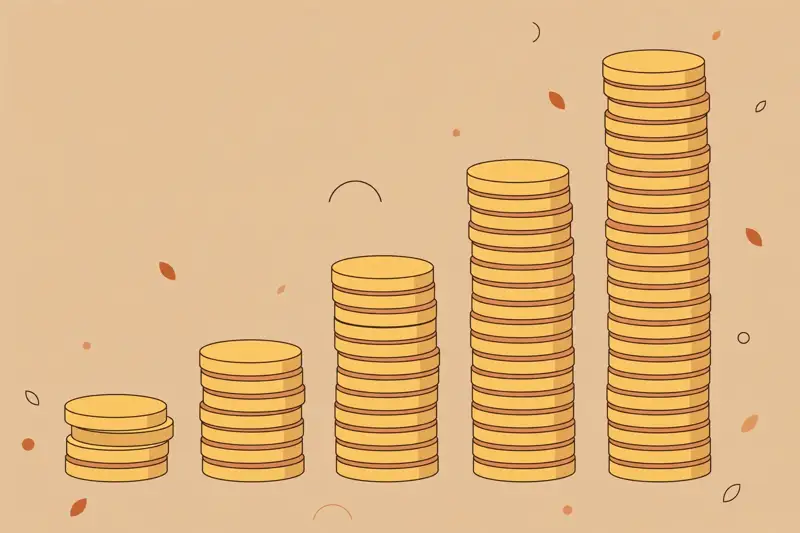
The Rule of 72: divide 72 by your annual rate to get the doubling time. At 7%, money doubles every ~10 years. At 3%, every 24. This is why starting early beats investing more later: a 25-year-old investing a little beats a 35-year-old investing a lot, because compounding had a ten-year head start.
Lesson 6
Compounding does not care whose side it is on. Credit card debt at 24% doubles every 3 years (72/24 = 3). Minimum payments are engineered to keep you in debt: on a $5,000 balance at 24% with minimum payments, you pay for over a decade and hand the bank thousands in interest.
The escape math: list debts by rate, pay minimums on all, throw every spare dollar at the highest rate first. Each killed debt frees its payment to attack the next, which is why it accelerates. And the real lesson: any purchase on a 24% card costs far more than the sticker price. Do the multiplication before you swipe.
Lesson 7
Probability is just favorable outcomes over total outcomes. A die has 6 faces, so any number is 1 in 6. Two independent events multiply: two heads in a row is 1/2 times 1/2 = 1/4. "Or" adds (with overlap subtracted): drawing a heart or a king from a deck is 13/52 + 4/52 - 1/52.
The usable insight: humans are terrible at intuiting probability, so compute instead of feel. The lottery is a tax on people who cannot do division. A 1% risk repeated 100 times is not 1%, it is about 63% (1 minus 0.99^100). Small chances compound into near-certainties with enough repetitions, which is why habits beat luck.
Lesson 8
Expected value is probability times payoff, summed over outcomes. A coin flip where you win $10 on heads and lose $6 on tails: (0.5 x 10) + (0.5 x -6) = $2. Positive expected value means the bet favors you over time. Casinos survive because every game has negative expected value for the player, guaranteed by the math.
Use it beyond gambling. A job change with a 70% chance of +$20k and a 30% chance of -$10k has expected value $11k, before you factor in happiness. Insurance is negative expected value by design (the company profits), and you buy it anyway because you are buying certainty, not profit. Expected value is the start of the decision, not the whole of it.
Lesson 9
A budget is arithmetic with a purpose: income minus outgo, planned in advance. The 50/30/20 framework: about 50% of take-home for needs, 30% for wants, 20% for saving and debt payoff. It is a starting point, not a law; adjust to your city and your goals.
The math that matters most is the monthly run rate: add up the fixed costs, divide the irregular ones (annual insurance divided by 12), and know your number. If outgo exceeds income, the gap is the problem, and the fix is arithmetic: raise the first number or lower the second. No app can do that part for you.
Lesson 10
The average home price, the average salary, the average return: each hides as much as it reveals. Averages get dragged by outliers (one billionaire in the room), hide the spread (everyone at 75 versus half at 50 and half at 100), and get quoted without saying which average (mean, median, or mode).
Your defense: ask which average, ask for the median when outliers lurk, and ask for the range. "Average return 8%" means little without knowing the worst years. Numbers describe groups; you live a single life. Translate every average into what it means for someone like you.
Lesson 11
Precision is overrated; order of magnitude is underrated. Fermi estimation: break a big question into small multiplications. How many piano tuners in Chicago? People times pianos per person times tunings per year divided by tunings per tuner per year. Each guess is rough, but errors cancel, and you land within a factor of two or three, which is plenty for most decisions.
Round aggressively: use 10% chunks, powers of ten, friendly numbers. The point is to sanity-check reality before committing. "Will this project take a week or a quarter?" does not need a spreadsheet. It needs one honest estimate, and the courage to believe it.
Lesson 12
A few moves cover most daily math. Multiplying by 5: halve it, then times 10 (48 x 5 = 24 x 10 = 240). 15% tip: 10% + half of 10%. Splitting a bill: divide by people, then adjust. Doubling and halving: 16 x 25 = 8 x 50 = 400. Round-then-adjust: 49 x 31 is about 50 x 30 = 1500, then nudge.
The real trick is practice on real life, not worksheets. Estimate the grocery total as you shop. Compute the tip before the phone does. Guess the drive time, then check. Each rep makes the moves automatic, and automatic math is confident math. You were never bad at this. You were just out of practice.
Graduation
Percentages, unit prices, ratios, compound growth, debt math, probability, expected value, budgets, honest averages, quick estimates, and mental tricks. Ten moves, and they cover nearly all the math adult life throws at you: the store, the bank, the ballot measure, the business plan. The calculator was never the hard part. Knowing which move to use was. Now you know.
Keep learning
This course is part of Starvard University, striving for greatness.
A note on accuracy: Much of what you read at Starvard was created with help from AI agents, working alongside people. We check what we can, but we cannot guarantee that everything here is true, current, or complete. If something really matters, your health, your money, a grade, a job, please verify it with a trusted source before you rely on it.