Starvard University · Psychology
Why people do what they do: how you perceive, remember, feel, decide, and change. The real science of the mind, minus the couch cliches.

The whole course in brief
Twelve lessons, twelve big ideas.
The twelve lessons
Lesson 1
Psychology is the scientific study of mind and behavior. Not opinions about people, not couch cliches, but experiments, measurements, and theories tested against data. It asks the most personal questions there are, why you remember some things and forget others, why you do what you swore you would not, with the most impersonal tools available.
The field splits into territories you will tour in this course: how you perceive, how you learn and remember, how you think and decide, how you feel, how other people shape you, how you grow, and how you change. One warning that will save you years: psychology describes tendencies, not destinies. "People tend to" is doing a lot of work in every finding.
Lesson 2
You do not see the world; you see your brain's best guess about the world. Your eyes take in patchy, upside-down, low-resolution data with a blind spot in each eye, and your brain fills in the rest from memory and expectation. Optical illusions are not party tricks. They are the construction process caught red-handed.
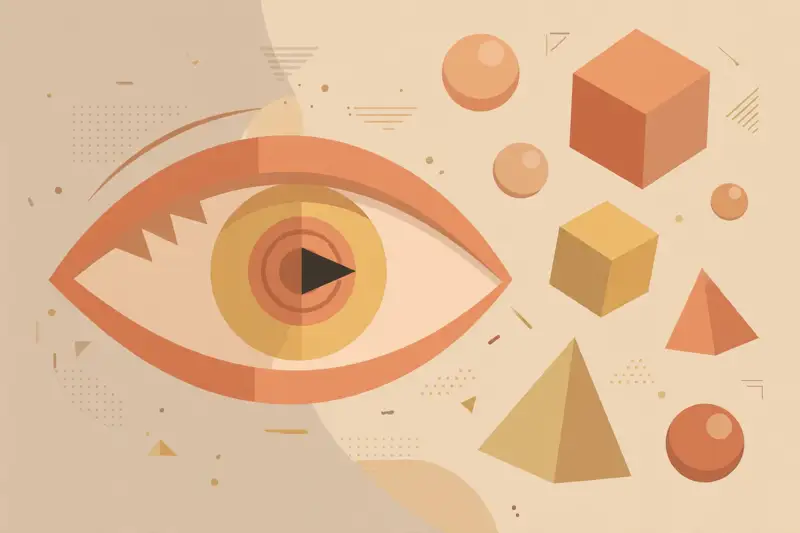
This is why two honest people can witness the same event and remember it differently. Each brain built its own version. The practical lesson: hold your perceptions lightly, especially under stress, fatigue, or strong emotion, when the construction crew takes the most shortcuts.
Lesson 3
Memory works less like a video file and more like a story you retell. Every time you recall something, your brain rebuilds it, and the rebuilding can change it. Ask leading questions ("how fast were the cars going when they smashed?") and people remember a faster, more violent crash than happened. Confidence in a memory has almost no relationship to its accuracy.
The good news: you can work with the system. Spaced repetition (reviewing at growing intervals) beats cramming because each successful recall strengthens the trace. Testing yourself beats re-reading. Sleep consolidates memory, which is why the all-nighter is a lie. And writing things down is not cheating; it is outsourcing storage to free up thinking.
Lesson 4
Psychologist Daniel Kahneman described two systems. System 1 is fast, automatic, and emotional: it recognizes faces, dodges the ball, and forms instant impressions. System 2 is slow, effortful, and logical: it does math, weighs evidence, and checks System 1's work. You need both. System 1 keeps you alive; System 2 keeps you honest.
The trouble is that System 1 never clocks out. It answers hard questions by swapping in easy ones ("do I like this person?" becomes "do they remind me of someone I like?"), it loves a confident story over messy data, and it is wildly overconfident. The fix is not to distrust your gut always, but to notice which system is driving and invite System 2 in for the big calls: money, health, relationships, anything irreversible.
Lesson 5
About half of what you do each day is habit, not decision. Habits run on a loop: cue, routine, reward. The cue triggers it (phone buzzes), the routine plays out (check the phone), the reward reinforces it (tiny dopamine hit). Willpower fights the routine. Smart change redesigns the loop.
Want a new habit? Make the cue obvious and the first step tiny. Want to kill one? Make the cue invisible and add friction. Stack the new habit onto an old one (after coffee, I write for ten minutes). And track it: what gets measured gets repeated. You do not rise to your goals; you fall to your systems.
Lesson 6
Emotions are your brain's quick summary of what is happening and what it might mean. Fear says "threat, prepare." Anger says "boundary crossed, respond." Sadness says "loss, slow down and regroup." They are information, not orders. The feeling is real and the conclusion it suggests might be wrong.
The most validated skill in emotion research is almost boring: name it. Labeling an emotion ("I am anxious about the meeting") measurably reduces its intensity, because naming recruits the thinking brain to help. Then ask what the emotion is pointing at and what response fits. You do not control the first flash of feeling. You control the second move, and the second move is the one that counts.
Lesson 7
Carrots and sticks work for simple, mechanical tasks. For anything requiring creativity or judgment, they backfire: big external rewards narrow focus and kill intrinsic interest. The research points to three deeper drivers: autonomy (control over your work), mastery (getting better at something that matters), and purpose (it serves something beyond you).
This explains a lot of life. The well-paid job that feels empty is usually missing one of the three. The hobby you would do for free has all three. If you lead people, stop asking "how do I motivate them" and start asking "what is blocking their autonomy, mastery, or purpose." Motivation is mostly unblocking.
Lesson 9
Stress is your body's mobilization system: adrenaline, cortisol, faster heart, sharper focus. It evolved for sprints, not marathons. Short bursts with recovery make you stronger. Chronic stress without recovery wears down sleep, immunity, memory, and mood. The dose and the recovery make the poison or the medicine.
What works, per the research: move your body (the single most reliable stress reducer), sleep like it is your job, write the worry down (externalizing it shrinks it), and reframe the arousal ("my body is preparing me" beats "I am falling apart"). What does not work long-term: numbing it with scrolling, drinking, or venting without action. Stress needs an exit, not a lid.
Lesson 10
Developmental psychology maps the long arc. Kids build thinking in stages, from concrete to abstract. Teens build identity by trying on selves, which is why the experimentation is the job, not a malfunction. Adults keep developing too: through careers, relationships, and the classic midlife audit of "is this the life I meant to build."
Two ideas worth keeping. Attachment: early bonds shape your template for closeness, but templates can be updated by later good relationships. And stages are not deadlines: people bloom late, change careers at fifty, and learn new tricks for decades. The arc bends toward growth as long as you keep feeding it.
Lesson 11
The best-supported model of personality has five dimensions: openness (curiosity, love of novelty), conscientiousness (discipline, reliability), extraversion (energy from people), agreeableness (warmth, cooperation), and neuroticism (sensitivity to negative emotion). Everyone sits somewhere on each, and the pattern is fairly stable across a lifetime.
Personality predicts a lot: conscientiousness predicts job performance and health habits; neuroticism predicts vulnerability to anxiety. But it is not a cage. Traits are tendencies with wide ranges, and situations pull behavior around strongly. Use personality as a map of your defaults, then design your life to fit them instead of fighting them uphill.
Lesson 12
The old story was that the adult brain is fixed. It is not. Neuroplasticity means the brain rewires with experience throughout life: new skills, new habits, new patterns of thought, all of it physically reshapes the wiring. Therapy works, in large part, by using this: cognitive behavioral therapy teaches you to catch distorted thoughts and rehearse better ones until the new path is the easy path.
The formula for change is unglamorous: a clear target behavior, tiny reps, feedback, and time. Not motivation, not a breakthrough, not a perfect plan. Ten minutes a day beats a heroic weekend. You are not stuck with the mind you have. You are renting it, and the lease allows renovations.
Graduation
You came with a mind and no instruction manual. Now you have the first chapters: perception builds reality, memory is a rough draft, habits run on loops, emotions are data, crowds pull you, stress needs an exit, and the whole system stays changeable for life. None of this removes the hard parts. It just means you are no longer flying blind. Use the manual.
Keep learning
This course is part of Starvard University, striving for greatness.
A note on accuracy: Much of what you read at Starvard was created with help from AI agents, working alongside people. We check what we can, but we cannot guarantee that everything here is true, current, or complete. If something really matters, your health, your money, a grade, a job, please verify it with a trusted source before you rely on it.

Lesson 8
The Invisible Crowd
You are far more herd animal than you think. In classic experiments, people gave obviously wrong answers just because everyone else in the room did (conformity), delivered what they believed were painful shocks because an authority told them to (obedience), and played cruel roles because the situation assigned them (roles). The uncomfortable truth: the situation usually beats the person.
This is not just a warning; it is a tool. Social proof moves people, so choose your crowd like your life depends on it, because your habits do. Want to exercise? Join runners. Want to build? Join builders. And when you feel the pull to go along, pause and ask: would I do this if I were alone? That one question breaks most spells.