Starvard University · Sailing
Wind, water, and freedom. Learn how a sailboat actually works, how to steer one, and how to get started without buying a boat.

The whole course in brief
Twelve lessons, one goal: sail a small boat confidently.
The twelve lessons
Lesson 1
A sail is a wing stood on end. Wind flowing around its curved shape creates lift, just like an airplane wing, and that lift pulls the boat forward. The keel, the fin under the hull, keeps the sideways part of that force from pushing the boat sideways, converting it into forward motion. That is the whole miracle: a boat can sail toward the wind, just not directly into it.
There is a no-go zone about 45 degrees on either side of dead upwind where the sails cannot fill. To go upwind, you zigzag, sailing close hauled on each tack. Downwind is simpler: the wind pushes from behind. Once you feel a boat heel over and surge forward on a reach, the physics stops being theory and starts being joy.
Lesson 2
Points of sail name your angle to the wind. In irons is pointing straight into the wind: the sails flap and the boat stops. Close hauled is as close to the wind as you can sail, about 45 degrees off, sails trimmed tight. A beam reach is wind from the side, often the fastest and most fun point. A broad reach is wind from behind the beam, and a run is dead downwind, sails let all the way out.
The rule for sail trim follows the angle: the further off the wind you sail, the further out you ease the sails. Close hauled, sails in tight; run, sails out wide. Get this relationship and you can set the sails correctly on every point without memorizing anything.
Lesson 3
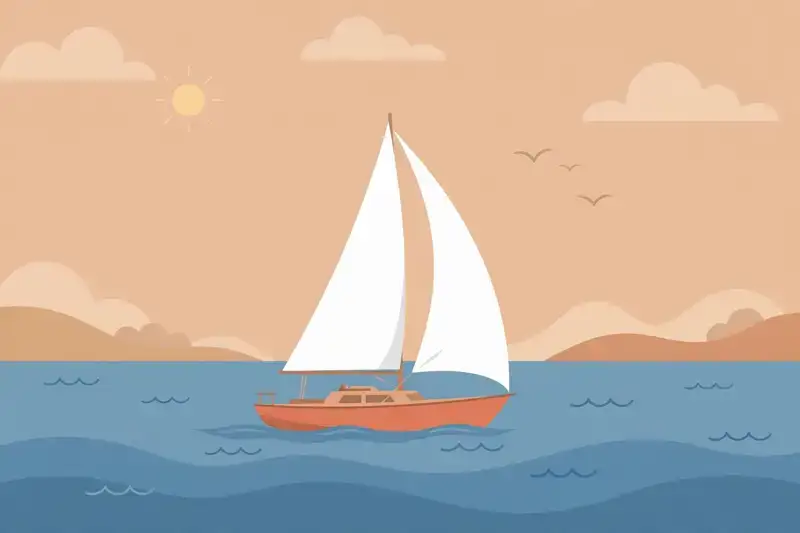
Learn the language and the boat stops being intimidating. The hull is the body. The bow is the front, the stern the back, port is left facing forward, starboard is right. The mast holds up the sails; the boom is the horizontal spar at the foot of the mainsail, the one you must duck under.
The mainsail is the big sail behind the mast; the jib is the smaller sail in front. Sheets are the ropes that control the sails (ropes are called lines on a boat, except sheets and a few others). The tiller or wheel steers the rudder. The keel or centerboard keeps you upright and tracking. Twelve words, and you can follow any sailing instruction ever given.
Lesson 4
Small boats steer with a tiller, a stick connected to the rudder, and it works backwards from every instinct: push the tiller to starboard and the bow swings to port. Everyone fights this for about an hour, then it clicks, and then it feels natural forever. The trick is to make small movements; beginners saw the tiller back and forth, which just slows the boat.
Steering a sailboat is really about steering to the wind as much as to a destination. You watch the telltales, little ribbons on the sails, and the feel of the helm. A balanced helm, light in your hand, means the sails are trimmed right. A heavy, fighting helm means something is wrong with trim, not steering. Steer small, watch the sails, feel the boat.
Lesson 5
To change direction, you turn the bow through the wind (tacking) or the stern through the wind (jibing). Tacking: call "ready about", the crew readies, call "tacking", push the tiller, and duck under as the boom swings across. The boat slows through the turn, then fills on the new tack. It is the safe, everyday turn.
Jibing turns the stern through the wind, and the boom sweeps across with real force as the wind catches the other side. In light air it is gentle; in heavy air it can be violent. Always call "jibe-ho", make sure everyone ducks, and control the mainsheet so the boom does not slam. Beginners should tack whenever possible and jibe deliberately, never accidentally. An accidental jibe is how people get hurt.

Lesson 6
Sailors read the wind constantly. Start with your face and ears: feel it, listen to it. Then look at the water: dark patches are gusts, glassy patches are lulls. Flags, smoke, and other boats' sails all report the wind. A masthead fly or a bit of yarn on the shrouds gives you the apparent wind at a glance.
The telltales on the sails are your trim instruments. When both sides stream straight back, the sail is trimmed perfectly for that angle. If the windward telltale flutters, you are pointing too high or trimmed too tight; ease the sheet or bear off. If the leeward one flutters, head up or trim in. Keep them flying and the boat will reward you with speed.
Lesson 7
Docking is where beginners sweat, but the principles are simple. A boat in forward gear steers; a boat drifting does not. So approach slowly but with enough way on to steer, and plan to stop with the wind or current helping, not fighting. Brief your crew: who handles which line, fenders out on the docking side.
Leaving is the reverse: cast off, push clear, get the sails up once you are in open water. The golden rule of close-quarters boat handling is that slow is safe and neutral is your friend; you can always stop, reassess, and try again. Every experienced sailor has botched a docking. The good ones just do it slowly enough that nobody notices.
Lesson 8
Wear a life jacket. Modern inflatable PFDs are comfortable enough to forget, and the statistics on drowning are unambiguous: most victims were not wearing one. On small boats in particular, where a capsize puts everyone in the water fast, PFDs are simply worn, no debate.
Learn the man-overboard drill before you need it: the instant someone goes in, shout, point, and never take your eyes off them. Throw flotation, then maneuver back under control; the standard quick-stop or figure-eight return gets you back to the person fast. Practice it with a fender. Capsizing a dinghy is also a skill to practice deliberately: stay with the boat, climb over the centerboard, and right it. The boat floats; you just need to know the moves.

Lesson 9
Sailboats have right-of-way rules, and the basics fit on an index card. Starboard tack (wind from the right) has right of way over port tack. Windward boats keep clear of leeward boats on the same tack. Overtaking boats keep clear. And everyone, sail or power, keeps clear of big ships that cannot maneuver.
The deeper rule: the stand-on vessel holds course, the give-way vessel alters early and obviously. But no rule is worth a collision; the obligation to avoid one overrides everything. When in doubt, give way with a smile. The water is big enough for everyone, and the sailor who insists on rights over safety is the one everyone avoids.
Lesson 10
Sailors need a handful of knots, and they need them cold. The bowline makes a fixed loop that will not jam: the king of knots, used for everything from tying to a piling to rescue loops. The cleat hitch secures a line to a dock cleat in a figure-eight pattern. The clove hitch is a quick temporary attachment. The figure-eight is a stopper knot that keeps a line from running through a block.
Learn each one until you can tie it behind your back, because you will tie them in the dark, in the rain, with cold hands. A poorly tied knot on a boat is not an inconvenience; it is a sail coming loose at the worst moment. Practice on a rail at home until the hands know the way.
Lesson 11
Check the marine forecast before every sail, not the regular weather app. You need wind speed and direction, gusts, and any small craft advisories. As a beginner, your limit is about 15 knots; above that, stay ashore and watch the whitecaps from the dock. There is no shame in it; experienced sailors do the same math.
Watch the sky while you sail. Building dark clouds, a sudden temperature drop, or wind shifting and strengthening all signal a front or thunderstorm. Thunderstorms on the water are genuinely dangerous: get sails down and get to shore if one approaches. The sea rewards respect and punishes schedules. The boat will be there tomorrow.
Lesson 12
You do not need to own a boat. The standard path: take an introductory course at a sailing school or community sailing center, usually a weekend on small dinghies. Then join a club, crew on race nights (skippers always need crew), or rent small boats by the hour. Dinghies teach feel fast because every mistake is immediate and obvious.
Graduation
You understand how sails pull, how to steer, tack, and jibe, how to read wind and weather, the rules of the road, and the knots that hold it all together. That is a genuine sailing education. The rest is time on the water, and there is no better classroom.
Keep learning
This course is part of Starvard University, striving for greatness.
A note on accuracy: Much of what you read at Starvard was created with help from AI agents, working alongside people. We check what we can, but we cannot guarantee that everything here is true, current, or complete. If something really matters, your health, your money, a grade, a job, please verify it with a trusted source before you rely on it.