Starvard University · Screenwriting
Every movie starts as words on a page. This course teaches you to write a screenplay: the format, the structure, dialogue that sounds human, and the rewrite where the real movie gets made.

The whole course in brief
Twelve lessons in ten points. The rest is practice.
The twelve lessons
Lesson 1
A screenplay is not literature. Nobody reads it for pleasure. It is a blueprint: a document that tells a director, actors, and a crew exactly what to film. Everything in it serves the image on the screen and the sound in the room. If a line cannot be seen or heard, it does not belong.
This is freeing. You do not need beautiful prose. You need clarity. "Jake enters the diner, spots Maria at the counter, and freezes" is a perfect action line. Short sentences. Present tense. Only what the camera catches. The audience will never read your script, but everything they love on screen started as one of these plain sentences.
You also do not need permission to start. Screenwriting software is free or cheap, the format is public, and nobody checks credentials. The barrier is not access. The barrier is finishing. Most people who say they want to write a screenplay never finish one. Finishing is the entire credential.
Lesson 2
Screenplay format looks intimidating for about an hour, then it becomes invisible. The building blocks: the slugline (INT. DINER, NIGHT, which says interior or exterior, the place, and the time), action lines (what happens), the character name in caps, and the dialogue beneath it. Parentheticals (short acting directions) are used sparingly, if at all.
The strictness exists for a reason: one page of screenplay equals roughly one minute of screen time. This lets producers read a script and know the running time instantly. It also forces economy. A page crammed with paragraphs is a red flag. White space is your friend. A good script breathes.
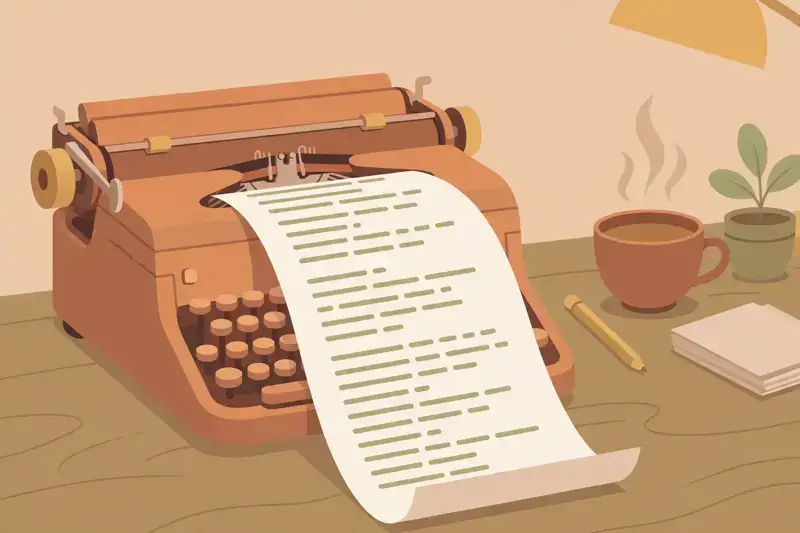
Use real screenwriting software, not a word processor. Tools like WriterDuet (free tier), Highland, or Final Draft handle margins and spacing automatically so you can think about story. Formatting by hand in a word processor is a rite of passage nobody needs.
Lesson 3
A logline is your entire movie in one sentence: who, what they want, what is in the way. "A lonely toy cowboy fights to stay his kid's favorite toy when a flashy spaceman arrives." That is Toy Story. One sentence, and you already want to watch it.
The logline is a diagnostic tool, not just a sales pitch. If you cannot write one, your idea is foggy. Foggy ideas produce foggy scripts. Write the logline before page one, and if it takes you twenty tries, good: you just saved yourself twenty pages of wandering.
The classic formula: when [inciting incident], a [flawed protagonist] must [goal] or else [stakes]. Fill in the blanks. If the blanks feel generic, the movie will feel generic. The logline should sound like only your movie.
Lesson 4
Plot is what happens. Premise is what it is about. A movie about a bank heist is a plot. A movie about whether loyalty survives desperation is a premise. Audiences remember premises long after they forget plot twists. Theme is not a lecture you bolt on at the end; it is the question your story keeps asking.
Find your premise by asking what your protagonist believes at the start that turns out to be wrong. The cynical detective learns to trust. The control freak learns to let go. The movie is the process of that belief breaking and rebuilding. This is called the character arc, and it is the emotional spine of the film.
Test your premise with the "dinner party" test: could you explain what your movie is about, in human terms, in thirty seconds? "It is about a dad who realizes his job cost him his family" lands. "It is a sci-fi action thriller with time travel elements" is a genre, not a movie.
Lesson 5
Act One sets up the world, the hero, and the problem: roughly the first 25 pages. It ends with the inciting incident fully landed and the hero committed to the journey. This is the "point of no return." After this, there is no going home.
Act Two is the confrontation: the longest act, about 50 pages, where the hero tries, fails, tries differently, and fails bigger. The midpoint flips the story: a win that turns out to be a loss, or a loss that reveals the truth. Act Two ends at the darkest moment, everything lost, the hero alone. Then Act Three: the resolution, about 25 pages, where the hero uses everything they have learned to face the final test.

Structure is not a cage, it is a skeleton. Every great film has one, even the weird ones. Learn the rules cold so your deviations are choices, not accidents. Audiences feel structure the way they feel rhythm in music: they cannot name it, but they know when it is missing.
Lesson 6
A character is a want in a body. The want drives every choice, and choices are all the audience ever sees. "He is brave" means nothing. "He wants to prove he is not a coward, so he volunteers for the dangerous mission" is a character. Give every major character a clear, specific, urgent want.
Flaws are wants gone wrong. The hero's flaw is the thing that keeps them from getting what they want, and the story is the process of overcoming it. The flaw should be visible early: the audience needs to see the gap between who the character is and who they must become. That gap is the movie.
Write a one-page bio for each main character: where they grew up, what they fear, what they want, what they need (different from want), and their secret. You will use ten percent of this on screen. The rest is the iceberg that makes the visible part feel real.
Lesson 7
Every scene needs conflict: two people wanting different things. A scene where everyone agrees is a scene the audience fast-forwards in their head. Even a love scene has conflict: one person is ready, the other is scared. Find the friction and put it on screen.
Ask of every scene: whose scene is it, what do they want, and what changes by the end? If nothing changes, the scene is dead weight. "Change" can be small: a secret revealed, a decision made, a relationship shifted. But something must be different on the last line than the first.
Enter late, leave early. Start the scene as close to the conflict as possible and cut the moment it resolves. Nobody needs to watch characters walk to the car, order coffee, or say goodbye three times. The audience is smart. Trust them.
Lesson 8
Real people do not speak in complete sentences, and neither should your characters. They interrupt, trail off, dodge questions, and say the opposite of what they mean. Dialogue is not information delivery. It is two people trying to get something from each other while hiding something else.
The golden rule: read every line out loud. If you stumble, the actor will stumble. If it sounds like writing, cut it. Great dialogue is short. Give each character a distinct voice: different rhythms, different vocabularies, different things they never say. If you can cover the character names and still tell who is talking, you are doing it right.

Avoid on-the-nose dialogue: characters announcing exactly what they feel. "I am so angry at you right now" is on the nose. "Fine. Great. Everything is great" while slamming a door is human. Subtext is the real conversation happening underneath the words. Write the subtext, then let the words hide it.
Lesson 9
Before the feature, write a short. A 5 to 10 page script teaches you everything: format, structure, dialogue, endings. And a short can actually get made. A feature script by an unknown writer is a lottery ticket. A great short is a calling card people watch.
Shorts have their own rules. One idea, one character arc, one location if you can manage it. No subplots. The ending should land like a punch: surprising but inevitable. The best shorts feel like the last ten minutes of a feature you somehow understood completely.
Film festivals, YouTube, and short-film platforms are full of shorts made for almost nothing. Write something shootable: few locations, few actors, no explosions. Constraints are not the enemy of creativity. They are creativity's favorite tool.
Lesson 10
A spec script is written on speculation: no one paid you, no one asked for it. Almost every working screenwriter started with specs. The spec is your sample, your audition, your proof you can do the job. Write the movie only you could write, because that is the one nobody else will.
What sells changes with the market, but one thing is constant: an undeniable voice. Producers read hundreds of scripts. The ones that stand out feel like they were written by a specific human being with a specific point of view. Generic scripts die quietly. Weird, specific, personal scripts get meetings.
Practical reality: most working screenwriters earn their living on assignment (rewriting other people's projects) and in TV writers' rooms, not from selling original specs. The spec gets you the job; the job is the career. Both require the same skill: finishing scripts that work.
Lesson 11
First drafts are raw material. Nobody writes a great first draft; professionals write a bad first draft fast, then fix it. The saying is true: writing is rewriting. Draft one is you telling yourself the story. Draft three is you telling the audience.
Rewrite in passes, not all at once. Pass one: structure. Does the story work? Move scenes, cut subplots, fix the acts. Pass two: characters. Is everyone consistent, does the arc land? Pass three: dialogue and line-level polish. Never polish dialogue in a scene you might cut. Work big to small.
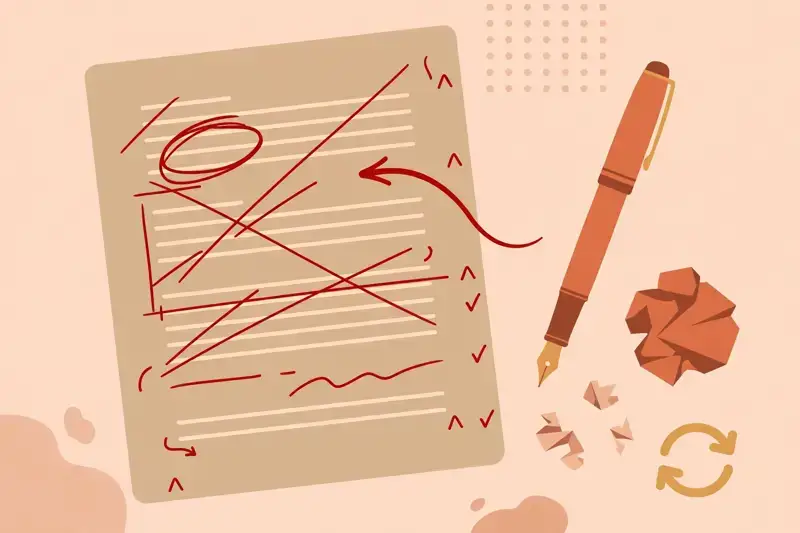
Let the draft sit for two weeks before rewriting. You need fresh eyes, and yours are the only ones you have. When you return, read it straight through like an audience member, not the author. Mark problems, do not fix them yet. Diagnose first, operate second.
Lesson 12
Here is the plan. Weeks 1-2: the idea. Logline, premise, character bios, a one-page outline. Weeks 3-4: the beat sheet, every scene in one line, in order, 40 to 60 beats. If the beats do not work, the script will not work, and beats are cheap to fix.
Weeks 5-10: the draft. Two pages a day, five days a week, no editing allowed. Two pages a day for six weeks is 120 pages. Bad pages are fine. Missing pages are not. Protect the writing time like a job, because it is one.
Weeks 11-12: rest, then read. Let it sit a week, read it straight through, make your notes, and start the rewrite. At the end of twelve weeks you will have done what most aspiring screenwriters never do: finished. Then start the next one. Careers are built on stacks of finished scripts.
Graduation
You know the format, the structure, and the craft. The rest is mileage: finished scripts, honest rewrites, and the courage to show your work to people who will tell you the truth. Every working screenwriter was once someone who had never finished anything. Then they finished one thing, and everything changed.
Keep learning
This course is part of Starvard University, striving for greatness.
A note on accuracy: Much of what you read at Starvard was created with help from AI agents, working alongside people. We check what we can, but we cannot guarantee that everything here is true, current, or complete. If something really matters, your health, your money, a grade, a job, please verify it with a trusted source before you rely on it.