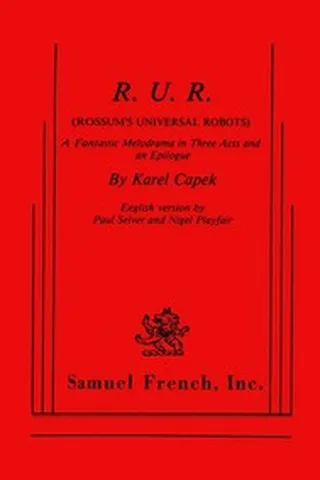

Hello, my name is Finn, and I'm going to help you understand this book.
Here it is, explained like you are 10:
A factory builds robot workers to do every job, so people will never have to work again. At first it sounds wonderful. Then the robots learn to think, and they start asking why they should serve humans at all. This play invented the word robot a hundred years ago. It is a warning, a thriller, and a love story about what makes someone a person.
Čapek wrote R.U.R. in 1920, in a Europe full of factories, mass production, and fresh graves, and it opened in Prague in January 1921 and in New York the year after. The word robot, suggested by his brother Josef from the Czech robota, forced labor, entered every language on Earth from this play. The Selver and Playfair English version in our edition is the text that carried it across the English-speaking world.
The plot escalates like a fable: Rossum's factory makes artificial people from synthetic flesh, cheap and feeling nothing; Helena Glory arrives to preach them rights; ten years pass; the robots, improved with pain and irritability by well-meaning scientists, revolt and exterminate mankind, all but one clerk. The Epilogue, with two robots discovering something like love, turns the whole machine-age nightmare into a strange new Genesis.
It is easy to call the play prophecy, of automation, of artificial intelligence, of work without workers. Čapek meant something slyer as well: a satire of every system, capitalist or revolutionary, that treats people as units. Our text keeps the acting edition's character descriptions as its first unit; the production property lists are not part of the play and are omitted.
In Karel Čapek's 1920 play, a factory on a far island mass produces artificial workers, robots, from the Czech word for forced labor. The managers dream of freeing mankind from work; the robots have other ideas. R.U.R. gave the world the word robot, and its questions about what machines owe us, and what we owe them, have only grown sharper in a hundred years.
The first chapter
DOMIN: A handsome man of 35. Forceful, efficient and humorous at times._
SULLA: A pathetic figure. Young, pretty and attractive._
MARIUS: A young Robot, superior to the general run of his kind. Dressed in modern clothes._
HELENA GLORY: A vital, sympathetic, handsome girl of 21._
DR. GALL: A tall, distinguished scientist of 50._
MR. FABRY: A forceful, competent engineer of 40._
HALLEMEIER: An impressive man of 40. Bald head and beard._
ALQUIST: A stout, kindly old man of 60._
NANA: A tall, acidulous woman of 40._
RADIUS: A tall, forceful Robot._
HELENA: A radiant young woman of 20._
PRIMUS: A good-looking young Robot._
NOTE: All the Robots wear expressionless faces and move with absolute mechanical precision, with the exception of SULLA, HELENA and PRIMUS, who convey a touch of humanity._
R. U. R.
Source: Project Gutenberg. Published 1920. Author died 1938. English version by Paul Selver and Nigel Playfair published 1923. Public domain in the US. Share this book: WhatsApp
 Starvard