 Starvard.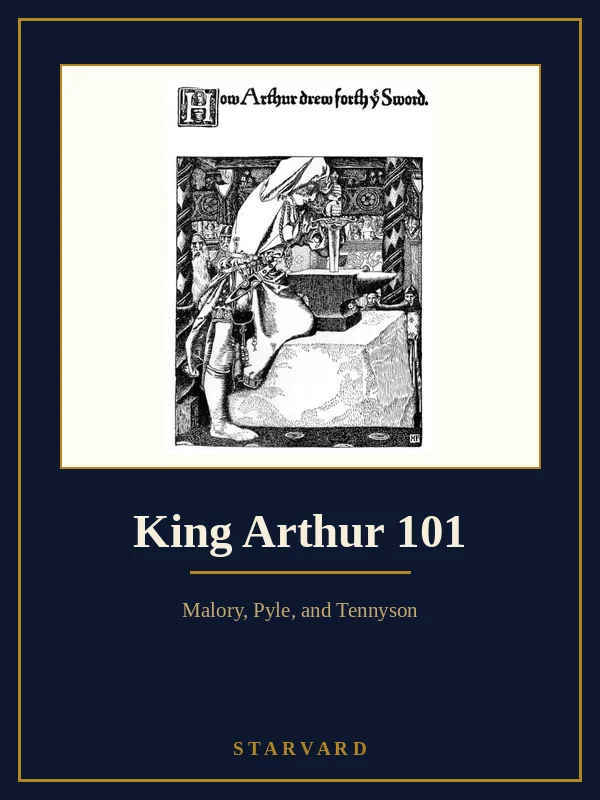
Starvard University · King Arthur
Meet the king, the sword, and the fellowship of the Round Table in the three tellings that made Camelot immortal: Malory, Pyle, and Tennyson.


Hello, my name is Finn, and I'm going to help you understand this course.
Here it is, explained like you are 10:
Long ago in Britain there may have been a brave king named Arthur, and storytellers loved him so much that they kept adding adventures for hundreds of years. In this course you meet Arthur as a boy who pulls a sword nobody else can move, watch him gather the best knights in the world around a round table with no head seat, and follow those knights on quests, including the search for the Holy Grail. You also see how love, pride, and broken promises slowly undo the whole kingdom, and why people still retell the story today.
Think of Camelot as a team with a strict code. The king's job is to be fair, the knights promise to protect people, give mercy when an enemy asks for it, and never fight for a wrong cause. When the team keeps the code, the kingdom shines. When famous knights break it, even in secret, the cracks spread until the team falls apart. That is why these old stories still feel alive: they are about whether good people can stay good when nobody is watching.
You will read the story in three voices. Thomas Malory wrote the grand old version in the 1400s, full of battles and marvels. Alfred Tennyson turned it into soaring poems in the 1800s, sad and beautiful. Howard Pyle retold it in 1903 with clear, noble language and drew the pictures himself. Same king, three storytellers, three different mirrors. By the end you will be able to tell which mirror you are looking into, and why each age needed its own Arthur. Watch for the small tests along the way, the offered mercy, the kept promise, the seat at the table, because in Camelot the little choices decide everything long before the big battles do.
The whole course in brief
What you will be able to do after this course
The eight lessons
Lesson 1
Start with an honest puzzle: none of our three authors lived anywhere near Arthur's time. If a British war leader named Arthur resisted invaders after Rome left Britain, he belongs to the fifth or sixth century. Thomas Malory finished Le Morte d'Arthur in the 1400s, and Caxton printed it in 1485, roughly a thousand years later. Tennyson published his Idylls in the Victorian age, and Howard Pyle retold the story in 1903. Every book in this course is a retelling of retellings.
That does not make the story worthless. It makes it a legend, a story a whole culture keeps because it carries what that culture admires. Pyle is frank about his own faith in the hero, writing in his foreword: "I believe that King Arthur was the most honorable, gentle Knight who ever lived in all the world." Malory treats Arthur as a real king of Britain and piles up battles, marriages, and marvels without ever asking whether a modern historian could prove them.
So read with two eyes at once. With one eye, enjoy knights, enchantment, and a kingdom worth loving. With the other, notice what each age added, because the additions tell you what that age longed for.
Lesson 2
Malory opens with trouble. King Uther Pendragon dies, the realm has no clear heir, and Britain slides toward war among its lords. Then a wonder appears in the churchyard at London: a stone with an anvil on it and a sword fixed in the anvil, with letters saying that whoever pulls out the sword is the rightful king. Baron after baron tries and fails.
Young Arthur does not even know he is a candidate. Raised in Sir Ector's household, he serves as squire to his foster brother Kay. When Kay's sword is missing at a tournament, Arthur goes to fetch one, sees the sword in the anvil, and pulls it out as easily as picking up a tool, simply because nobody was guarding it and his brother needed a blade. He has to repeat the feat before witnesses, and when the truth of his birth comes out, the commons insist on the boy the sword chose. Pyle tells the same scene in the first part of his book, the Winning of Kinghood, and his own drawing of Arthur at the anvil is on our cover.
Keep the two famous swords separate. The sword in the stone proves Arthur's right to rule. Excalibur, his great war sword, comes later, given by the Lady of the Lake after Merlin's counsel in Book I of Malory.
Lesson 3
In Book III of Malory's first volume, Arthur marries Guenever, daughter of King Leodegrance. Her father's wedding gift is the Round Table itself, which had come to Leodegrance from Uther, together with a company of knights. Merlin helps choose the rest, the seats are filled, and the fellowship is complete. The shape is the point: a round table has no head, so the greatest knight and the newest sit as fellows in one order, even though Arthur remains their king.
A table alone does not make chivalry, so Malory gives the fellowship a sworn code. After the wedding quest, Arthur charges his knights never to commit murder or outrage, always to flee treason, and never to be cruel. They must give mercy to anyone who asks for it, help ladies and gentlewomen on pain of death, and take no battle in a wrongful quarrel. Every knight, old and young, swears to this, and the oath is renewed every year at the high feast of Pentecost.
Read that oath slowly, because the whole tragedy is hidden inside it. Camelot stands while its knights keep these promises in private as well as in public. It falls as one promise after another is broken by the very people who swore it.
Lesson 4
Be careful here, because our sources tell this famous love in different measures. In Malory's first volume, Lancelot arrives as the rising star of the court, the knight other knights measure themselves against, and Guenever is the queen at the centre of Camelot's courtesy. The volume praises both of them separately. The consuming love between them, and its exposure, belongs to the later part of Malory's full story, beyond Volume 1, so this course does not pretend otherwise.
Tennyson takes up what Malory's first volume leaves in the future. In Lancelot and Elaine, the pure Elaine loves Lancelot and dies of that love, while Lancelot's heart stays bound to the queen. His divided loyalty is the crack in the fellowship: the best knight of the Round Table loves the king's wife, and Arthur's court begins to run on a secret everyone half knows.
In the Idyll called Guinevere, suspicion hardens into scandal, the queen flees to a convent at Almesbury, and Arthur comes to her not with a sword but with a rebuke full of grief, forgiving her before he rides to his last war. Tennyson's tragedy is not that two people fell in love. It is that a private sin, hidden for years, rotted public trust until the whole fellowship could be pulled down by it.
Lesson 5
Gawain, Arthur's nephew, gets the first great test of the new Round Table, and he fails it in a way every student should study. At Arthur's wedding feast a white hart bursts into the hall, and Gawain is sent on the quest to recover it. Chasing the hart into a castle, he fights its owner, beats him, and then refuses the mercy the beaten knight begs for. As Gawain lifts his sword to strike off the man's head, the knight's lady throws herself over her lord, and Gawain's blow kills her instead.
His brother Gaheris names the shame on the spot: a knight who will not give mercy to one who asks it is a knight without worship, meaning without honour. Back at court the queen makes the lesson permanent, and the oath Arthur lays on all his knights, to give mercy and to protect women, grows directly out of Gawain's disgrace. Pyle retells the same hart quest in the Story of Sir Gawaine, and ends it by showing Gawain's nobility recovered through hard lessons.
Tennyson adds a matching trial in Gareth and Lynette, where Arthur's youngest nephew serves a year in the kitchen, then rides out and stays courteous while the lady he rescues mocks him the whole way. Courtesy, in Camelot, is not good manners at dinner. It is strength that stays gentle under insult, defeat, and victory alike.
Lesson 6
Here is this course's most important piece of honesty: the Grail quest in full is not in Malory's Volume 1, which ends long before it, and Pyle's 1903 book stops earlier still. In this course the Grail comes to you from Tennyson, whose idyll The Holy Grail retells the quest as an old man's memory. Sir Percivale, now a monk, describes how a vision of the Grail appeared at Camelot and how the knights swore themselves to the search.
Arthur alone sees the danger. He grieves at the vows, because he knows his fellowship will scatter across the world, that many will never return, and that the work of ruling and protecting the realm will be left undone. The quest is glorious and disastrous at once. Sir Galahad, the purest knight, achieves the Grail and is taken up in glory. Percivale glimpses it from afar and ends his days in a monastery. Most of the rest wander, fail, or die, and the Round Table never recovers its numbers or its unity.
Tennyson's point cuts deep: a spiritual adventure can still damage a community when everyone abandons their post to chase it. The Grail is real and holy in the poem, and the kingdom is still poorer for the quest. Hold both truths together and you are reading like Tennyson wanted.
Lesson 7
Tennyson builds the end of Camelot in three movements, and this lesson follows his Idylls, since the fall lies beyond the end of Malory's first volume. First, in The Last Tournament, the court is already coarsening: the queen's favour is fought over at a jaded tournament, old courtesies are mocked, and Sir Tristram's cynicism shows a fellowship that no longer believes its own oath. The Round Table still stands, but its spirit is leaking away.
Second, in Guinevere, the long hidden love of Lancelot and the queen becomes open scandal, watched and spread by Modred, Arthur's own son and nephew in the old story, who hungers for the throne. War follows between Arthur and Lancelot, and while the king is weakened and distracted, Modred seizes power in Britain.
Third, in The Passing of Arthur, king and traitor meet in a last battle by the sea, in mist, where friend can barely be told from foe. Arthur kills Modred and receives his own death wound. Sir Bedivere, the last knight left, twice fails to throw Excalibur back into the lake because the jewelled hilt tempts him, then obeys at last and watches an arm rise from the water to receive it. Queens in a black barge carry Arthur away toward Avilion, and Bedivere is left alone in a changed world.
Lesson 8
Finish by laying our three books side by side. Malory, writing near the end of a century of civil war in England, gathered the French and British romances into one vast prose story of a united kingdom held together by an oath. His Arthur is a war leader and law giver, and his book reads like a chronicle of a better order that England had lost. It is no accident that a divided age treasured a story about fellowship.
Tennyson, poet laureate to Queen Victoria, turned the same material into twelve linked poems about faith, doubt, purity, and decay. His Camelot shines with Christian hope and rots with modern suspicion at the same time, which is exactly the tension his Victorian readers felt in their own booming, anxious Britain. Pyle, an American illustrator writing in 1903, simplified the language, sharpened the moral lessons, and drew hundreds of pictures, making Arthur a hero children could imitate.
That is the pattern to carry away. Each age keeps the sword, the table, and the fall, then quietly changes what they mean. When a new Arthur film, novel, or game appears, ask the question this course has trained you to ask: what does this age long for, that it needs Arthur to carry?
Sources
This course is taught from classic texts that are free for anyone to read. Every method in the lessons traces back to one of these books.
Graduation
You started with a boy and a sword and finished with the last knight alone on a shore, and you can now say which parts Malory tells, which parts Tennyson sings, and which parts Pyle drew for young readers. Keep the oath in mind, mercy, honesty, and protection of the weak, and you hold the key that unlocks every Arthur story still to come. Congratulations, knight of the reading table.
Keep learning
This course is part of Starvard University, striving for greatness.
A note on accuracy: Much of what you read at Starvard was created with help from AI agents, working alongside people. We check what we can, but we cannot guarantee that everything here is true, current, or complete. If something really matters, your health, your money, a grade, a job, please verify it with a trusted source before you rely on it.