 Starvard.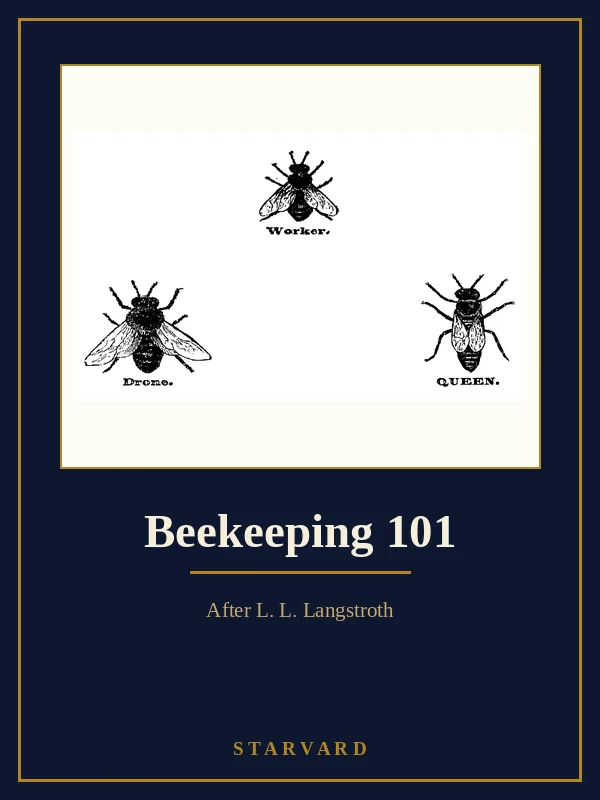
Starvard University · Beekeeping
Start with one hive and learn how a colony really works, from Langstroth's movable frames to your first jar of honey.


Hello, my name is Finn, and I'm going to help you understand this course.
Here it is, explained like you are 10:
A beehive is one big family with one mother, thousands of hardworking sisters, and a few lazy brothers who do almost no chores. In this course you learn how that family lives, what each bee does, and how a beekeeper helps without getting in the way. You will learn the clever hive with frames you can lift out, how to visit bees calmly, how to stop them moving house, and how to take a little honey while leaving plenty for them. By the end, a buzzing box will feel like a neighborhood you understand.
Most beginners think beekeeping is mostly about honey. It is really about reading a colony. A good beekeeper can lift one frame and tell whether the queen is laying well, whether the bees have enough food, and whether they are planning to swarm. This course teaches that reading skill step by step, starting with the three kinds of bee and the one measurement, bee space, that made the modern hive possible.
You will also learn the calm, slow way to handle bees, because bees forgive a careful beginner and punish a hurried one. We follow a colony through a full year: installing new bees in spring, inspecting through summer, harvesting in late summer, and tucking the hive in for winter. Keep a simple hive diary as you go, because memory lies and notes do not. The lessons lean on Langstroth, who invented the hive almost everyone still uses, and on Maeterlinck, who watched bees closely and wrote about their lives like a poet.
The whole course in brief
What you will be able to do after this course
The eight lessons
Lesson 1
A honeybee colony is one family, and it only works as a crowd. Langstroth opens his book with the point that a single bee alone is almost helpless, unable even to survive a cool summer night. Together, tens of thousands of bees keep the hive warm, fed, and defended.
Three kinds of bee share the hive. The queen, whom Langstroth calls the mother bee, is the only fully developed female and lays every egg in the colony. She is longer and more tapered than the others, with shorter wings, and attendants constantly surround her, feeding her and clearing her path. The workers, some thousands strong, are females whose egg laying never develops. They do everything else: nursing young bees, building wax comb, guarding the entrance, and gathering nectar and pollen. The drones, a few hundred in season, are the males. They have big eyes, no sting, and one job, mating. When food runs short in autumn, the workers push them out.
Maeterlinck calls the shared instinct that coordinates all this work the spirit of the hive. Learn the three castes first, and every inspection later in this course becomes a story you can read.
Lesson 2
In 1851 the Reverend L. L. Langstroth noticed something small that changed beekeeping forever. Bees treat gaps in their home by size. A gap smaller than about a quarter of an inch they fill with propolis, their sticky tree resin glue. A gap larger than about three eighths of an inch they fill with new wax comb. But a gap in between, roughly a quarter to three eighths of an inch, they leave open as a hallway. That hallway is bee space.
Langstroth built a hive that respects bee space everywhere. Each comb hangs inside its own wooden frame, and every frame sits exactly one bee space from its neighbors, from the walls, and from the frames above. Because nothing is glued or built across those gaps, the beekeeper can lift any single comb out, inspect it, and slide it back without cutting comb or crushing bees.
Before this, harvesting honey usually meant destroying the colony. With movable frames, you can check the queen, find disease early, swap frames between hives, and take honey while the bees keep their home. Nearly every hive sold today is still Langstroth's design.
Lesson 3
Good gear is simple: a veil to protect your face, a smoker, a hive tool, and light colored, smooth clothing that bees find less alarming than dark, woolly cloth. Gloves help beginners, though many beekeepers drop them later for better feel. The smoker is the important one. A few puffs of cool smoke from pine needles, burlap, or wood chips mask the alarm scent bees release and send them to sip honey, which makes them slower and more docile.
Handle bees the way bees like it: slow, smooth, and quiet. Work from the side or back of the hive, never blocking the entrance where foragers are flying in and out. Pry frames gently with the hive tool, lift them straight up, and avoid jarring or banging the box, since a sharp knock reads as an attack.
Stings happen anyway. A worker who stings leaves her barbed stinger in your skin, still pumping venom, so scrape it off sideways with a fingernail or the hive tool at once. Do not pinch and squeeze it, which pushes more venom in. Then puff a little smoke over the spot to cover the alarm scent, and carry on calmly.
Lesson 4
A package is a screened box holding roughly three pounds of loose bees and one mated queen in her own small cage. It is the most common way beginners start. Set up your hive first, in its permanent sunny spot, with a few frames removed from the middle to make room.
Now feed. New bees have no comb, no stores, and a huge building job, so give them sugar syrup mixed one part sugar to one part water, and keep it coming until they stop taking it. Wait about a week before opening up. Then check that the queen has been released from her cage and, better still, look for tiny white eggs standing in the bottoms of cells.
Lesson 5
An inspection is a quick, kind checkup, usually ten to fifteen minutes on a warm, calm day when foragers are out. Smoke lightly, remove the covers, then lift the outermost frame first to make working room. Move inward frame by frame, always looking at the frame you are about to move so you do not roll the queen between two combs.
Read each frame like a page. A good brood frame shows a solid pattern of capped brood with honey in the top corners and a bright arc of pollen beside the brood. Eggs look like tiny grains of rice, one per cell, and seeing eggs proves the queen was there within the last three days, even if you never spot her. Chalky gaps or a spotty pattern deserve a closer look and a note in your diary.
The seasons change the questions. In spring, ask whether the colony is building up and has food until flowers open. In summer, ask whether it needs another honey box before it feels crowded. In autumn, ask whether it is heavy with stores, queenright, and ready for cold. In winter, mostly leave it alone and check by lifting the back of the hive to feel its weight.
Lesson 6
Swarming is not a colony misbehaving. It is a colony reproducing. When a hive thrives in late spring, roughly June in Langstroth's New England, the bees raise new queens in large, peanut shaped queen cells hanging from the comb edges. Just before a new queen emerges, the old queen leaves with about half the bees, and the cloud pours out, circles, and clusters on a nearby branch while scouts argue over new homes.
The causes are a success story: a young, vigorous queen, combs crowded with brood, honey coming in fast, and no empty space to expand into. Warning signs include queen cells with larvae floating in milky food, brood frames backfilled with nectar so the queen has nowhere to lay, and bees idling in a beard on the front of the hive on warm evenings.
You cannot talk bees out of swarming, but you can stay ahead of it. Inspect weekly in swarm season, add honey boxes early, keep giving the queen open comb to lay in, and if queen cells are already charged, split the colony yourself: move the old queen and several frames into a new box. A planned split keeps both halves, and your bees, at home.
Lesson 7
Honey is ready when the bees say so. A frame is ripe when most of its cells are sealed under dry, pale wax caps. Uncapped nectar still holds too much water and can ferment in the jar, so leave frames that are mostly open for the bees to finish. A honey box that feels surprisingly heavy and shows capped frames is your harvest.
Getting bees off the frames is the fiddly part. The gentle method is a bee escape board placed under the honey box a day ahead, which lets bees leave downward and stops them returning. Otherwise, lift frames one at a time, shake the bees off with a firm downward snap over the hive, and brush the last few off softly.
Inside, slice the cappings off with a warm knife, spin the frames in an extractor, and strain the honey into a bucket to settle before jarring. The gift of the extractor is that the empty combs survive, and drawn comb is treasure: bees refill it far faster than they can build new. Do not waste the cappings. Wash them, dry them, and melt them gently, never over direct flame, into clean beeswax for candles and balms.
Lesson 8
Winter bees live for months, not weeks, and their job is to keep the cluster warm by shivering their flight muscles and slowly eating their way upward through the honey stores. Your job is done in autumn: a heavy hive, a reduced entrance fitted with a mouse guard, a windbreak, and a slight forward tilt so condensation runs out instead of dripping on the cluster. Cold rarely kills bees. Damp, starvation, and disease do.
Pests need watching all year. The varroa mite, a reddish brown parasite that feeds on developing bees and spreads viruses, is the biggest killer of colonies today. Monitor it by counting mites washed from a sample of bees, and treat on the advice of your local association when counts rise. Langstroth's great enemy was the wax moth, whose worms tunnel through weak colonies' combs; strong colonies police them out, and storing drawn comb cold and dry protects it.
Health, in the end, is mostly strength. A well fed colony with a young queen, dry housing, low mite counts, and room to work will shrug off problems that finish a struggling one. Inspect, record, and act early.
Sources
This course is taught from classic texts that are free for anyone to read. Every method in the lessons traces back to one of these books.
Graduation
You started with a buzzing box and finished knowing who lives inside it, how to visit without fear, and how to carry a colony through a full year. Keep your inspections regular, your notes honest, and your movements slow, and your bees will teach you the rest, one frame at a time. Congratulations, and welcome to the apiary.
Keep learning
This course is part of Starvard University, striving for greatness.
A note on accuracy: Much of what you read at Starvard was created with help from AI agents, working alongside people. We check what we can, but we cannot guarantee that everything here is true, current, or complete. If something really matters, your health, your money, a grade, a job, please verify it with a trusted source before you rely on it.