 Starvard.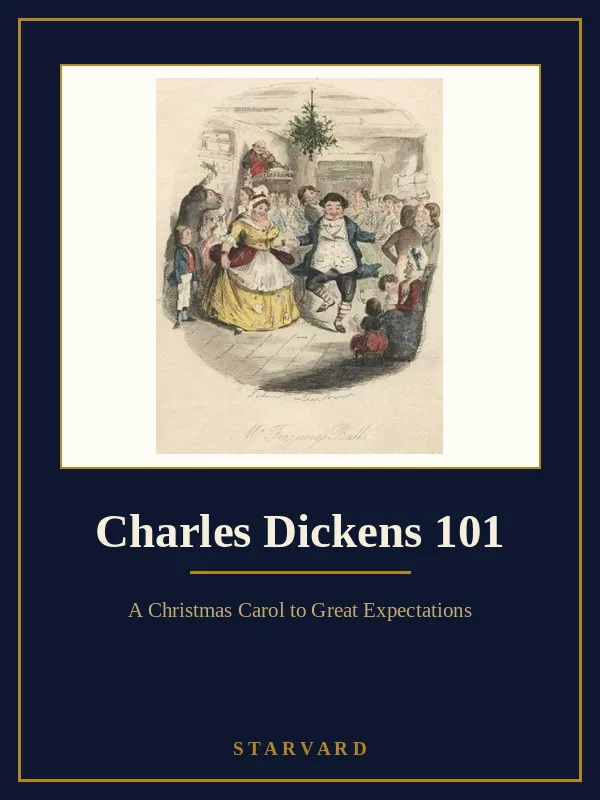
Starvard University · Charles Dickens
Ghosts, guillotines, and a boy who expected more from life. Learn how Dickens turned a hard childhood into the most loved stories in English, and how to read him like a friend instead of a school assignment.


Hello, my name is Finn, and I'm going to help you understand this course.
Here it is, explained like you are 10:
Charles Dickens wrote big, exciting stories full of ghosts, villains, kind strangers, and children who have to be brave. When he was a boy, his family ran out of money, and he had to work in a dirty factory while other children went to school. He never forgot how that felt, so his books stand up for poor and lonely people. In this course you will meet a grumpy old man who learns to be kind, a prisoner freed after eighteen years, and a boy named Pip who learns what really makes someone great.
Dickens published his stories a piece at a time, in magazines, a chapter or two each week or month. Whole families read each new part out loud together, guessed what would happen next, and argued about the characters as if they were neighbors. That is why his books feel so alive and why so many chapters end with a surprise. He was writing for everyone, not just for scholars, and he wanted every installment to make you laugh, worry, or cry.
Under the fun runs a serious engine. Dickens had seen, as a twelve year old factory boy, how easily a child could be thrown away by the world, and he spent his career making readers look at the people they preferred to ignore: clerks, orphans, prisoners, and the very poor. His Christmas ghost story is really about a rich man learning to see his own clerk's family. His novel about France is about what cruelty does to a whole country. Read him for the stories first. The lessons sneak in with the tears. Keep a notebook just for the names you meet along the way, because half of Dickens's jokes, and most of his judgments, are hiding inside them.
The whole course in brief
What you will be able to do after this course
The seven lessons
Lesson 1
In 1824, when Charles Dickens was twelve, his father was arrested for debt and sent to the Marshalsea prison in London. The family moved into the prison with him, all except Charles. The boy was sent to work at Warren's blacking factory by the Thames, pasting labels on pots of shoe polish for long hours, among rats and rotting floors, while his school friends went on with their lessons. He visited his family on Sundays, and the shame and loneliness of those months burned themselves into his memory.
The job lasted only months, and his father eventually inherited enough money to free the family and send Charles back to school. But Dickens hid the episode for most of his life, telling almost no one, not even his wife. It became the secret engine of his fiction. Again and again his novels return to abandoned children, debtors' prisons, and adults who fail the young: Pip's shame and hunger for a better life, the suffering children shown to Scrooge, the prisoner buried for eighteen years in A Tale of Two Cities.
He worked ferociously to escape that factory boy: shorthand reporter in Parliament, then journalist, then, at twenty four, a bestselling author. The energy never left the writing. Dickens does not describe poverty from a carriage window. He describes it from the memory of a hungry child who was sure the world had thrown him away, and his readers have felt the difference ever since.
Lesson 2
The most famous Christmas story ever written begins by insisting on a death: Marley was as dead as a door-nail. Only once we accept that can the wonder start. Ebenezer Scrooge, Marley's surviving partner, is a squeezing, wrenching, grasping, scraping, clutching old miser who answers his nephew's cheerful greeting with two words: Bah, humbug. He keeps his clerk Bob Cratchit shivering over a tiny fire, refuses charity collectors, and goes home alone to dark, cheap rooms.
That night Marley's ghost arrives dragging chains he forged in life, link by link, and warns that Scrooge will be haunted by three spirits. The Ghost of Christmas Past shows him a lonely schoolboy, then the joyful ball of his old master Fezziwig, then the fiancee who released him because money had become his idol. The Ghost of Christmas Present shows him the Cratchits' small, brave Christmas, and two starved children hiding under the spirit's robe: Ignorance and Want. The last spirit shows him a dead man nobody mourns, and a gravestone with his own name.
Scrooge wakes on Christmas morning a man remade, sends a huge turkey to the Cratchits, raises Bob's salary, and becomes, the book tells us, as good a friend and master as the city knew. Tiny Tim's blessing stands as the verdict on the whole experiment: God bless us every one. Dickens called it a ghost story, but its real subject is the machinery of conversion, one memory, one witness, one warning at a time.
Lesson 3
Dickens did not mostly publish books. He published installments. His novels appeared in monthly parts or in weekly magazines, a few chapters at a time, and readers lived inside a story for a year or more. A Tale of Two Cities ran week by week in his own magazine in 1859, and Great Expectations followed the same weekly rhythm soon after. A novel was not an object you finished. It was a companion you waited for.
That schedule shaped his craft. Every installment had to deliver a complete pleasure, a laugh, a scare, a revelation, and then stop at the exact moment that made waiting painful. A stranger appears on the marshes and seizes a small boy. A hand reaches out of the dark in a Paris prison story. Pip, expecting his fortune to come from Miss Havisham, is told his benefactor is someone else entirely. These are chapter endings engineered like promises: come back next week and find out.
Serial writing also meant Dickens worked in public, listening to his audience. Sales and letters told him which characters readers loved, and his readings aloud, performed like theater, tuned his ear for the scene that lands. When you read Dickens today, read him the way his first readers did: a few chapters, then a pause to argue about what happens next. The cliffhangers are not decoration. They are the heartbeat of the form.
Lesson 4
It opens with the most famous balancing act in fiction: it was the best of times, it was the worst of times. London and Paris, 1775 and after, are held up as mirrors, and Dickens's point is that the two cities, and the two eras, resemble each other more than either would like. At the center stands Dr. Manette, a French physician imprisoned in the Bastille for eighteen years for what he witnessed, now recalled to life in London, where he sits making shoes to keep madness at bay.
His daughter Lucie rebuilds him with patience, and two men love her: Charles Darnay, a French aristocrat who has renounced his family's cruelty, and Sydney Carton, a brilliant, wasted English lawyer who is Darnay's physical double and spiritual opposite. In France the revolution Manette suffered under now devours the innocent with the guilty. Madame Defarge knits the names of the condemned into her register, patient as fate, and Darnay, returning to help a servant, is arrested by the new regime his family helped create.
Carton's ending pays off every contrast the novel has built. The double takes his original's place at the guillotine, buying Lucie her husband and himself a meaning he never found in life. His imagined last words are the book's signature: it is a far, far better thing that I do, than I have ever done. Dickens asks what a wasted life is worth, and answers: everything, if it is finally spent on someone else.
Lesson 5
The narrator introduces himself with a child's logic: his father's name was Pirrip, his own name Philip, and his infant tongue could make of both nothing longer than Pip, so, I called myself Pip, and came to be called Pip. Pip is an orphan on the Kent marshes, raised by his sharp tongued sister and her husband Joe, the gentle blacksmith. In the churchyard an escaped convict, Magwitch, terrifies him into stealing food and a file, and Pip carries the guilt like a stone.
Then comes Satis House, where the wealthy Miss Havisham sits in a decayed wedding dress among stopped clocks and a rotting wedding cake, jilted years ago and frozen at the moment of betrayal. She raises Estella as a weapon, training her to break men's hearts, and instructs her to practice on Pip. Her command follows him for years: love her, love her, love her. When a lawyer announces that Pip has great expectations from a secret benefactor, Pip assumes it is Miss Havisham, leaves Joe with shameful relief, and goes to London to become a gentleman.
The revelation, when it comes, inverts everything: the fortune is Magwitch's, earned in Australia and given in gratitude to the boy who fed him. Pip's gentility was built by a convict, while the respectable Miss Havisham only used him. His real education begins there: Joe, whom he was ashamed of, is the finest man in the book, and a gentleman is made by loyalty, not accent or money.
Lesson 6
Nobody forgets a Dickens character, and that is engineering, not luck. Start with the names, which arrive already judging their owners. Scrooge sounds like a scrape and a squeeze. Miss Havisham seems to whisper have a sham. Madame Defarge carries defiance in her syllables. Even the kindly Joe Gargery has a name like a hearth. Dickens wants you oriented before a character has finished their first sentence.
Next comes the signature detail, repeated until it becomes the person. Miss Havisham's stopped clocks and yellowed dress. The lawyer Jaggers, forever washing his hands with scented soap, as if his clients' guilt could be scrubbed off. Wemmick, Jaggers's clerk, is two men in one: dry as a post office at work, and tenderly devoted to his deaf old father in a little castle with a drawbridge at home. Dickens returns to these details the way a composer returns to a theme, and each return adds a layer rather than just repeating the note.
Finally, notice how often his characters come in pairs that argue with each other. Scrooge against his laughing nephew Fred. Pip's ambition against Joe's contentment. Carton's despair against Darnay's hope. The pairs let Dickens stage his big questions as people instead of essays, which is why readers argue about his characters as if they were real. Two centuries of actors, illustrators, and imitators agree: they are.
Sources
This course is taught from classic texts that are free for anyone to read. Every method in the lessons traces back to one of these books.
Graduation
You started with a factory boy and finished with three of the most loved books in the language: a ghost story that reforms a miser, a revolution that redeems a wasted life, and a fortune that teaches a snob humility. Read him in installments, a few chapters at a time, and let the cliffhangers work on you the way they worked on his first readers. Congratulations, and mind the ghosts: they mean well.
Keep learning
This course is part of Starvard University, striving for greatness.
A note on accuracy: Much of what you read at Starvard was created with help from AI agents, working alongside people. We check what we can, but we cannot guarantee that everything here is true, current, or complete. If something really matters, your health, your money, a grade, a job, please verify it with a trusted source before you rely on it.
Lesson 7
Dickens and social reform
Dickens wrote to make things change, and he aimed his stories at specific targets. His own father's imprisonment for debt stands behind every prison in the novels, and behind his lifelong campaign against a system that jailed the poor for owing money. When Scrooge is asked for charity and replies by asking whether there are no prisons and workhouses for the poor, the line is a policy position wearing a costume, and the spirits spend the book refuting it.
The child victims are his sharpest evidence. The starved figures of Ignorance and Want, hidden under the robe of Christmas Present, come with a warning to beware them both, but most of all the boy, Ignorance, because on his brow is written doom. Pip's London, full of transported convicts, bought influence, and lawyers feeding on misery, makes the same argument at novel length: a society is judged by what it does to the people at the bottom of it.
Did it work? A Christmas Carol measurably moved Victorian readers to give, and Dickens reinforced the fiction with journalism, speeches, and public readings that raised money for hospitals and schools. He was not a politician and trusted stories more than statutes. His wager, which this whole course has been watching him win, is that a reader who has wept for Tiny Tim will vote, give, and hire differently on Monday morning.