 Starvard.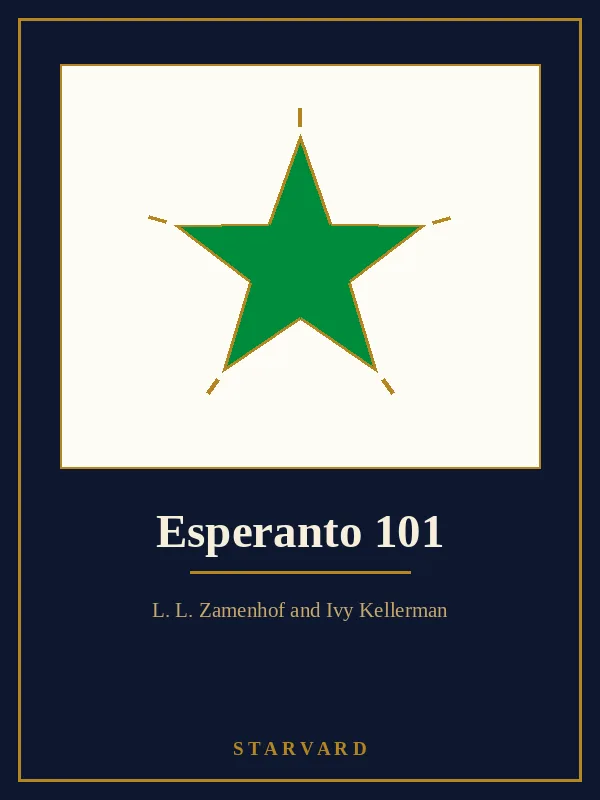
Starvard University · Esperanto 101
In 1887 a young eye doctor in Warsaw published a small language he had designed so that anyone could learn it. In this course you learn that language the way Ivy Kellerman taught it: sound by sound, ending by ending, until you are reading a real Esperanto story.


Hello, my name is Finn, and I'm going to help you understand this course.
Here it is, explained like you are 10:
A man named Zamenhof looked at the people in his town, who all spoke different languages and often misunderstood each other, and he made up a brand new language that would be easy for everybody to learn. Every word is pronounced exactly as it is spelled, verbs never change their pattern, and you can build big words out of small pieces, like blocks. It is called Esperanto, which means the one who hopes.
Zamenhof published Esperanto in 1887, when he was 27 years old, and signed his first book Doktoro Esperanto, Doctor Hopeful. Five years of work by teachers like Ivy Kellerman Reed turned his outline into full grammars, readers, and dictionaries. Her book A Complete Grammar of Esperanto, published in 1910, is the book this course is taught from, and it carries a learner from the alphabet to real stories in sixty careful lessons.
This short course takes the first stretch of that road. You will learn the alphabet, the noun and adjective endings, the whole verb system in one lesson, and the word building pieces that let one root become a whole family of words. In Lesson 7 you read one of Kellerman's own little stories, the cat and the sparrow, and in Lesson 8 we tell you honestly where Esperanto stands today: a real, living community of speakers, though never the universal second language its maker hoped for.
The whole course in brief
What you will be able to do after this course
The eight lessons
Lesson 1
Ludwik Lejzer Zamenhof was born in 1859 in Białystok, a busy trading town then ruled by the Russian Empire. Poles, Russians, Germans, and Jews lived side by side there, each group speaking its own language, reading its own newspapers, and too often distrusting its neighbours. As a schoolboy Zamenhof formed a simple idea that stayed with him for life: much of that suspicion grew because people literally could not understand one another, and a shared language that belonged to no one nation might help strangers become neighbours.
He worked on his language through school and university, trained as an eye doctor, and in 1887, in Warsaw, he finally published it. The little first book was signed with a pen name, Doktoro Esperanto, which means the one who hopes, and the language soon took its name from that signature: Esperanto. His plan was modest and radical at once. Esperanto would replace nobody's mother tongue. It would be everyone's second language, deliberately built to be easy: a small grammar with no exceptions, words drawn mostly from the European languages many people half knew already, and spelling you could trust completely.
In 1905 the first international congress met at Boulogne in France, and that same year Zamenhof set out the Fundamento, a slim foundation volume holding the grammar, a set of exercises, and a basic dictionary. He declared that this foundation must remain forever untouchable, so the language could grow without ever shifting under its speakers' feet. The grammar in this course, Ivy Kellerman Reed's A Complete Grammar of Esperanto, follows the Fundamento faithfully. Now the honest part, which this course will not hide. Esperanto never became the universal second language Zamenhof hoped for, and English, carried by trade, empire, and later the internet, largely took that role instead. What did happen is smaller and still remarkable: a real, living community of speakers on every continent, yearly congresses, original novels and poems, and even a few families raising children in the language. In 1907 a dispute over proposed reforms split the movement, and the reformers left to build a rival language called Ido, while most Esperantists kept the Fundamento as it was.
Lesson 2
Esperanto has 28 letters, and the first rule is the friendliest in all of language learning: one letter, one sound, always. Kellerman puts the companion rule in one short sentence: “There are no silent letters.” If a letter is written, you say it, and it sounds the same in every word. The five vowels are a, e, i, o, u, taught by Kellerman with English guides close to the a in far, the a in fate, the i in machine, the o in toll, and the u in rude. Say them cleanly and shortly, and you already sound more Esperanto than most beginners in most languages.
Six letters wear little hats, and they are the only new sounds to learn. Ĉ sounds like the ch in chin, ĝ like the g in gem or the j in jar, ĵ like the s in azure, ŝ like the sh in shine, and ŭ is a quick w sound used inside diphthongs like aŭ and eŭ. The letter ĥ is a deep breathed sound from the back of the throat, as in Scottish loch, and Kellerman notes there are only a few words containing it, so it will not trouble you often. The letter c, without a hat, sounds like ts in hats, j sounds like the y in yes, and r is lightly trilled or rolled. Where hats cannot be printed, Esperantists write ch, gh, and the other pairs with an h, or use the x system you will see in the plain text edition of Kellerman's book, writing cx, gx, and sx instead.
Stress is just as regular. Kellerman states the rule plainly: “Words of more than one syllable are accented upon the syllable before the last.” So it is TA-blo for table, a-GRA-bla for pleasant, and sus-PEK-ti for to suspect, every time, with no exceptions to memorise and no dictionary checks. A word has as many syllables as it has vowels and diphthongs, so hodiaŭ, meaning today, has three beats: ho-di-AŬ, with the stress falling, as always, on the next to last one. Spend ten minutes reading Kellerman's practice words aloud and the whole system is yours. That is the deal Esperanto offers from its first page: pronounce it exactly as written, and you will be understood.
Lesson 3
In Esperanto the ending of a word tells you its job. Kellerman's second lesson opens with the rule in its simplest form: “The ending, or final letter, of nouns in Esperanto is o.” So knabo is boy, pomo is apple, ĉevalo is horse, and tablo is table. Learn a root and you know how to make its noun. There is exactly one definite article, la, meaning the, and it never changes: la knabo, la tablo. Esperanto has no word for a or an, so knabo alone can mean boy or a boy, and nothing is lost.
Adjectives end in -a: bela, beautiful; granda, large; flava, yellow; forta, strong. Put the two endings together and sentences start to build themselves: la granda ĉevalo, the large horse, and bela birdo, a beautiful bird. An adjective can stand before or after its noun, and it must agree with the noun in number. The plural ending is -j, added to both noun and adjective alike: bonaj viroj, good men, and grandaj ĉevaloj, large horses. The article and the verb do not change for the plural, so la viroj marŝas, the men walk, uses the same la and the same verb shape you will meet in the next lesson.
One more ending completes the picture, and it is Esperanto's most famous trick. A noun receiving the action of a verb takes the accusative ending -n: La viro havas seĝon, the man has a chair, and La knabo trovas belan floron, the boy finds a beautiful flower, where the adjective belan wears the -n too. Because the -n marks the object, word order can relax: a speaker may move words for emphasis without losing who did what to whom. Predicate words after estas, to be, never take -n: La birdo estas bela, the bird is beautiful. Hold the pattern o for things, a for qualities, j for more than one, and n for the one acted upon, and you hold most of Esperanto grammar in one hand.
Lesson 4
Here is the lesson that makes language teachers weep with envy. An Esperanto verb has one ending for each tense, the ending is the same for every person, and there are no irregular verbs at all. The infinitive, the dictionary form, ends in -i: kuri, to run; esti, to be; havi, to have. The present tense ends in -as, as Kellerman lists it: kuras, runs; brilas, shines; flugas, flies; dormas, sleeps. The past tense ends in -is: kuris, ran; flugis, flew; brilis, shone. The future tense ends in -os: kuros, will run; flugos, will fly; brilos, will shine. Three endings, learned in a minute, cover all of time.
Because the ending never changes, the pronoun does all the work of saying who acts, and Kellerman's conjugation tables are almost boring to read, which is exactly the point. Mi estas, I am; vi estas, you are; li estas, he is; ni estas, we are; ili estas, they are. Run the same table with vidi, to see, and you get mi vidas, vi vidas, li vidas, ni vidas, ili vidas, and then in the past mi vidis and in the future mi vidos, with the same six pronouns slotting in unchanged. Compare that with English am, are, is, was, were, or with the dozens of forms a French or Latin verb demands, and you see what Zamenhof was buying with his regularity: hours that other students spend memorising tables, you will spend actually reading.
Two more forms round out the system, and both follow the same tidy pattern. The conditional ends in -us, for wishes and what-ifs: mi vidus, I would see, and se li estus, if he were, with estus built from esti in the same regular way. The imperative, for commands and requests, ends in -u: vidu, see; venu, come; and the gentle first person form mi vidu, let me see. Add participles later if you wish, for shades like is seeing or having seen, but nothing in this lesson ever breaks the rule. One set of endings for all really means all: every verb, every person, every number, no exceptions list taped to the back page.
Lesson 5
Esperanto's vocabulary works like a box of building blocks. You learn a root, then snap pieces onto it to make the whole family. Start with the prefix mal-, which makes opposites. Kellerman's list is a delight: alta, tall, gives malalta, low; amiko, friend, gives malamiko, enemy; juna, young, gives maljuna, old; and nova, new, gives malnova, old in the sense of not new. One small prefix doubles a whole shelf of adjectives overnight, and the same trick works with nouns and verbs too, as helpi, to help, becomes malhelpi, to hinder.
Suffixes do even heavier lifting, each with one steady meaning. The suffix -in- makes a feminine noun: frato, brother, becomes fratino, sister, and patro, father, becomes patrino, mother. The suffix -il- names a tool: kudrilo, a needle, from kudri, to sew, and flugilo, a wing, from flugi, to fly, since a wing is a bird's tool for flying. The suffix -ej- names a place: ĉevalejo, a stable, from ĉevalo, horse, and dormejo, a dormitory, from dormi, to sleep. The suffix -ist- names a person's trade: floristo, a florist, and okulisto, an eye doctor, which is a nice nod to Zamenhof himself.
Keep snapping. The suffix -ar- gathers a collection: arbaro, a forest, a gathering of arboj, trees, and libraro, a library, a gathering of books. The suffix -ul- makes a person described by the root: junulo, a young man, from juna, young. The suffix -eg- makes things bigger or stronger, so bona, good, becomes bonega, excellent, and domo, house, becomes domego, mansion, while -et- shrinks them kindly: libreto, a booklet, and monteto, a hill. The pair -ig- and -iĝ- turn verbs transitive and back again, one meaning to cause something, the other to become something. This is why Esperanto learners read so soon: a thousand roots, multiplied by a few dozen faithful pieces, behave like a vocabulary many times larger.
Lesson 6
Esperanto asks questions in two clean ways. For a yes or no question, you place the little word ĉu at the front of an ordinary statement and change nothing else: Ĉu la knabo estas bona? Is the boy good? Kellerman points out that since there is no inversion of word order, there is no need for an English style do or does to rescue the verb. The voice rises, the ĉu stands at the gate, and everyone knows a question has been asked. To answer, jes means yes, ne means no, and ne before a verb also serves as the plain word for not inside any sentence.
For questions that ask who, what, where, when, why, and how, Esperanto uses a family of words called the correlatives, and Kellerman claims, with some pride, that “in Esperanto the correlative system is more complete than in any other language.” The family is a table you can generate instead of memorize. Five beginnings carry the sense: ti- points at that, ki- asks or links a question, ĉi- means every, i- means some, and neni- means none. Nine endings say what kind of word you want: -o for a thing, -u for a person or one, -a for a kind, -e for a place, -am for a time, -al for a reason, -el for a manner, -om for an amount, and -es for possession.
Now multiply. Ki- plus -o gives kio, what; ki- plus -e gives kie, where; ki- plus -am gives kiam, when; ki- plus -al gives kial, why; ki- plus -el gives kiel, how; and ki- plus -om gives kiom, how much. Swap the beginning and the whole row follows: tie, there; ĉie, everywhere; nenie, nowhere; tiam, then; ĉiam, always; neniam, never; tio, that thing; ĉio, everything; nenio, nothing. Forty-five words, learned as one small grid, and many of them double as relative words linking sentences, so kiu also means who or which when it joins a clause. Try two aloud: Kie vi loĝas? Where do you live? Kiam vi venos? When will you come? If you can build those, the table is already working for you.
Lesson 7
Time to read. This is Kellerman's own little fable, La Kato kaj la Pasero, The Cat and the Sparrow, from her ninth lesson, and it uses almost nothing you have not already met. It opens quietly: “Griza kato iris de la domo ĝis la strato.” A gray cat went from the house to the street. Notice iris, went, wearing the past tense -is from Lesson 4, and kato, cat, a plain -o noun. The cat spots a sparrow and catches it: it stood behind a big tree, kaptis la paseron, and the -n on paseron tells you the sparrow is the one acted upon.
Then the sparrow talks its way out. “Bona kato lavas sin antaŭ sia manĝo, sed vi ne lavis vian vizaĝon.” A good cat washes himself before his meal, but you did not wash your face. Every word earns its place: lavas is present tense, lavis is past, manĝo is a meal built from the root for eating, and vizaĝon, face, carries the accusative -n. The interesting remark surprises the cat, and like many of us it obeys the custom at exactly the wrong moment: it lets go of the sparrow and begins to wash its own face. “La pasero flugis de la kato ĝis la arbo.” The sparrow flew from the cat to the tree.
The cat's closing speech is the fable's sting, and you can read it unaided now: “Mi perdis mian manĝon, ĉar mi komencis lavi min antaŭ la manĝo!” I lost my meal, because I began to wash myself before the meal. Kellerman finishes with a mock solemn explanation that ever since that day cats wash after their meals, not before, and hold their sparrows tight: the cats are happy, she says, but the sparrows are not happy. La katoj estas feliĉaj, sed la paseroj ne estas feliĉaj. If you followed that story, even slowly, you have done the thing this course promised: you read real Esperanto, written for learners in 1910 and still perfectly clear, jokes and all.
Lesson 8
So where are the Esperantists? The honest answer comes first: nobody knows the exact number. Estimates of fluent speakers range from tens of thousands upward, with far larger numbers who have learned some Esperanto, and claims of millions should be read as hope, not census. What is certain is that the community is real, organised, and unusually welcoming to beginners, because every Esperantist alive remembers being one. The movement has held an international congress, the Universala Kongreso, since the first gathering at Boulogne in 1905, pausing only for the two world wars, and national associations in dozens of countries run smaller meetings, courses, and local groups.
Finding them is easier than finding speakers of most small languages. The world association, Universala Esperanto-Asocio, and its national affiliates keep directories of local groups and events, and a library of books in and about the language. Esperanto has a literature of its own, too: Zamenhof himself translated works like Hamlet, later writers wrote original novels, poems, and songs in the language, and Kellerman's grammar closes with long vocabularies meant to send you straight into that reading. A famous travellers' network, Pasporta Servo, lists hosts who offer fellow speakers a free place to stay, which turns a holiday into a language course with a family at the end of it. Online, the language found a second wind: free courses and apps have introduced millions of curious learners to at least its first lessons, even if only a fraction stay to become speakers.
Your first steps can be small and real. Learn the greeting Saluton, hello, and the green five pointed star that Esperantists wear as their symbol, the same star on this course's cover, green for hope. Read Kellerman's remaining stories, which grow longer and better as her book goes on, and try a local group or an online conversation meeting, where patient speakers expect beginners and correct them kindly. Esperanto will probably not become the world's shared second language, and this course has promised you no such thing. What it offers instead is a friendly, worldwide circle of people who learned a language purely because they liked the idea of meeting as equals, and a door into it that you can now open yourself: Ĝis la revido, until we meet again.
Sources
This course is taught from one book, free for anyone to read in full at Project Gutenberg. Ivy Kellerman Reed's grammar follows Zamenhof's Fundamento, the 1905 foundation of the language, and carries the learner from the alphabet to full stories with graded exercises and vocabularies.
Graduation
You met Zamenhof and his hope for a language everyone could share, learned an alphabet with no silent letters and no exceptions, built nouns, adjectives, and verbs from endings that never change, multiplied words with prefixes and suffixes, generated the whole correlative table from one small grid, and read a cat and sparrow story in the original. Gratulon, congratulations: you now hold the working core of Esperanto, and Kellerman's full grammar is free whenever you want the rest of the road.
Keep learning
This course is part of Starvard University, striving for greatness.
A note on accuracy: Much of what you read at Starvard was created with help from AI agents, working alongside people. We check what we can, but we cannot guarantee that everything here is true, current, or complete. If something really matters, your health, your money, a grade, a job, please verify it with a trusted source before you rely on it.