 Starvard.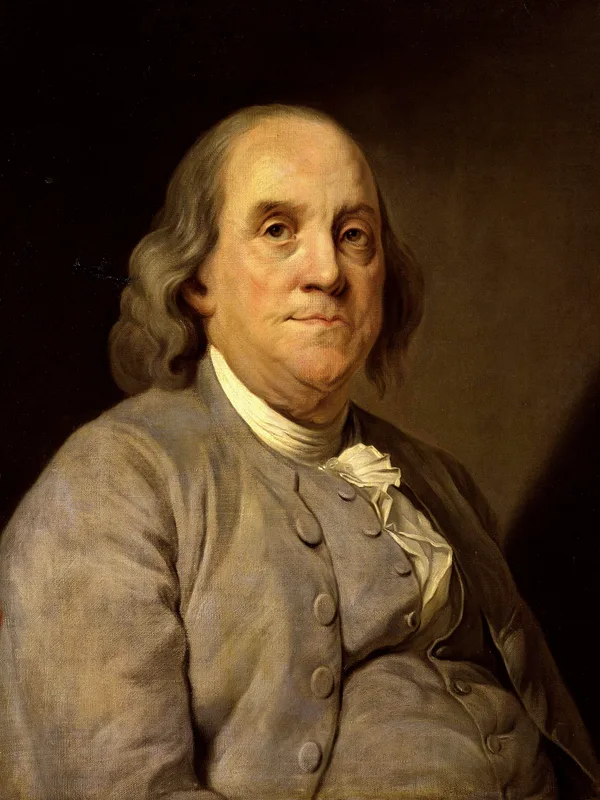
Starvard University · Benjamin Franklin
Run away at seventeen, teach yourself to write, chart thirteen virtues for thirteen weeks, and build your own better habits with Benjamin Franklin as your coach.


Hello, my name is Finn, and I'm going to help you understand this course.
Here it is, explained like you are 10:
Benjamin Franklin may be the most practical teacher who ever lived. He was not born rich, educated at a great school, or handed a single advantage. He was a printer's apprentice who ran away at seventeen, and he built himself, on purpose, the way you would build a house: one habit at a time, measured on paper. In this course he shows you his actual tools, all from his own Autobiography. A trick for teaching yourself to write. A list of thirteen virtues. A little book with red lines and black spots. A club of friends who met on Fridays to get smarter together. Nothing here is theory. Franklin tested every bit of it on himself first.
Franklin wrote his Autobiography as a letter to his son, and later to the public, because he thought his methods might be useful to people coming after him. That is the spirit of this course. We are not studying Franklin the statue, the face on the hundred dollar bill. We are studying Franklin the working teenager and young printer, hungry, a little vain, often wrong, and completely serious about getting better. He tells on himself constantly, which is what makes him trustworthy as a coach. When his system failed, as it did with the virtue of Order, he says so, laughs at himself, and keeps the parts that worked.
So bring a notebook. Each lesson ends with something you can actually do, and the final lesson assembles everything into your own thirteen week experiment: one virtue a week, a simple chart, a short evening check, and a weekly hour with people who want to improve too. Franklin repeated his course four times a year and carried his little book for decades. You do not need his genius to borrow his method. You only need his honesty about the black spots, and his patience to keep clearing them, one line at a time.
The whole course in brief
What you will be able to do after this course
The eight lessons
Lesson 1
Benjamin Franklin was born in Boston in 1706, the son of a candle maker, and at twelve he was apprenticed to his older brother James, a printer. The work taught him a trade, but the shop also fed his mind: books passed through his hands, and he read everything he could borrow. When James started a newspaper, teenage Benjamin secretly wrote a series of witty letters signed Silence Dogood and slipped them under the printing house door at night. They were printed, praised, and argued over, and nobody guessed the author was the apprentice.
The brothers quarrelled, though, and in 1723, at seventeen, Franklin ran away. He travelled by boat and on foot to Philadelphia with very little money, and his Autobiography preserves the famous arrival: he bought three great puffy rolls, walked up Market Street with a roll under each arm, eating the third, looking, by his own cheerful admission, most awkward and ridiculous. He gave two of the rolls away to a woman and child from the boat. The runaway had nothing but a trade, a reading habit, and a plan to improve. It turned out to be enough.
Lesson 2
Franklin wanted to write well, and nobody was going to teach him, so he invented a method, and it is still one of the best ever described. He found an odd volume of the Spectator, the celebrated London essays by Addison and Steele, read it over and over, and was delighted. Then he set to work. He took some of the essays and made short notes, a hint of the sentiment in each sentence. He laid the notes aside for a few days. Then, without looking at the book, he tried to write the essays again in his own words, as fully as he could.
Afterwards he compared his version with the original, discovered his faults, and corrected them. Finding his vocabulary weak, he turned essays into verse, which forced him to hunt for words of the right length and sound, and after time had made him forget the prose, he turned the verse back into prose again. Sometimes he jumbled his notes into confusion and rebuilt the essay's order from scratch, teaching himself method in the arrangement of thoughts. He practised at night, before work, and on Sundays. Clear writing, in Franklin's school, is not a gift. It is reps.
Lesson 3
As a young man Franklin formed what he calls a bold and arduous project: arriving at moral perfection. His first move was a list. Finding that writers used too few names for too many ideas, he settled on thirteen virtues, each with a short rule that fixed exactly what he meant by it. In his order they run: Temperance, eat not to dullness and drink not to elevation. Silence, speak only what may benefit others or yourself. Order, let all your things have their places and each part of your business its time. Resolution, perform without fail what you resolve. Frugality, waste nothing.
The list continues: Industry, lose no time and be always employed in something useful. Sincerity, use no hurtful deceit. Justice, wrong none. Moderation, avoid extremes. Cleanliness, in body, clothes, and habitation. Tranquility, be not disturbed at trifles. Chastity. And last, Humility, summed up in four words: imitate Jesus and Socrates. The order is part of the design: Temperance first, to keep the head cool and clear, Resolution before Frugality and Industry, because keeping promises to yourself makes the money virtues easier. It is less a sermon than an engineering plan for a character.
Lesson 4
A list is easy to admire and easy to forget, so Franklin built a measuring tool. He made a little book and allotted a page to each virtue. On every page he ruled red lines making seven columns, one for each day of the week, and crossed them with thirteen lines, one for each virtue, marked with its first letter. Each evening he examined the day honestly, and wherever he had faulted against a virtue, he marked a little black spot in that virtue's line, under that day's column.
The genius of the scheme is focus. Franklin gave a week's strict attention to one virtue at a time, trying to keep its line completely clear of spots, while the other twelve were left to ordinary chance and merely marked. Moving down the list week by week, he completed a full course in thirteen weeks, which meant four courses in a year. He compared himself to a gardener weeding one bed at a time rather than attacking the whole garden at once. The spots, he reports, diminished, and the pleasure of watching his pages grow cleaner kept him going. Later he transferred the tables to ivory leaves he could wipe clean, and carried the little book for the rest of his life.
Lesson 5
Franklin knew that self improvement goes further in company, so in 1727 he gathered his most ingenious acquaintances into a club of mutual improvement called the Junto. They met on Friday evenings. The rules Franklin drew up required every member, in turn, to bring one or more queries on any point of morals, politics, or natural philosophy, to be discussed by the company, and once every three months to read aloud an essay of his own writing on any subject he pleased.
The debating rules were as carefully designed as the virtue chart. Discussions were led by a president and conducted in a sincere spirit of inquiry after truth, without fondness for dispute or desire of victory. To keep things cool, expressions of absolute certainty and direct contradiction were eventually banned, with small fines for breaking the rule. The members were working tradesmen like Franklin himself, a scrivener's copyist, a self taught mathematician, a surveyor, a joiner, and a merchant's clerk, and the club pushed them all to read seriously, since the queries were announced a week ahead. Franklin called it the best school of philosophy, morality, and politics in the province. It lasted more than forty years, and its members later pooled their books into America's first great lending library.
Lesson 6
For twenty five years Franklin published Poor Richard's Almanack under the name Richard Saunders, filling its margins with short, sharp maxims about work, time, and money. In 1758 he gathered the best of them into one short piece, the Way to Wealth, which became one of the most reprinted texts in the English language. Its frame is a scene at an auction of merchants' goods, where the crowd, grumbling about heavy taxes and hard times, calls on an old man with white locks, Father Abraham, to advise them.
Father Abraham answers almost entirely in Poor Richard's sayings, strung together like beads. On self reliance: "God helps them that help themselves." On time: lost time is never found again, and sloth makes all things difficult while industry makes all things easy. On rising: "early to bed, and early to rise, makes a man healthy, wealthy, and wise." On thrift: a fat kitchen makes a lean will, and a man who cannot save as he gets may keep his nose to the grindstone all his life and die not worth a groat. The sting in the tail is Franklin's joke: the crowd praised the speech warmly, and then went straight in and bid at the auction anyway.
Lesson 7
The virtue of Order demanded that every part of his business have its allotted time, so Franklin drew up a scheme of employment for the twenty four hours, and printed it in his little book. The day begins at five in the morning: rise, wash, and address Powerful Goodness, then settle the day's business and take the resolution of the day while studying and breakfasting. Over the whole morning hangs the question that gives the day its aim: "What good shall I do this day?"
Work fills the morning from eight to twelve. At noon he read, or overlooked his accounts, and dined. Work resumes from two until six. The evening turns outward and then inward: put things in their places, then supper, music or diversion or conversation, and at nine, examination of the day, under the evening question: "What good have I done to-day?" Sleep runs from ten at night until five. Franklin confesses Order was the virtue that cost him most trouble, and a working printer with customers arriving at their own hours could rarely keep the scheme exactly. He kept it anyway, as a pattern to steer by rather than a law to obey, and the two questions, morning aim and evening audit, are the parts anyone can steal today.
Lesson 8
Now it is your turn, and the method scales down gracefully. Start by copying Franklin's tools exactly, before improving them. Take a small notebook or a single spreadsheet. Give each of the thirteen virtues its own page or sheet. Rule seven columns for the days of the week and thirteen rows for the virtues. Choose Franklin's order at first, Temperance first and Humility last, because the sequence was designed so early wins make later virtues easier. If one of his thirteen does not fit your life, swap it for a virtue you genuinely need, but keep the count at thirteen so the course still runs one clean season.
Then run the experiment the way he did. Each week, pick the next virtue and give it your strict attention: try to keep its row spotless, while merely noting faults against the others. Every evening, take two honest minutes, ask his evening question in your own words, and mark your black spots without flinching and without despair. Expect Franklin's own results: more spots than you imagined in the first weeks, then fewer. He never claimed perfection. He claimed he was a better and happier man for the endeavour, like a copyist whose hand improves by aiming at beautiful writing. Finish thirteen weeks, and you will have something better than inspiration. You will have data about yourself, and a course you can run four times a year for life.
Sources
This course is taught from classic texts that are free for anyone to read. Every method in the lessons traces back to one of these books.
Graduation
Franklin's whole school fits in a coat pocket: thirteen virtues, one ruled page, two questions a day, and a Friday club of friends who want to get better. He began it as a young printer with spots on every line, and he was still carrying the book as an old man. Start your first week this week, keep your spots honest, and congratulations on finishing Ben Franklin's School of Self-Improvement.
Keep learning
This course is part of Starvard University, striving for greatness.
A note on accuracy: Much of what you read at Starvard was created with help from AI agents, working alongside people. We check what we can, but we cannot guarantee that everything here is true, current, or complete. If something really matters, your health, your money, a grade, a job, please verify it with a trusted source before you rely on it.