 Starvard.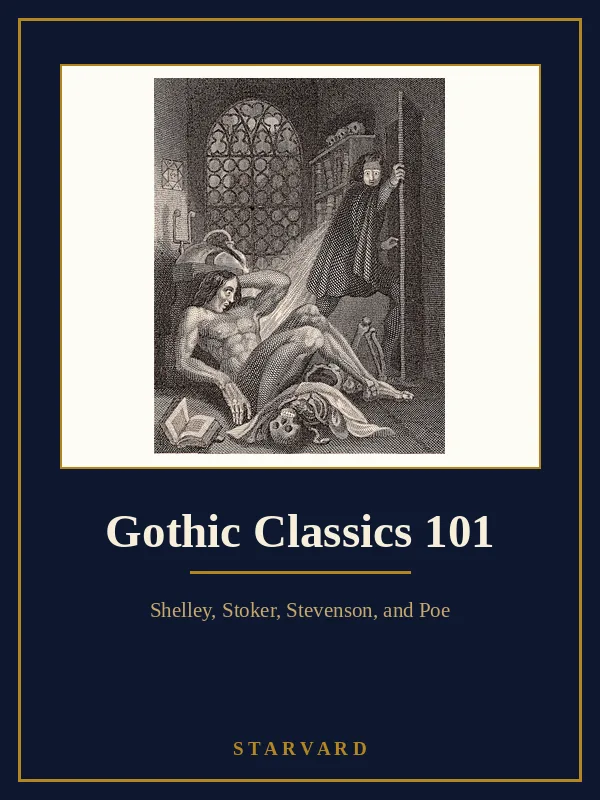
Starvard University · Gothic Classics
Castles, doubles, diaries, and one very famous creature: learn how Poe, Shelley, Stevenson, and Stoker built the stories that still scare us.


Hello, my name is Finn, and I'm going to help you understand this course.
Here it is, explained like you are 10:
Some stories are scary in a fun way, like a creaky house you explore with a flashlight and friends nearby. In this course you meet four famous scary storytellers. Edgar Allan Poe traps you in a haunted room inside a haunted mind. Mary Shelley asks what happens when a scientist makes a living creature and then runs away from it. Robert Louis Stevenson splits one polite man into a good half and a wicked half. Bram Stoker chases a vampire across Europe using diary pages and letters. You will learn every trick they use, then write a ghost story of your own.
Here is the secret that makes these books less frightening and more fun: the fear is built, like a machine. The writers choose an old, shut in place, a narrator who only knows part of the truth, and one big broken rule, and then they tighten the screws page by page. Once you can see the machine working, you can enjoy the shiver without being fooled by it. That is what real readers do, and it is what stage magicians and film makers learned from these very books.
A second secret: every monster in this course is also an idea. The creature is a child nobody loved. Mr. Hyde is the bad temper and secret sin a polite man hides. Dracula is an old evil that travels to a new, busy, modern city and must be fought with teamwork and records. When you spot the idea inside the monster, the story stays with you long after the scare fades, and you start noticing gothic shapes everywhere, in old houses, in secrets families keep, and in the part of your own mind that would rather not be examined. Finish the course by using the same tools yourself, in one short page of your own invention.
The whole course in brief
What you will be able to do after this course
The seven lessons
Lesson 1
The word gothic started with buildings: towering medieval churches and castles with pointed arches, long shadows, and rooms behind rooms. When writers borrowed the word for stories, they borrowed the buildings too. A gothic tale puts modern, reasonable people inside an old, unreasonable place, a ruined abbey, a locked wing, a Transylvanian castle, and lets the past reach out and grab them.
Learn the ingredient list, because all four authors in this course cook with it. Expect a shut in or decaying setting, extreme weather and darkness, a secret in the family or the house, a double or a hidden second self, forbidden knowledge, and emotion pushed past its limit into terror or madness. Poe's tale The Oval Portrait, which you will meet next lesson, even nods to the tradition inside its first page, describing a chateau of the kind found in the fancy of Mrs. Radcliffe, the great gothic novelist Ann Radcliffe.
One more mark matters most: in gothic fiction the setting thinks. The house, the castle, and the laboratory are not scenery. They are the state of a soul drawn large, which is why these stories still work in an age of electric light.
Lesson 2
Edgar Allan Poe built the modern short tale of terror, and this lesson teaches only from the volume this course actually uses, The Works of Edgar Allan Poe, Volume 1 in the 1903 Raven Edition. Its contents are eight prose works, among them MS. Found in a Bottle, The Oval Portrait, The Murders in the Rue Morgue, and The Gold-Bug. Know that list, because Poe's most famous poem and several famous tales sit in other volumes, not this one.
The method is already complete here. In MS. Found in a Bottle, a rational narrator is swept by a storm onto a vast, rotting ship crewed by ancient, silent men, and he can do nothing but write his account and seal it in a bottle as the ship sinks toward some dreadful discovery. In The Oval Portrait, a wounded traveller in a remote chateau finds a portrait so lifelike that it seems alive, then reads the terrible price of its making: the painter drained his young wife's life into the canvas, sitting by sitting.
Notice Poe's tools, since your final lesson will borrow them. One narrator, one place, one effect aimed at like an arrow, and no wasted page. He argued a tale should be short enough to read at one sitting, so the spell never breaks. Rue Morgue adds his other gift, the detective who reasons his way through horror, the ancestor of every fictional detective since.
Lesson 3
This course teaches Frankenstein from Project Gutenberg 84, the 1818 text, the novel as Mary Shelley first published it. That matters, because the famous introduction describing the ghost story contest at Lake Geneva was written for the revised 1831 edition and is not in this text. The 1818 book opens cold, with Captain Walton's letters home from the ice, and Walton's rescue of a dying young man named Victor Frankenstein, who tells him everything.
Victor, a brilliant student at Ingolstadt, discovers how to give life to dead matter, builds a huge being from parts of corpses, and animates it. Then he runs. The horror of the novel is not the making but the abandoning. The creature teaches himself to speak by secretly watching a poor family, learns kindness from them, is beaten and driven off for his face, and finally confronts his maker with the most reasonable demand in all gothic fiction: "I ought to be thy Adam, but I am rather the fallen angel." Give me a companion, he says, and I will leave mankind in peace.
Victor refuses, destroys the half finished female creature, and pays in everyone he loves: his little brother William strangled, the servant Justine hanged for it, his bride Elizabeth murdered on her wedding night. Creator and creature die pursuing each other across the ice, each ruined by the refusal of responsibility.
Lesson 4
Robert Louis Stevenson hides his monster in plain sight and in a smaller package than any other author here: inside a respectable London doctor. The Strange Case of Dr Jekyll and Mr Hyde is told as an investigation. The lawyer Mr. Utterson hears of a brute named Edward Hyde who trampled a child and paid off the witnesses with a cheque signed by the upright Dr. Henry Jekyll. Utterson spends the book doing detective work through fog, wills, and locked doors before any explanation is allowed.
The structure is the lesson. We get Enfield's story of the door, a murder witnessed from a window, a letter, Dr. Lanyon's sealed narrative, and only at the very end Jekyll's full statement. Each document turns the key one notch, so the reader lives inside the same ignorance as the friends who loved Jekyll and could not save him.
In his statement Jekyll explains that his experiments began as philosophy. He had concluded, in his own words, "that man is not truly one, but truly two," and he found a drug that let the worse of his two natures walk abroad in a smaller, younger body. Hyde began as a release and ended as a master: the transformations started coming uninvited, the drug ran out, and Jekyll's last act was to leave the truth in writing for Utterson to find.
Lesson 5
Bram Stoker never narrates Dracula in his own voice. Open the book and read its own table of contents: Jonathan Harker's journal, Mina Murray's journal, Lucy Westenra's diary, Dr. Seward's diary kept on a phonograph, letters, and even a cutting from a newspaper, the Dailygraph. The whole novel is a file of evidence, assembled by the characters themselves, and its famous preface note boasts that every record was written at the time, so memory cannot be blamed for the horror.
The form creates the dread. Harker, a young solicitor, travels to a castle in Transylvania to complete a house sale for a Count who never eats, casts no reflection, and keeps his guest politely, fatally, a prisoner. Harker escapes knowing everything and able to prove nothing. Then the evil travels, to Whitby in a storm with a dead captain lashed to the wheel, and into London, where Lucy's sleepwalking, pallor, and death are recorded in sweet, ordinary diary entries that the reader learns to dread before the writers do.
Against an ancient predator, Stoker sets modern teamwork. Mina types and collates everyone's records into one timeline, Van Helsing supplies old knowledge, and the group wins by sharing information the Count tried to keep in separate, frightened heads. Dracula is a vampire story that is also, quietly, a story about the power of keeping good notes.
Lesson 6
Now step back and ask the cheerful question underneath this whole course: why do sane people pay for nightmares? Part of the answer is safety. A book is a haunted house with a door you control. Your heart can race over Harker's journal while your body sits in a chair with a lamp on, and you can close the cover, which no character in Dracula ever gets to do. The fear is real and the danger is not, and that combination feels like play.
A second part is mastery. Gothic stories train attention. Poe teaches you to notice the one detail that does not fit, Stevenson teaches you to suspect the respectable surface, and Stoker teaches you to assemble scattered facts into a pattern. Readers finish these books feeling sharper, the way you feel after solving a hard puzzle, because they have rehearsed spotting danger in a place where mistakes cost nothing.
The deepest part is recognition. Hyde is the temper and appetite every polite person manages. The creature is every abandoned child and every project its maker refused to answer for. Dracula is disease, invasion, and the charming stranger, all in one cape. We enjoy these fears because they give shapes to worries that are otherwise formless, and a worry with a shape can be faced, fought, and, in the last chapter, defeated.
Lesson 7
Time to use the machine you have been studying. Your task is one page only, roughly 400 to 500 words, which forces Poe's discipline on you: one narrator, one place, one effect. Before you draft, choose your effect in a single sentence, such as "a sister slowly realises the voice on the old voicemail is answering her," and cut anything that does not serve it.
Build with the course's tools, in this order. First, borrow Stoker's form: write your page as a diary entry, a letter, or a set of notes, dated, ordinary, and precise about times and small facts. Second, borrow the gothic setting from lesson one: one shut in place with a history, described through two senses only, sound and smell work harder than sight. Third, borrow Stevenson's double: give your narrator a secret or a second self they are managing, even a small one, because a haunted person beats a haunted house. Fourth, borrow Shelley's sympathy: let your ghost or creature want one understandable thing.
Now draft in three passes. Pass one, write the ordinary opening and delay anything strange for a full third of the page. Pass two, tighten the screws with three details that each reinterpret an earlier detail, and end scenes on questions, not answers. Pass three, read it aloud, cut every sentence that explains the fear instead of causing it, and finish on one quiet image that lets the reader's imagination do the last, worst work. Share it by lamplight.
Sources
This course is taught from classic texts that are free for anyone to read. Every method in the lessons traces back to one of these books.
Graduation
You came for castles and vampires and you leave with the blueprints: Poe's single effect, Shelley's abandoned creature, Stevenson's double, and Stoker's paper trail of dread, plus a ghost story of your own on one page. Read these books again on a stormy night and notice how your eye now catches the joins. That noticing is real literary skill. Congratulations, and sleep well, if you can.
Keep learning
This course is part of Starvard University, striving for greatness.
A note on accuracy: Much of what you read at Starvard was created with help from AI agents, working alongside people. We check what we can, but we cannot guarantee that everything here is true, current, or complete. If something really matters, your health, your money, a grade, a job, please verify it with a trusted source before you rely on it.