 Starvard.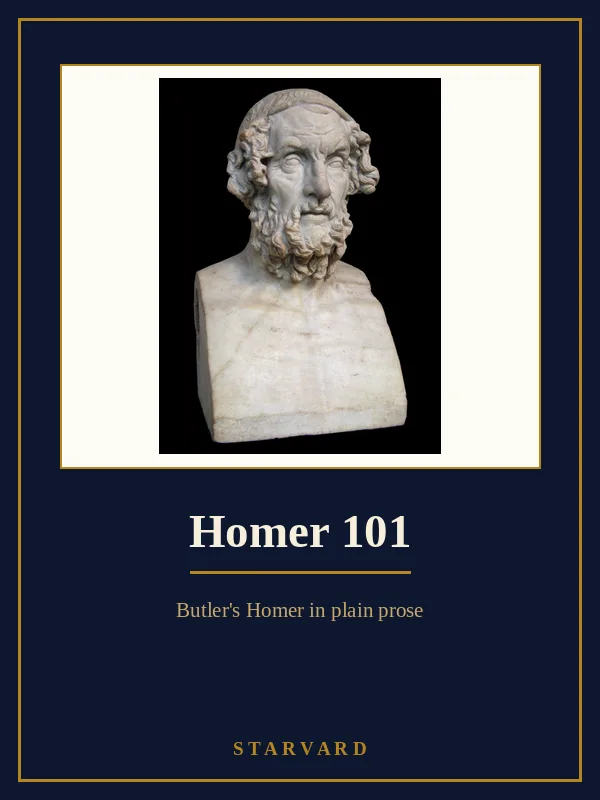
Starvard University · Homer
Read the two oldest great stories in the West in Samuel Butler's clear plain prose: a war fought over honor at Troy, and one man's ten year voyage home.


Hello, my name is Finn, and I'm going to help you understand this course.
Here it is, explained like you are 10:
Long ago in Greece, singers told two giant stories by heart. One is about a war: the strongest hero, Achilles, gets so angry that he stops fighting, and everyone suffers until his best friend dies. The other is about a clever hero, Odysseus, who takes ten years to sail home through monsters, magic islands, and storms. A man named Homer is said to have shaped these tales, and Samuel Butler turned them into plain, friendly prose. In this course you will meet brave Hector, sad old King Priam, faithful Penelope, and a one eyed giant, and see why we still tell these stories today.
The Iliad and the Odyssey are the oldest big books in European literature, and they began as songs. Singers carried them in memory, performing them over many nights, and the poems still carry the marks of that world: repeated phrases, feasts, catalogues of ships, and heroes who introduce themselves by naming their fathers. Samuel Butler, the Victorian novelist who translated both poems into prose, believed they read best as good stories told plainly, and his versions are famous for being clear and quick.
The two poems are a matched pair. The Iliad is about war and what anger costs; it covers only a few weeks in the tenth year of the siege of Troy, yet it contains the whole war in miniature. The Odyssey is about peace and how hard it is to come home; its hero wins not by strength but by patience, disguise, and wit. Read together, they ask the two oldest questions in storytelling: what is a hero, and what is home? By the end of this course you will know both plots cold, meet the scenes readers have loved for nearly three thousand years, and start noticing Homer everywhere, in novels, films, and even video games.
The whole course in brief
What you will be able to do after this course
The eight lessons
Lesson 1
Nobody knows for certain whether Homer was one man. Tradition pictured a blind singer from Ionia, on the coast of what is now Turkey, and the ancient busts show him exactly that way: old, bearded, with sightless eyes. What scholars do know is that the poems grew out of oral poetry. Singers composed in performance, using a stock of ready made phrases fitted to the meter, so a hero is always "swift footed Achilles" and dawn is always rosy fingered.
The story behind the poems is the Trojan War. Paris, a prince of Troy, carried off Helen, wife of the Spartan king Menelaus, and a Greek fleet under Agamemnon sailed to win her back. The siege lasted ten years. Whether a real war lies behind the tale is debated, but a ruined city at Hisarlik in Turkey, excavated in the 1870s by Heinrich Schliemann, shows that a great stronghold really stood where the poems place Troy.
The Iliad and the Odyssey were probably written down in the eighth century BC, and together they became the schoolbooks of Greece: quoted in courts, memorized by schoolboys, and treated as a guide to how to live. Butler's prose translations, published in 1898 and 1900, keep the pace of a spoken tale, which makes them the friendliest first door into Homer.
Lesson 2
Butler's Iliad opens with a request and a warning: "Sing, O goddess, the anger of Achilles son of Peleus, that brought countless ills upon the Achaeans." The poem is not, at heart, about the war. It is about one man's anger and what that anger costs everyone around him.
The quarrel is about honor. Agamemnon, the Greek commander, is forced to give up a captive girl, Chryseis, so he takes Achilles' own prize, the girl Briseis, in her place. To Achilles this is not about the girl herself but about public respect: the army has voted him the prize, and the king has shamed him before everyone. Achilles withdraws from the fighting, calls on his mother, the sea goddess Thetis, and asks her to persuade Zeus to let the Trojans win until the Greeks learn his worth.
The plan works terribly well. Without Achilles the Greeks are driven back to their ships, and his closest friend Patroclus cannot bear it. Patroclus borrows Achilles' armor, charges out, and is killed by Hector, the great Trojan prince. Grief turns Achilles' anger in a new direction, and in the poem's final movement he returns to battle a changed and terrifying man.
Lesson 3
Hector is the Iliad's most human hero. He fights not for glory but for a city: his parents, his wife, and his baby son are all inside the walls he defends. In Book 6 he leaves the battle to visit them, and finds Andromache at the Scaean gates, begging him not to go back out. She has already lost her father and seven brothers to Achilles, and she tells him plainly that he is now father, mother, brother, and husband to her, all in one.
Hector answers with the poem's tragic honesty. He knows Troy will fall; he says so. What he cannot bear is the thought of Andromache enslaved in some Greek household, and his own shame if he hid from the fighting. Then comes the tenderest moment in ancient literature: his little son Astyanax screams at the sight of his father's tall helmet and nodding plume, and both parents laugh. Hector takes off the helmet, kisses the child, and prays that the boy will one day be a greater warrior than his father.
Readers remember that prayer because the poem lets us know it will not be answered as Hector hopes. The cost of war in Homer is never counted in cities. It is counted in scenes like this one.
Lesson 4
In the last book of the Iliad, Achilles has killed Hector and dragged his body around Patroclus's tomb for twelve days. Then old King Priam does the bravest thing in the poem. Guided by the god Hermes, he crosses the battlefield alone at night, in a wagon loaded with ransom, and walks into the tent of the man who killed his son.
Butler's sentence is unforgettable: Priam "clasped his knees and kissed the dread murderous hands that had slain so many of his sons." Then he speaks: remember your own father, he says, an old man like me, and pity me, who have endured what no man ever has. Achilles thinks of his own father Peleus, whom he will never see again, and the two men weep together, the king for Hector, the hero for his father and for Patroclus.
Achilles accepts the ransom, orders Hector's body washed and returned, shares food with Priam, and grants Troy eleven days of truce for the funeral. The Iliad ends not with the fall of Troy but with Hector's burial. A poem that began in anger ends in shared grief and mercy, and that ending is why readers call this the greatest scene in literature.
Lesson 5
The Odyssey opens ten years after the war. Butler begins, "Tell me, O Muse, of that ingenious hero who travelled far and wide," and the word ingenious is the key: Odysseus wins by cleverness. When the poem starts he is stranded on Ogygia, where the nymph Calypso has kept him seven years, offering him immortality if he will stay as her husband. Every day he sits on the shore weeping for Ithaca, for Penelope, and for his son Telemachus, left behind as a baby.
Released at last by the command of Zeus, Odysseus builds a raft, is wrecked by his enemy the sea god Poseidon, and washes up among the Phaeacians, to whom he tells his wanderings. The most famous is the Cyclops. Trapped in the cave of the one eyed giant Polyphemus, who eats two of his men at a sitting, Odysseus gives his name as Noman, plies the giant with wine, and blinds his single eye with a heated stake.
When the neighboring giants call out, Polyphemus shouts Butler's punchline: "Noman is killing me by fraud; no man is killing me by force," so they go away. But escaping, Odysseus cannot resist shouting his real name, and the giant prays to his father Poseidon for revenge. Pride, in one shout, adds years to the voyage.
Lesson 6
After the Cyclops, the wanderings turn from monsters to tests of the mind. On Aeaea the enchantress Circe turns Odysseus's scouts into swine. Protected by a magic herb given by Hermes, Odysseus resists her spell, wins her respect, and stays a year in her house. When he finally asks to leave, she tells him the shocking price of the route home: first he must sail to the land of the dead and consult the ghost of the prophet Teiresias.
The visit to the underworld is the Odyssey's deepest chapter. Odysseus pours offerings, and the shades crowd round: his mother Anticleia, who died of grief waiting for him; Agamemnon, murdered by his wife on his own homecoming, warning him about trusting too easily; and Achilles, who says he would rather be a living slave than king of all the dead. Only Teiresias can tell him the way home, and the dangers still waiting.
One of those dangers is the Sirens, whose singing lures sailors onto the rocks. Circe's advice is pure Odysseus: stop the crew's ears with wax, and have yourself tied to the mast so you can hear the song and live. Curiosity itself becomes a thing to be managed, not obeyed.
Lesson 7
Odysseus reaches Ithaca at last, alone and in disguise. His palace has been taken over by more than a hundred suitors, who are eating his stores and courting Penelope, certain he is dead. Penelope has held them off for years with a famous trick: she promised to choose a husband when she finished weaving a shroud, and every night she unpicked the day's work. The trick has been discovered, and her time has run out.
With help from his grown son Telemachus and the loyal swineherd Eumaeus, Odysseus, dressed as a beggar, enters his own hall unrecognized. Penelope announces the contest of the bow: she will marry whoever can string Odysseus's great bow and shoot through twelve axe heads. The suitors fail one by one. Then the beggar takes the bow, strings it with ease, and sends an arrow clean through all twelve.
What follows is vengeance: the suitors are killed, and then comes the quieter test. Penelope, refusing to be fooled again, orders the servants to move the marriage bed. Odysseus protests that the bed cannot be moved, because he built it around a living olive tree. Only the real Odysseus could know that, and husband and wife are truly reunited.
Lesson 8
Start with the shapes. The Iliad gives literature the hero defined by a single overwhelming trait, the quarrel that starts a tragedy, and the enemy, Hector, whom we love as much as the hero. The Odyssey gives it the journey home: a hero blown off course through a world of wonders, tested at every stop, racing to save his household. Nearly every adventure story since, from medieval romances to space operas, is one of these two shapes or a mix of both.
Homer also stocked the common shelf of images the West still draws on: the wooden horse, the faithful wife, the loyal dog who recognizes his master after twenty years, the scar by which a hero is known, the voyage to the dead and back. When a modern film sends its hero to consult the dead, or brings a veteran home to a changed house and a patient partner, it is spending Homer's money, usually without knowing it.
Best of all, the poems survive because they are not really about the Bronze Age. Anger that ruins the angry man, grief shared between enemies, homesickness, pride after victory: these have not dated. Read Butler's plain prose once, and you will start seeing Homer everywhere, because he has been there all along.
Sources
This course is taught from classic texts that are free for anyone to read. Every method in the lessons traces back to one of these books.
Graduation
You started with a blind singer and a ten year war and finished with the two plots almost every later story reuses. Keep Butler's volumes close: the Iliad rewards a slow reread in winter, and the Odyssey is the best sea story ever told. You now own the map that Western literature was drawn from. Congratulations, and welcome to the oldest book club in the world.
Keep learning
This course is part of Starvard University, striving for greatness.
A note on accuracy: Much of what you read at Starvard was created with help from AI agents, working alongside people. We check what we can, but we cannot guarantee that everything here is true, current, or complete. If something really matters, your health, your money, a grade, a job, please verify it with a trusted source before you rely on it.