 Starvard.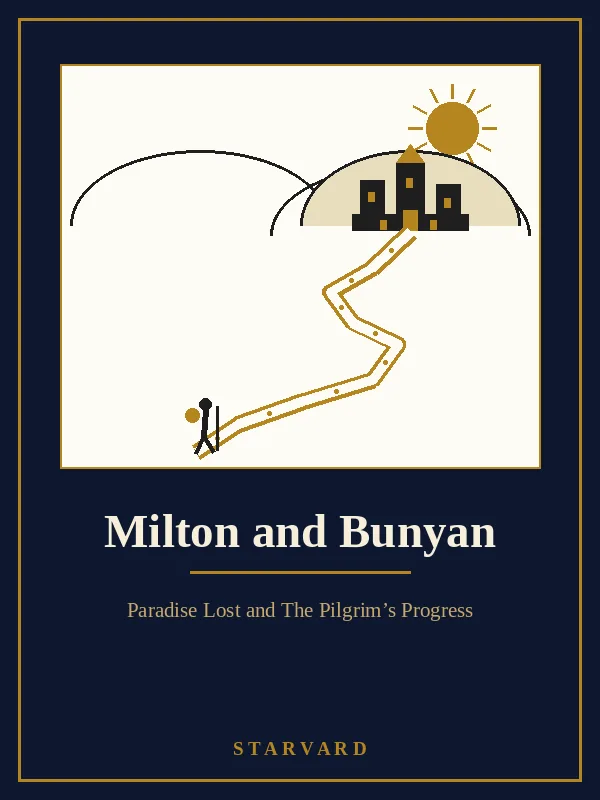
Starvard University · Milton and Bunyan
Two Puritan writers, a blind epic poet in London and a tinker who preached his way into prison, gave English its two great stories of the soul: the fall of man in Paradise Lost and one man's road to heaven in The Pilgrim's Progress. This course walks both roads with you, in the writers' own words.


Hello, my name is Finn, and I'm going to help you understand this course.
Here it is, explained like you are 10:
John Milton was a blind poet who wrote a giant poem about Adam and Eve, angels, and a proud rebel angel named Satan. John Bunyan was a tinker, a man who fixed pots, and he wrote a dream story about a man named Christian carrying a heavy bundle on his back, walking a hard road toward a shining city. Both books ask one big question: how do we find our way home?
Milton (1608 to 1674) was a Cambridge scholar who served England's Puritan government and went completely blind in his forties; he dictated Paradise Lost, his twelve-book epic on the fall of man, to assistants, and it was published in 1667. Bunyan (1628 to 1688) was a travelling tinker with almost no schooling who was jailed for years for preaching without a license, and began The Pilgrim's Progress, published in 1678, during his time in prison.
This course reads both books as the soul stories they are. You will meet Satan at his most magnificent and most mistaken, stand in Eden on the morning of the Fall, and then walk Bunyan's road step by step: the burden that falls at the cross, the fair that sells everything except what matters, and the shining city at the end. We also tell the hard parts of both men's lives plainly, in Lesson 1, because their books make more sense, not less, when you know what each man risked and lost.
The whole course in brief
What you will be able to do after this course
The eight lessons
Lesson 1
John Milton was born in London in 1608, the son of a scrivener who loved music, and he was educated like a scholar: St Paul's School, then Christ's College, Cambridge, then years of private study, reading Latin, Greek, Hebrew, and Italian poetry. He wrote accomplished verse young. But England was sliding toward civil war, and Milton put his pen at the service of the Puritan cause, writing pamphlets for reform. When the war ended he became the Commonwealth government's Latin secretary, composing state letters to Europe.
Here is the honest line this course owes you, before the poems: Milton defended the execution of King Charles I in print, in a book arguing that a tyrant may lawfully be judged by his people, and he argued for divorce reform in famous tracts written after his young wife left him for three years; Paradise Lost, in his own stated purpose, aims "to justify the ways of God to men"; and Bunyan, as you will see in a moment, wrote his great book from prison, jailed for preaching without a license. When the monarchy returned in 1660, Milton, by then completely blind, was briefly imprisoned and lucky to keep his life. In his blindness he composed Paradise Lost by dictation, holding whole passages in his head overnight for an assistant to write down in the morning, and published it in 1667.
John Bunyan was born in 1628 near Bedford, twenty years after Milton and a whole world away. He was a tinker, a travelling mender of pots and pans, whose schooling was so slight he feared he had forgotten it. He soldiered as a teenager in the same civil war, married poor, and went through a long, tormented conversion, fearing he was beyond saving. He became a preacher anyway, and when the restored monarchy required preachers to be licensed, Bunyan refused. He spent most of twelve years in Bedford jail, supporting his family by making shoelaces, and preaching to the prisoners around him. There, in prison, he began the dream story that became The Pilgrim's Progress, published in 1678. Between the blind scholar and the jailed tinker, English got its two great stories of the soul.
Lesson 2
Paradise Lost opens not in Eden but in Hell, and its first great character is the loser. Satan and his angels, beaten in a war in Heaven, lie on a burning lake in a place of "darkness visible", and Satan rises to survey his loss. What he has left is his voice. Milton, who had served a revolution and watched it fail, gives his villain the finest rhetoric in the poem: speeches of defiance, wounded grandeur, and self persuasion that readers have found magnificent for three and a half centuries, sometimes to Milton's own embarrassment: Blake later joked that Milton was secretly of the devil's party.
Listen to Satan rally his ruined army: "The mind is its own place, and in itself can make a Heaven of Hell, a Hell of Heaven". Half of it is even true: the mind really can transfigure its surroundings. But watch what Satan uses it for: not repentance, but ambition. A few lines later comes the famous conclusion: "Better to reign in Hell than serve in Heaven". Milton is showing you how a brilliant mind talks itself into ruin, choosing sovereignty in misery over service in joy, and dressing the choice up as courage. The tragedy is that Satan nearly persuades us, too.
In Book II the fallen angels debate their options in their new capital, Pandemonium: open war against Heaven, sullen inaction, or empire building in Hell. The winning counsel is the most dangerous one. A rumour says that God has created a new world and a new creature, man; the devils will take their revenge by corrupting that creature. Satan alone volunteers for the voyage, flies up past the gates of Hell, bargains his way through Chaos, and at last sees the created universe hanging in space, and below it, shining, Eden. Keep one question with you through the next lesson: everything Satan says about freedom, he says on his way to take someone else's away.
Lesson 3
Satan enters Adam and Eve's story as a watcher. Leaping the wall of Paradise, he sits in the Tree of Life disguised as a cormorant and overhears the one law of the garden: of every tree they may eat freely, except one tree, on pain of death. His soliloquy on Mount Niphates is one of his great moments of honesty: Satan admits that God is good, that his rebellion was ungrateful pride, and that repentance might still be possible. Then he talks himself out of it, unwilling to face shame before his followers, and vows to take evil itself as his good. Everything he does in Eden afterward is done with open eyes.
Milton's Eden is a working garden, not a museum. Adam and Eve tend it together, eat, pray, and welcome their one angelic teacher, Raphael, sent down to warn them that an enemy is near and that obedience is theirs to choose, not a chain laid on them. Raphael retells Satan's war and fall, and leaves them with the poem's central freedom: strong enough to stand, free enough to fall. Eve has already dreamed a troubling dream, in which a voice urged her toward the forbidden tree. The stage is fully set, and nobody in the garden is ignorant of the stakes.
The Fall itself, in Book IX, is deliberately unspectacular, and that is the point. Satan, returned inside the serpent, flatters Eve: he praises her beauty, marvels that a creature so lovely should live unseen, and argues that the fruit has made him, a beast, able to speak and reason, so it cannot kill her. He questions God's fairness in forbidding knowledge at all. Eve reasons, hesitates, and eats, and then resolves that Adam shall share her doom rather than be left unharmed, perhaps to a new wife. Adam, who is not deceived and knows exactly what she has done and what it means, eats too, choosing her over the garden. No thunder sounds. There is shame, covering, and quarrelling, and then a judge who comes in mercy, with a promise folded inside the sentence: speaking to the serpent, God says, "Her seed shall bruise thy head, thou bruise his heel". The first thread of hope is sewn into the worst day in the world.
Lesson 4
The poem could have ended the human story in despair. Adam and Eve, hiding their shame, fall first on each other: recrimination, self pity, a wish for death. What turns the story is Eve: she comes to Adam in a humility she did not have in the garden, takes her share of blame without bargaining, and proposes that they go together to the place of judgment, confess, and pray. Adam's heart softens, and their prayers are heard: the Son intercedes for them, and the Father accepts their repentance. Nothing is undone: death still stands, Eden is still lost, and they will still be expelled. Repentance, in this poem, is not an eraser. It is a door, and it opens forward, into a hard world, not backward into the garden.
The final two books belong to the archangel Michael, sent to show Adam what his choice has set in motion. It is a pageant of the whole Bible still to come: Cain's murder of Abel, disease and flood, Abraham and the Exodus, law and kings and exile, and at the centre of history a birth in a stable and a death on a cross, which Adam slowly understands as the promised bruising of the serpent's head. He is taught the poem's hardest comfort: God will not abandon the story, and a greater Paradise is promised at its end than the one now closing behind them. Adam must add deeds to knowledge, faith, patience, and temperance, and learn that obedience and love can build, in Michael's words, "A Paradise within thee, happier far".
Then comes the most beloved ending in English poetry. The angel leads them down the hill; behind them the gate of Eden stands thronged with dreadful faces and fiery arms. Milton slows everything to walking pace: "Some natural tears they dropt, but wiped them soon; The world was all before them, where to choose". The final picture is not a slammed door but two people holding hands on an open road: "They, hand in hand, with wandering steps and slow, through Eden took their solitary way". Bunyan took up exactly that image: one pilgrim, one road, and the whole world before him.
Lesson 5
Bunyan begins with a dream, and says so: asleep in a den in the wilderness of this world, he dreams of a man "clothed with rags", a book in his hand, and "a great burden upon his back". The man is Christian, and the burden is the weight of his sins and of a sentence in his book: his city, the City of Destruction, is doomed, and so is he, unless he flees. His family think him distracted. He stands in the fields weeping and crying out, "What shall I do?", until a man named Evangelist asks him why he cries so. "What shall I do to be saved?" Christian asks him. Evangelist points across the field: "Do you see yonder shining light?" Run to the wicket gate at its foot, he says, and knock.
Christian runs, with his fingers in his ears against his family's calls to come back, and the road immediately fights him. Neighbours pursue him; a companion, Pliable, joins him and quits at the first hardship. The burden makes every mile heavier, and Mr Worldly Wiseman nearly diverts him to a village called Morality, where a gentleman named Legality relieves burdens cheaply, by good behaviour instead of by the cross. Evangelist rescues him and sets him straight. At the wicket gate a man named Goodwill pulls him quickly in, just ahead of arrows shot at him from a castle nearby, and sends him on to the Interpreter's House, where picture lessons arranged in living rooms teach him what the road holds: a fire that water cannot quench, and a man in an iron cage who waited too long to come.
Then comes the scene the whole book is remembered by. Christian climbs a little hill and comes to a cross, and there, as if the straps give way, his burden looses from his shoulders, tumbles down the hill, and falls into an open sepulchre, never to be seen again. Christian does not unburden himself by effort, insight, or respectability. He comes to the cross, and the burden falls. Three Shining Ones meet him on the road with forgiveness, new clothing for his rags, and a sealed roll to present at the Celestial Gate. Then, Bunyan writes, Christian gave three leaps for joy, and went on singing. The rest of the pilgrim's progress is not about getting the burden back off. It is about keeping the road.
Lesson 6
The road's two great dangers attack opposite weaknesses: one near the beginning, one near the middle. The Slough of Despond comes first, before even the wicket gate. It is a bog lying across the road where, Bunyan explains, the fears, doubts, and discouragements of awakened sinners run down and collect, like the scum of a drain. Christian, still weighted with his burden, begins to sink, the king has laid stepping stones through it, but in his panic Christian misses them. Pliable scrambles out on the side nearest home and goes back. Christian is pulled out by a man named Help, who gives the book's plain doctrine of despair: the slough is real, it is not the end of the road, and no one crosses it by standing still. It is the season when trouble is known faster than comfort arrives, and Bunyan's genius is to make help arrive as a person, not an argument.
Vanity Fair comes later, in a town called Vanity where a fair runs all year round, founded long ago, in Bunyan's telling, by Beelzebub and his companions to catch pilgrims passing through. Almost everything is for sale in its rows: houses, honours, titles, kingdoms, pleasures, and lives themselves. Christian and his companion Faithful pass through, answering every eager sales pitch with the most offensive sentence in the whole market: they will buy only the truth. The fair riots. The pilgrims are caged, mocked, and put on trial before Lord Hategood, with witnesses named Envy, Superstition, and Pickthank, and a jury of Mr Blind-man, Mr Malice, and Mr Heady.
Faithful is condemned, and executed with every cruelty the fair can devise, and Bunyan simply adds that a chariot and horses were standing ready just beyond the suffering, to carry Faithful straight up to the Celestial Gate by the shortest road of all. Christian escapes, and a man of the town who watched Faithful die, named Hopeful, takes the martyr's place beside him: one pilgrim's witness creates the next pilgrim. Read the two places of this lesson together and you have Bunyan's map of opposition. The Slough is the enemy inside, despair that says the road is impossible. Vanity Fair is the enemy outside, a world that says the road is unnecessary, because everything worth having is already for sale right here. Between sinking and buying, the pilgrim is meant simply to keep walking.
Lesson 7
After Vanity Fair the road runs through country every long journey knows: pleasant meadows that belong to a giant, and a smooth bypath that looks easier than the rough highway. Resting in By-Path Meadow, Christian and Hopeful are caught by Giant Despair and locked in the dungeon of Doubting Castle, where the giant beats and starves them, shows them the bones of earlier pilgrims, and urges them to end their own lives. Bunyan had spent twelve years in a real jail and knew what a cell does to hope at three in the morning. The pilgrims survive by prayer, and by Hopeful refusing to let Christian despair alone.
The escape, when it comes, is the book's tenderest lesson about despair. On the last night, Christian suddenly remembers himself: "I have a Key in my bosom called Promise", he says, which will open any lock in Doubting Castle. It does, gate after gate, until the pilgrims slip away as the giant wakes. The key was in his bosom the whole time. From there the road climbs to the Delectable Mountains, where shepherds named Knowledge, Experience, Watchful, and Sincere lend the pilgrims a perspective glass, and through it they catch a distant glimpse of the gates of the Celestial City itself, still far off and already shining. They pass the flatterers, warn a cheerful man named Ignorance who trusts in his own good heart, and come at last to Beulah, where the sun shines day and night and the city bells sound across the river.
One barrier remains, the one every reader feels in the stomach: a deep river with no bridge, the river of death. Christian begins to sink in it, crying out in terror, and it is Hopeful who holds him up, in the book's great pattern of friendship, telling him to be of good cheer: he can feel the bottom, and it is good. They come up together on the far shore, shining men strip away their mortal garments, and the gates open to trumpets, bells, and the King's own welcome. Christian's sealed roll, carried the whole long way, is presented and accepted. And Bunyan ends the dream with a warning tucked inside the joy: he saw Ignorance, who had crossed the river easily with a ferryman's help, bound and carried away from the very gates. Arriving is not the same as entering: the road, not the shortcut, is the point.
Lesson 8
An allegory is a story whose places are also meanings, and Bunyan's is the most successful: The Pilgrim's Progress has been translated into more languages than nearly any book besides the Bible and has never been out of print since 1678. Milton works the opposite way, by grandeur: a cosmos to stand inside, Heaven, Hell, Chaos, and a garden, and one question, what freedom means in each. From Milton: freedom is real, it is costly, and it is lost or kept by choice. From Bunyan: the life of faith is a journey, taken on foot, in company, through weather you did not choose.
So now draw your own map. Take a page and mark, honestly, the landmarks this course has named. What is the burden you actually carry, not the one you would admit to in company? Where is your Slough of Despond, the season or the recurring thought where you sink, and who has played Help for you there, pulling you out rather than arguing with you? What is your Vanity Fair, the market whose goods you are most tempted to settle for, and whose salesmen know your name? Who is your Hopeful, the companion whose courage has covered your sinking moments, And what stands at the end of your road: what shining city, what paradise within, are you truly walking toward?
To read on from here, both books are free in full at Project Gutenberg, listed below, and two tips from three centuries of readers will serve you. First, read Paradise Lost aloud: the verse was composed in a blind man's ear, in long musical sentences, and it gives up its sense to the voice faster than to the silent eye. Second, do not skip Bunyan's second part, where Christian's wife Christiana walks the same road with their children and finds it both the same and entirely different. Milton ends with a world all before his pair. Bunyan ends with a gate swinging open. Between the road and the gate, these two books have kept more readers company than almost any others in English. Walk well.
Sources
This course is taught from two books, both free for anyone to read in full at Project Gutenberg. Every quotation in the lessons above was checked against these texts.
Graduation
You heard Satan make his magnificent, ruinous case, stood in Eden on the morning everything changed, and watched Adam and Eve walk out hand in hand with a promise in their ears. Then you shouldered a burden with Christian, sank in the Slough, stood your ground at Vanity Fair, escaped Doubting Castle with a key from your own bosom, and crossed the last river into the shining city. Congratulations: you now hold the two great English maps of the soul, and you have begun to draw your own.
Keep learning
This course is part of Starvard University, striving for greatness.
A note on accuracy: Much of what you read at Starvard was created with help from AI agents, working alongside people. We check what we can, but we cannot guarantee that everything here is true, current, or complete. If something really matters, your health, your money, a grade, a job, please verify it with a trusted source before you rely on it.