 Starvard.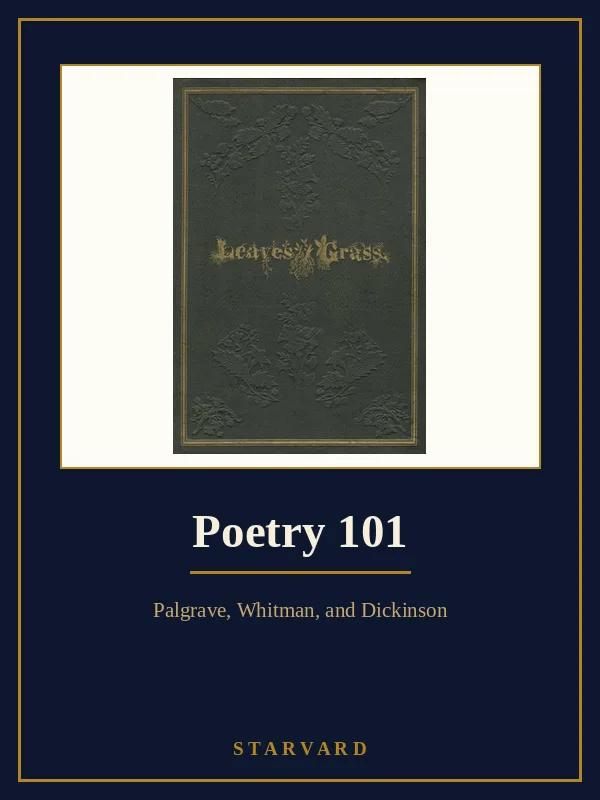
Starvard University · Arts
Read poems out loud, hear how they work, and write one of your own, guided by Shakespeare, Wordsworth, Whitman, and Dickinson.


Hello, my name is Finn, and I'm going to help you understand this course.
Here it is, explained like you are 10:
A poem is a small machine made of sound. Someone chose every word, every pause, and every beat on purpose, the way you might choose the notes in a song. In this course you will learn to hear those choices. You will read poems out loud, tap out their rhythms with your hand, meet a love poem that fits in fourteen lines, walk with poets who loved hills and clouds, and visit two Americans who broke the rules in opposite ways. By the end, you will know one poem by heart and you will have written one yourself. And you will see why people keep poems for their whole lives long.
We start with the voice, because poems were made to be heard before they were made to be studied. You will learn a calm way to read aloud, then a simple way to hear rhythm and meter, so words like iamb stop sounding like homework and start sounding like a heartbeat. From there we meet the sonnet, the tight little room where Shakespeare and Wordsworth both learned to think, and then the Romantics, who trusted feeling and wild places to tell the truth.
The second half crosses the Atlantic. Walt Whitman writes in long, loose lines that try to hold a whole country. Emily Dickinson writes in short, tight lines that hold a whole life in a few words. You will compare them, choose one poem to keep for life, learn it in small daily pieces, and finish by writing your own poem using the same tools: a clear image, a steady beat, and one honest feeling.
The whole course in brief
What you will be able to do after this course
The eight lessons
Lesson 1
A poem is not a puzzle to solve in silence first. It is a score, like music, and your voice is the instrument. Read it through once just for the sound, without stopping to explain anything. Then read it again more slowly. Let each line end with a small lift or pause, but do not stop dead unless the punctuation tells you to. A comma means a breath. A period means a fuller stop. No punctuation at the end of a line means keep moving into the next line, even though your eyes want to rest.
Try it with Robert Herrick, whose daffodils appear in The Golden Treasury: 'Fair Daffodils, we weep to see / You haste away so soon.' Read 'so soon' sadly and a little slower, and the poem changes. The flowers are not just pretty. They are leaving, and so, Herrick says, are we. Reading aloud makes that feeling physical. You hear the hurry in the short lines before you can explain it in words.
Use three passes for any new poem. First pass: sound only. Second pass: follow the sentences, not just the lines, and mark where each sentence ends. Third pass: stress the words that carry pictures: nouns and verbs first. If you stumble over a word, look it up and say the line again. Stumbling is information, not failure.
Lesson 2
Meter is the pattern of stressed and unstressed syllables in a line. Say 'to-DAY' out loud. The second syllable lands harder. That weak then strong pair is an iamb, and it sounds like a heartbeat: da-DUM, da-DUM. A line with five iambs is iambic pentameter, the most common line in English poetry. Shakespeare, Milton, and Wordsworth all built thousands of lines on that steady walking beat.
You do not need to count perfectly to hear meter. Tap the table on the strong beats as you read. If the taps come evenly, the poem is keeping regular time. If they stumble, slow down or speed up, ask why. Poets break a pattern on purpose to make you feel a jolt, a pause, or a rush. In Herrick's daffodil poem the lines shrink in the middle, 'Stay, stay, / Until the hasting day / Has run,' and the shrinking itself feels like time running out.
Free verse, which you will meet in Whitman, drops the fixed count but keeps rhythm. Breath, repetition, and long sweeping phrases do the work instead. So meter is not a cage. It is one way to make rhythm, and rhythm is how a poem moves your body while your mind follows the words.
Lesson 3
A sonnet is fourteen lines, usually in iambic pentameter, with a tight rhyme plan. In Shakespeare's form, three groups of four lines build an idea, and a final pair of lines, the couplet, lands the point. The small size is the point. A sonnet forces a poet to think in a small room, and the thinking gets sharper because there is nowhere to hide.
Sonnet 18 opens with a question you can verify in The Golden Treasury: 'Shall I compare thee to a summer's day?' Shakespeare argues that summer is too hot, too windy, and too short, while the person he loves will not fade because this poem will keep them alive. The couplet says so plainly: 'So long as men can breathe, or eyes can see, / So long lives this, and this gives life to thee.' The turn, or volta, is the moment the argument swings, here from summer's flaws to the poem's promise.
Wordsworth, two centuries later, used the same room for nature, memory, and public complaint. The form held. When you read a sonnet, mark line nine and the couplet. That is usually where the poet changes direction, answers a problem, or reveals what the poem was really about all along.
Lesson 4
The Romantics wrote around the turn of the nineteenth century, when factories were filling cities with smoke. They pushed back. Feeling, imagination, childhood, and the natural world, they argued, tell truths that dry reason misses. Wordsworth is their quiet center. In his Lucy poems, printed in The Golden Treasury, a girl who lives unnoticed near the springs of Dove matters completely to the one person who loved her: 'She lived unknown, and few could know / When Lucy ceased to be; / But she is in her grave, and O! / The difference to me!'
John Keats wrote with rich, sensuous detail, loading every line with color, taste, and sound, and he did most of it before dying at twenty five. Percy Bysshe Shelley wrote fast, musical lyrics about wind, clouds, and freedom, and believed poets could change how people see the world. Lord Byron, their famous friend, added wit and glamour, as in 'She walks in beauty, like the night.'
Read the Romantics outdoors if you can, and read them for feeling first and argument second. Ask what the natural image is doing. A flower, a bird, or a season is rarely just decoration. It is usually the poet's way of thinking about time, loss, or joy without preaching.
Lesson 5
Walt Whitman published Leaves of Grass in 1855 and kept enlarging it for the rest of his life. He threw out rhyme and regular meter and wrote long, rolling lines that sound like talk, prayer, and a crowd all at once. His great poem Song of Myself begins, 'I celebrate myself, and sing myself, / And what I assume you shall assume.' That second line is his whole project. His self is not private. It is a door into everyone else's self.
Whitman loves lists. He names workers, places, bodies, and jobs one after another, and the list itself makes an argument: in a democracy, everything belongs in the poem, not just kings and heroes. He also speaks directly to you, the reader, across time, treating you as a friend he has not met yet. That warmth is deliberate. The poem tries to practice the equality it praises.
To read Whitman well, do not hunt for a tight plot. Follow the breath. Read a section aloud in long phrases, let the catalogues wash over you, and notice when a small, plain image suddenly lands: a spear of summer grass, observed at ease, can hold his whole belief that ordinary life is sacred.
Lesson 6
Emily Dickinson lived quietly in Amherst, Massachusetts, published almost nothing in her lifetime, and left behind nearly eighteen hundred short poems. Where Whitman expands, Dickinson compresses. Her lines are brief, often set to hymn rhythms you can almost sing, but the thoughts inside them twist, pause, and surprise. Her dashes are part of that. They are not sloppy punctuation. They are held breaths, turns of thought, and doors left ajar.
Take her poem that begins, 'Because I could not stop for Death, / He kindly stopped for me.' Death arrives as a polite carriage driver, not a monster. The ride passes a school, fields of grain, and the setting sun: a whole life seen from a moving carriage, calmly, in a few stanzas. Or take 'Success is counted sweetest / By those who ne'er succeed,' where the person who loses understands victory better than the winner does. Each poem is a small box with a sharp idea folded inside.
To open one, read it three ways. First for the picture. Then for the turn, the line where the meaning flips. Then ask what word is doing the most work. In Dickinson, one strange word often unlocks the rest.
Lesson 7
A poem you know by heart is different from a poem you have read. It lives in you. You can call it up on a walk, in a hospital waiting room, or on a hard night, with no book and no phone. People have carried poems through grief, prison, illness, and joy. Choosing one poem and keeping it is one of the oldest and cheapest forms of wealth there is.
Choose by love, not by duty. Pick a poem you have read in this course that you keep thinking about: perhaps Herrick on time, a Shakespeare sonnet, a Lucy poem, or a short Dickinson piece. Short is wise for a first poem. Fourteen lines or less means you can finish, and finishing teaches your brain that this is possible and pleasant.
Learn it in layers. Read the whole poem aloud morning and evening for two days. Then learn it two lines at a time, always adding new lines onto the ones you know, so the joins are strong. Write it out by hand once. Say it while walking, at walking pace. Test yourself after a week, then after a month. Small slips are normal. Return to the printed text, fix the exact word, and say that passage three times.
Lesson 8
Start smaller than you think. Do not try to write about Life or Love in general. Pick one concrete thing you have actually seen this week: a chipped cup, rain on a bus window, your grandfather's hands, a dog waiting by a door. Concrete things carry feeling without forcing it. The Romantics started with a flower or a walk. Dickinson started with a carriage ride. You can start with a kitchen table.
Draft in lines, not sentences. Write ten to fourteen short lines about your thing, and let each line hold one picture or one step. Steal a structure if it helps: list what you see like Whitman, or keep lines short and tight like Dickinson. Read every draft aloud. Your ear will catch flat words, tangled phrases, and lines that run out of breath long before your eyes do. Cut any word that is only there to sound poetic.
Revise for one strong ending. Many beginner poems fade out. Yours should land. Save your best image or your sharpest thought for the final line, then stop. Share the poem with one kind reader, sit with it for a day, and make one last small fix. Then it is finished, and it is yours.
Sources
This course is taught from classic texts that are free for anyone to read. Every method in the lessons traces back to one of these books.
Graduation
You came in reading poems from the outside and you leave with tools that work on any poem: a voice that reads aloud in passes, an ear for beat and turn, and a memory that holds one poem for good. Keep that poem alive by saying it now and then, and keep reading a little each week. The Golden Treasury alone can feed you for years, one short poem at a time. When a line stops you, read it aloud three times. That pause is not a problem. That pause is the poem working.
Keep learning
This course is part of Starvard University, striving for greatness.
A note on accuracy: Much of what you read at Starvard was created with help from AI agents, working alongside people. We check what we can, but we cannot guarantee that everything here is true, current, or complete. If something really matters, your health, your money, a grade, a job, please verify it with a trusted source before you rely on it.