 Starvard.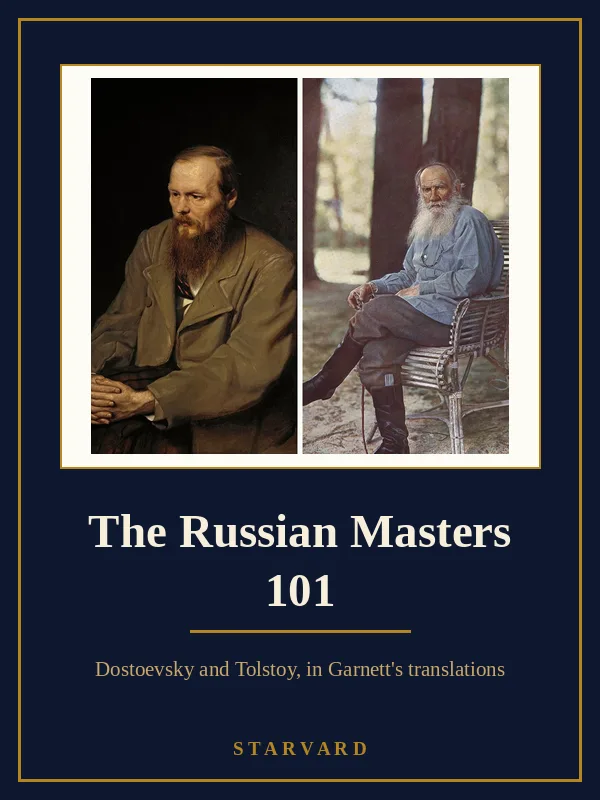
Starvard University · Russian Literature
Dostoevsky and Tolstoy ask the biggest questions in fiction: guilt, faith, love, and the meaning of life. Read their greatest scenes in Constance Garnett's classic translations.


Hello, my name is Finn, and I'm going to help you understand this course.
Here it is, explained like you are 10:
Two Russian writers from long ago wrote some of the longest, deepest storybooks in the world, and grownups still argue about them today. One, Dostoevsky, writes about a poor student who does a terrible crime and cannot escape his own conscience. The other, Tolstoy, writes about families: a woman who falls in love and breaks the rules, and a farmer who searches for God while he works in the fields. Their books ask big questions. Is it ever right to do a wrong thing? How should we love people? What makes life mean something? This course reads the best scenes slowly, together.
First, do not be scared of the size. These books were printed a few chapters at a time in magazines, like a television series that arrives week by week, and Russian families read them out loud and argued at the dinner table. You can read them the same way, a small piece every day. The names look hard, but they follow a pattern: a first name, a middle name that names the father, and a family name. Friends also have short pet names, so one man can be Alexey, Alyosha, and Karamazov all at once.
This course stays with the scenes everyone remembers. You will stand in a hot, stuffy room while a student talks himself into a crime, sit quietly while a kind young woman reads him a Bible story by candlelight, watch two very different marriages, hear a debate about God beside a monastery, and finish with a simple plan that makes any giant book feel friendly. The English words in this course come from Constance Garnett, a translator who carried these books into English more than a hundred years ago, and her spellings are the ones on our pages.
The whole course in brief
What you will be able to do after this course
The eight lessons
Lesson 1
Start with the stage. In 1861, just a few years before Crime and Punishment began appearing in a magazine, Tsar Alexander II freed the serfs, the peasants who had been bound to landowners and the land for centuries. Russia was changing fast and arguing about everything: faith, science, money, Western ideas, and whether the old authorities still deserved obedience. St. Petersburg, the capital, joined grand avenues and palaces to crowded lodging houses where poor students and clerks rented a corner of a room.
Our two authors knew this world from opposite ends. Tolstoy was a count with an estate, writing from inside the drawing rooms he described. Dostoevsky was arrested young for belonging to a reading circle, sentenced to death, reprieved at the scaffold itself, and sent to Siberia for four years of hard labor. He came home writing about criminals, students with dangerous ideas, and believers, because he had lived among all three.
You will read both men in the translations of Constance Garnett, the Englishwoman who carried nearly all of Russian literature into English in the early 1900s. Her versions are clear, musical, and free for anyone to read. Follow her spellings as you go: she writes Sonia, not Sonya, and Father Zossima, not Zosima.
Lesson 2
Raskolnikov is a former student living in a garret more like a cupboard, hungry, proud, and behind on his rent. He has written an article arguing that humanity divides into two kinds of people. Ordinary people must obey the law and keep society going. Extraordinary people, the Napoleons of the world, may step over the law when a great idea requires it, and conscience need not trouble them. Raskolnikov wants to know which kind he is, and he has a victim in mind: Alyona Ivanovna, a pawnbroker he sees as a harmful, hoarding old woman whose money could fund a useful life.
Before he acts, he overhears a stranger in a tavern arguing his own theory back to him, almost word for word: one worthless life weighed against thousands of lives saved by her money, presented as simple arithmetic. The coincidence shakes him. It suggests his private idea is simply in the air of the time, and that he may not be extraordinary at all.
He commits the murder, and the theory collapses at once. Panicked, he also kills the pawnbroker's gentle sister Lizaveta, who walks in on him. The stolen money goes under a stone, unspent. What follows is not triumph but fever, fainting, and terror of everyone he meets.
Lesson 3
Sonia Marmeladov is the moral center of the novel. Her drunken father has lost everything, and she supports the family the only way left open to her, at the cost of her own reputation, yet she keeps an unshaken faith. When Raskolnikov visits her tiny room, he asks her to read him the story of the raising of Lazarus from the Gospel. Garnett tells us that Sonia read distinctly and forcibly as though she were making a public confession of faith. A murderer and an outcast read together about a man called out of a tomb, and both of them understand why.
Later he confesses to her, not with an excuse but with the truth about his motive. He did not kill for money or to help his mother. He wanted to test himself, to learn whether I was a louse like everybody else or a man, whether he had the right to step over. Sonia's answer is not philosophy. She tells him to go to the crossroads, bow down, kiss the earth he has defiled, and say aloud what he did.
He does bow in the square, then confesses at the police station. The epilogue takes him to Siberia, where Sonia follows, and where change comes slowly, like a man recovering from a long illness.
Lesson 4
Tolstoy opens with the most famous first sentence in fiction: "Happy families are all alike; every unhappy family is unhappy in its own way." The unhappy family on the first page belongs to Stiva Oblonsky, caught in an affair with the children's former governess. His sister Anna travels to Moscow to patch up his marriage, and on the journey she meets the young officer Vronsky. The whole tragedy grows out of that meeting.
Anna's own marriage, to the high official Karenin, is correct in form and empty in life. He speaks in official phrases, guards his reputation above all, and treats forgiveness itself as a policy. Against this, Tolstoy sets the marriage Anna's story is braided with: Levin and Kitty, who begin the novel failing to understand each other and slowly build something real out of work, jealousy, apologies, a child, and ordinary days.
Anna and Vronsky's love is genuine, and Tolstoy never cheapens it, but it must live in hiding and exile from society, and it curdles into suspicion and despair. Anna ends her life at a railway station, under a train, in one of the saddest scenes ever written, while Levin's household, with all its friction, keeps choosing life.
Lesson 5
Konstantin Levin is Tolstoy's stand in, a landowner who distrusts fashionable ideas and keeps running experiments on his own life. He proposes to Kitty, is refused, and throws himself into farming. In the novel's most loved chapter he spends a day mowing with his peasants, and the rhythm of the scythe does what arguments could not: his self consciousness dissolves into shared work, sweat, and bread and kvass at the rest breaks, and he goes home at peace.
Marriage does not finish his search. He watches his brother Nikolai die and cannot accept that a conscious life simply stops. His son is born and he feels, to his shame, more irritation than rapture at first. Fatherhood, work, and death keep asking him the same question in different rooms: what is all this for?
The answer arrives quietly, from something a peasant says about a man who lives not for his own needs but for God and remembers souls. Levin thinks it through alone, lying in the grass, and concludes that he does know the meaning of my life: "To live for God, for my soul." He stays irritable, keeps arguing with Kitty, and knows he will sin again. The meaning holds anyway, because it does not depend on his moods.
Lesson 6
The Brothers Karamazov is Dostoevsky's last novel, the story of the violent, sensual Fyodor Pavlovich and his sons: passionate Dmitri, gentle Alyosha, and Ivan, the brilliant brother who has lost his faith. When their father is murdered, all three stand under suspicion in different ways, but Ivan carries the deepest wound, because he believes his ideas helped load the weapon.
Ivan shares those ideas with Alyosha over a restaurant table, in a poem he once composed in his head. In it, Christ returns quietly to Seville in the age of the Inquisition and is arrested by the aged Grand Inquisitor, who lectures him through the night. You came, he says, to give men freedom, but freedom is a burden they cannot bear. "Thou wouldst go into the world, and art going with empty hands," he charges, arguing that people will gladly trade their freedom for bread, certainty, and someone to worship together.
Christ never answers a word. At the end he simply kisses the old man, who opens the door and lets him go. Then Ivan looks at Alyosha, and Alyosha, without a speech, kisses his brother. The argument stands refuted in the only currency Dostoevsky trusts: an act of love.
Lesson 7
Alyosha, the youngest brother, is the novel's unlikely hero: a novice monk in his twenties, attached to the elder Father Zossima, whose cell draws crowds of sufferers looking for counsel. Zossima teaches that faith is proved not by fine feelings but by practice. "Strive to love your neighbor actively and indefatigably," he tells a visitor, promising that as love advances, doubt retreats. Elsewhere he is blunter: love in action is a harsh and dreadful thing compared with love in dreams, because active love is labor and fortitude.
When Zossima dies and his body decays quickly, scandalizing the believers who expected a sweet smelling miracle, Alyosha's faith nearly breaks. What restores him is not a sign but a memory of the elder's joy, a vision of the wedding at Cana, and a decision to go back into the world and work. He falls to the earth outside the monastery, weeps, and rises strengthened.
The novel ends with Alyosha doing small, faithful work: standing with a band of schoolboys at the funeral of their friend Ilyusha and urging them to keep one good memory from childhood, because a single sacred memory, preserved, can save a person later in life.
Lesson 8
These three novels run to thousands of pages between them, and length is their method, not their flaw. Dostoevsky and Tolstoy need room because people change slowly, in scenes, not summaries. So read the way their first readers did. Both men published in installments, and thirty pages a day, kept steadily, will carry you through any of these books in a season while leaving each scene time to settle.
Solve the names first and half the fear disappears. A Russian name comes in three parts: a given name, a patronymic meaning son of or daughter of, and a family name, so Ivan Fyodorovich Karamazov is Ivan, son of Fyodor, of the Karamazovs. Friends use pet names, and one page of notes in the front of your book, listing who is who, will pay for itself every day. Petersburg, Moscow, the estate, the monastery: a rough map helps too.
Finally, do not skim the talk. In these novels the conversations are the action: the tavern argument, the restaurant debate, the deathbed talk are where souls are won and lost. Read dialogue at speaking pace, aloud if a passage grips you. When you finish, reread the first chapter. You will be surprised how much of the ending was planted there.
Sources
This course is taught from classic texts that are free for anyone to read. Every method in the lessons traces back to one of these books.
Graduation
You came for three enormous novels and found three close companions: a student learning that no idea outranks a person, a farmer learning what his life is for, and a young monk learning to love in action. Keep Garnett's volumes by your chair, thirty pages at a time, and they will keep teaching you for years. Congratulations, and welcome to the long, deep shelf.
Keep learning
This course is part of Starvard University, striving for greatness.
A note on accuracy: Much of what you read at Starvard was created with help from AI agents, working alongside people. We check what we can, but we cannot guarantee that everything here is true, current, or complete. If something really matters, your health, your money, a grade, a job, please verify it with a trusted source before you rely on it.