 Starvard.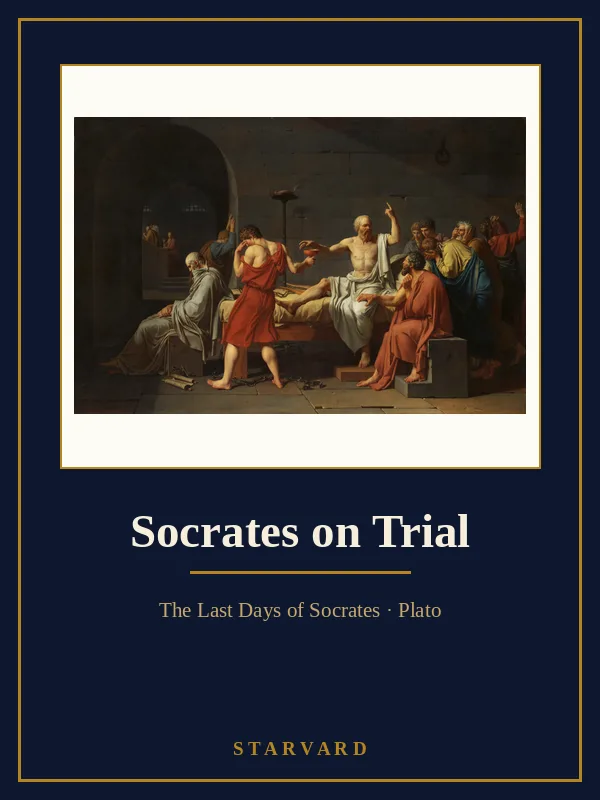
Starvard University · Socrates and Plato
Follow Socrates through his trial, his prison cell, and his final day, and learn why one old man who asked questions still shapes how we think.


Hello, my name is Finn, and I'm going to help you understand this course.
Here it is, explained like you are 10:
Hi, I am Finn. Socrates never wrote a book. He just walked around Athens asking people big questions, like what is courage, and what is justice, and he would not stop until their answers fell apart. Then Athens put him on trial. This course follows his last days through three short books by his student Plato. You will hear Socrates defend himself, refuse a chance to escape prison, and spend his very last day talking happily about whether the soul lives on. It is a sad story, but also a hopeful one, because he stayed calm and kind right to the end. Bring a notebook if you like, because Socrates has a habit of making people want to write down their answers.
You do not need any philosophy background for this course. Plato wrote these scenes like plays, with real people talking, joking, and sometimes getting annoyed. We will take one scene at a time, in plain words, and I will point out the famous lines when they come, including the moment Socrates says the unexamined life is not worth living.
By the end you will know why people have read these three little books for more than two thousand years. You will also have a tool you can use anywhere: Socrates' way of asking clear questions until a muddled idea becomes clear, or shows that it was muddled all along.
The whole course in brief
What you will be able to do after this course
The seven lessons
Lesson 1
Athens in 399 BC was a proud democracy that had just lost a long war with Sparta, and many citizens felt the city was slipping. Into this tense city walked Socrates, now more than seventy years old, barefoot, plainly dressed, and famous for one habit: he stopped people in the marketplace and asked them to explain what they thought they knew. Politicians, poets, and craftsmen all discovered, in front of an audience, that they could not define courage, piety, or justice. Young men loved watching. Their elders did not.
Three accusers brought Socrates to trial: Meletus, on behalf of the poets; Anytus, on behalf of the craftsmen and politicians; and Lycon, on behalf of the public speakers. The formal indictment, as Plato records it, ran like this: Socrates is an evil doer and corrupter of the youth, who does not receive the gods whom the state receives, but introduces other new divinities. Behind the legal words sat older resentments. A comic play by Aristophanes had mocked Socrates as a head in the clouds sophist years earlier, and some of his former companions had later harmed the city, which made ordinary jurors suspicious of the teacher himself.
Lesson 2
The Apology is not an apology in our sense. It is Socrates' speech in his own defence, and it begins with a story. His friend Chaerephon had gone to Delphi and boldly asked the oracle whether anyone was wiser than Socrates, and the prophetess answered that there was no man wiser. Socrates, who felt he knew nothing, set out to test the saying. He questioned men reputed to be wise and found that they thought they knew what they did not know. His small advantage was simple: he at least knew that he did not know.
He tells the jury he is a sort of gadfly, given to the state by God, stinging a great and noble steed that is slow because of its size and needs to be stirred into life. Killing him, he warns, will harm Athens more than it harms him. Near the end comes the course's most famous line. Even if the court freed him on condition that he stop philosophizing, he would refuse, because daily discussion about virtue, examining himself and others, is the greatest good of man, and the unexamined life is not worth living. For Socrates, thinking carefully about how to live was not a hobby. It was the whole point of being alive.
Lesson 3
Athenian trials ran in two votes. First the jury of citizens decided guilt; then, if the verdict went against the defendant, both sides proposed a penalty and the jury chose between them. Socrates was found guilty, and Plato's account suggests the margin was narrow: a small swing of votes would have acquitted him. Many jurors seem to have expected the second act to be humble. A defendant could propose exile or a fine, weep, and bring his children forward to plead. Socrates refused the script.
He first suggested, half seriously, that a man who had served the city as he had deserved public maintenance, like an Olympic victor. Then, pressed by friends including Plato and Crito, who offered to stand surety, he proposed a fine of thirty minae. Anytus had proposed death, and the jury, stung by the defendant's pride, chose death by a larger majority than had convicted him. Socrates accepted the result without panic. He told the court that death was either a dreamless sleep or a journey to a place where he could keep questioning the heroes of old, and either way it was nothing to fear. He also warned the jurors that younger, sharper questioners would follow him.
Lesson 4
The Crito opens before dawn in the prison cell. Crito, Socrates' wealthy old friend, has bribed the guards, found money, and arranged a safe welcome among friends in Thessaly. The ship from Delos, whose return will trigger the execution, is expected that day, so this is the last chance. Crito piles up the practical arguments: people will think his friends valued money more than Socrates' life, the judges were unjust, and Socrates' children will be left fatherless. Socrates listens, then insists they follow only the argument that seems best on reflection, not the opinions of the many.
His answer turns on one principle: you must never do wrong, and never return wrong for wrong, even when you have been wronged yourself. Then he stages the dialogue's great scene. Imagine, he says, the Laws of Athens standing before us as we slip out. The Laws remind him that the city gave him birth, education, and a lifetime of protection; that he stayed in Athens for seventy years when he was free to leave; and that escaping would break his fair agreement with them, teach his children that laws can be dodged, and make him an enemy of law in this world and the next. Crito has nothing to say in reply. Socrates stays.
Lesson 5
The Phaedo is set on Socrates' final day and is narrated by Phaedo, a young friend who was present, to Echecrates, who was not. Phaedo notes who was in the cell, and adds a quiet, famous aside: Plato, if I am not mistaken, was ill. With the execution only hours away, Socrates spends the day doing what he always did. He argues, this time for the claim that the soul is immortal and that a philosopher should therefore face death with good hope rather than fear.
Three arguments carry the conversation. First, opposites: living things come from their opposites, as the waking comes from sleeping and sleeping from waking, so the living may come from the dead in an endless cycle. Second, recollection: we recognize perfect equality and beauty even though we have never seen them perfectly with our eyes, which suggests the soul knew these things before birth. Third, affinity: the soul is most like what is invisible, divine, and unchanging, while the body is like what is visible and falling apart, so the soul is far more likely to survive the body's death. His friends Cebes and Simmias push back hard, comparing the soul to a tune played on a lyre or to a cloak that outwears many coats, and Socrates answers each objection patiently before the final, longer argument begins.
Lesson 6
When the arguments end, Socrates bathes so the women will not have to wash a corpse, says goodbye to his family, and receives the cup of hemlock from the prison officer, who weeps as he hands it over. Socrates asks, cheerfully, whether he may pour a little out as an offering, and jokes with Crito when a bull, rather than a man, is what one usually sacrifices. He drinks calmly, without trembling or changing colour, while his friends break down around him. He rebukes their tears gently, reminding them that a man should die in peace.
He walked about until his legs grew heavy, then lay down as the poison crept upward, cold and numb, toward his heart. As his face was covered, he uncovered it for his last words: Crito, I owe a cock to Asclepius; will you remember to pay the debt? Asclepius was the god of healing, and readers have debated the line ever since. Was Socrates thanking the god for the cure of death itself, treating life as the sickness? Or simply settling a small, ordinary debt, true to character to the very end? Phaedo closes with a verdict of his own: of all the men of his time whom he had known, Socrates was the wisest and justest and best.
Lesson 7
The tool Socrates left behind is called the elenchus, the testing cross examination of an idea. It works in four plain steps. First, state the claim clearly: courage is never retreating, say, or a good friend always agrees with you. Second, ask what follows from it and gather honest examples and counter examples. Third, follow the answers until two of them contradict each other. Fourth, revise the definition and begin again, a little wiser about what you do not know. Notice that the method does not humiliate the person. It tests the claim, and Socrates insisted his partners answer only what they truly believed.
You can use this anywhere. Before a hard decision, write your real reason down and question it the way Socrates questioned the politicians: do I actually know this, or do I just repeat it? In a disagreement, ask for the other person's definition before you argue with their conclusion. Half of all quarrels are two people using one word in two senses. And once a week, try his own practice from the Apology: examine the day. Where did I act from habit, fear, or flattery rather than from what I think is right? The examined life is not a life of doubt about everything. It is a life where your biggest beliefs can survive your own honest questions.
Sources
This course is taught from classic texts that are free for anyone to read. Every method in the lessons traces back to one of these books.
Graduation
Athens could silence Socrates, but it could not answer him, and Plato's three dialogues have kept the questions open ever since. The charges, the verdict, the refused escape, and the calm final day all point the same way: a life spent examining what matters most is worth more than a long life spent avoiding the questions. Take the gadfly's habit with you, and keep asking.
Keep learning
This course is part of Starvard University, striving for greatness.
A note on accuracy: Much of what you read at Starvard was created with help from AI agents, working alongside people. We check what we can, but we cannot guarantee that everything here is true, current, or complete. If something really matters, your health, your money, a grade, a job, please verify it with a trusted source before you rely on it.