 Starvard.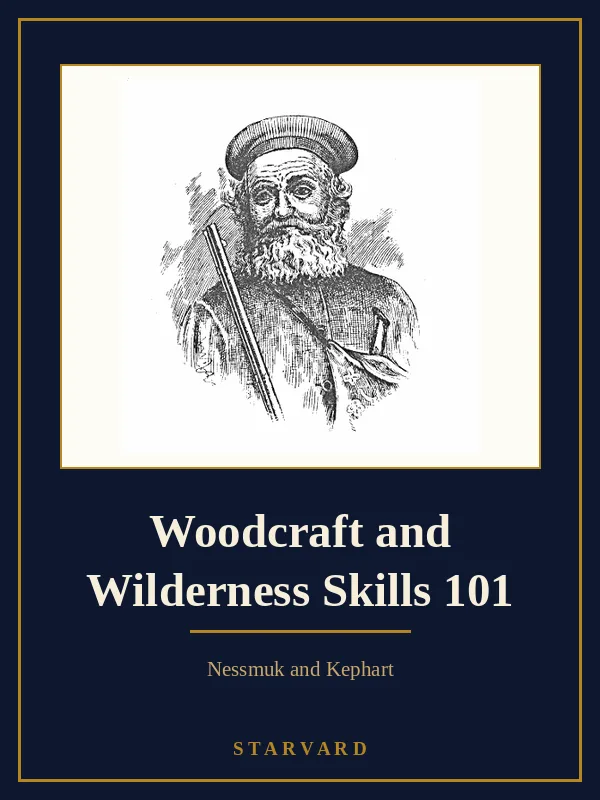
Starvard University · Woodcraft
Go light and camp comfortable, the Nessmuk way: a pocket axe and two knives, a small fire built right, an open shelter, clean water, and simple food over coals. Eight lessons in the old, kind art of being at home in the woods.


Hello, my name is Finn, and I'm going to help you understand this course.
Here it is, explained like you are 10:
Woodcraft means knowing how to live happily in the woods with very little stuff. A long time ago a small, tough outdoorsman who called himself Nessmuk wrote down how he did it: carry a tiny pack, a light axe, and two good knives, build a small fire that actually keeps you warm, sleep under an open shelter, and cook simple food that tastes wonderful outside. This course teaches his tricks one at a time, so a night in the woods feels easy, safe, and fun instead of cold and miserable.
Most beginners pack far too much, build far too big a fire, and sleep in a closed tent that traps cold and damp. Nessmuk, whose real name was George Washington Sears, did the opposite for fifty years in the North Woods. His whole load, canoe included, could weigh about 26 pounds. His secret was not toughness. It was choosing each item with care and knowing a few skills deeply: how to handle an axe, how to lay a fire with back logs, and how to make a shelter that lets the fire warm you all night.
Horace Kephart, the other great voice in this course, turned the same craft into a complete manual a generation later. Together they teach a gentle kind of competence: go light, keep camp neat, cook plain food well, and treat the woods as a home you borrow, not a place you conquer. Start with one easy overnight close to home and let the woods teach the rest at walking pace.
The whole course in brief
Eight lessons, one light pack, a comfortable camp.
The eight lessons
Lesson 1
Nessmuk opens Woodcraft and Camping with the rule this whole course obeys: 'Go light; the lighter the better, so that you have the simplest material for health, comfort and enjoyment.' He watched strong businessmen stagger in with pack baskets full of blankets, crockery, and spare boots, a load, he says, fit for a pack mule, and he answers with his own outfit: canoe, extra clothing, blanket bag, two days of rations, pocket axe, rod, and knapsack together never exceeded 26 pounds.
His system is a list of indispensables, thought over in advance and stowed in handy fashion so nothing needful is missing where it cannot be bought. The knapsack itself weighs just 12 ounces empty and holds over half a bushel. Inside rides a blanket bag plus a waterproofed cotton shelter cloth 6 by 8 feet, together about five or six pounds, with extra shirt, drawers, and socks bringing the dry goods to about eight pounds.
Try his test on your own kit: lay everything out, ask of each item whether it earns its weight in health, comfort, or enjoyment, and leave behind anything of more weight than worth. We do not go to the woods to rough it, Nessmuk insists. We go to smooth it.
Lesson 2
Nessmuk's cutting kit is three tools, each chosen after years of disappointment. First, a light pocket axe with a double edge: one thick, stout edge for knots and bone, one fine, keen edge for clear timber. Second, a thin bladed sheath knife, handy for skinning, cutting meat, or eating with. Third, a strong double bladed pocket knife. With the sheath knife, he says, that pair is all sufficient for camp use. Skip the thick, clumsy bowie knives sold to look murderous in shop windows.
Use each tool inside its strength. The axe fells and splits: Nessmuk's camp crews felled small birch, ash, and butternut and cut fire lengths with pocket axes alone. The sheath knife does camp kitchen and craft work, the pocket knife the small jobs, and a folding saw crosscuts firewood and shelter poles with less effort and risk than swinging at every log.
Safety rules never change. Cut away from your body and your free hand, keep a clear swing circle before you chop, never leave an axe stuck in a stump where a foot can find it, sheath every blade before you walk, and keep edges sharp: a keen edge bites where you aim, while a dull one glances.
Lesson 3
Nessmuk watched a hundred camp fires built wrong: a bonfire of whole logs that roasts the camp at midnight and leaves no level place to set a pot. His fire is small, organised, and built to reflect heat into an open shelter. Against two slanted back stakes he stacks three back logs, largest at the bottom, each about five feet long. Two short thick sticks serve as fire dogs in front, a fore stick about five feet long and five inches thick closes the front, and a pyramid of bark, knots, and small logs gives a bright, cheery fire that lasts the night on half the fuel.
Build yours in stages whatever your ignition source:
Keep night wood ready: drag birch and ash poles to camp in long lengths, burn them in two on the fire, and feed them forward as they shorten.
Lesson 4
Nessmuk distrusted closed tents: a week in a wall tent with a little stove left his party freezing and roasting by turns. His camp must admit a bright fire in front, with a lean to or shed roof overhead to reflect the fire heat down onto the bedding. Dryness, lightness, and low cost are his tests.
His simplest shelter, the Indian camp, goes up in an evening: a ridge pole about twelve feet long jammed between ground and tree, young hemlocks shingled over it tips downward, a bed of browse a foot thick, and a muslin pillow bag stuffed with moss or hemlock browse. The brush shanty scales the idea up: a cross pole resting on two crotches about six feet high, poles laid about six inches apart, and hemlock thatch laid a foot thick from the ground upward, shingled so rain runs off. It will stand a pretty heavy rain.
His favourite, the shanty tent, is a cotton roof sheet 9 feet long by 4 to 4 1/2 feet wide with sewn sides, open at the front to the fire. Whichever you build, pitch on high, dry ground near water, not in a hollow, and let the fire, not the fabric, do the heating.
Lesson 5
Water decides where camp happens. Nessmuk's woodsman, caught by darkness, dives down the first little hollow until he strikes a rill of water, because, in his words, water is a prime necessity, and only then reaches for his hatchet. Plan the same way: choose shelter and fire sites within an easy walk of a stream, spring, or lake, on the high bank rather than the damp bottom, and carry a container on every tramp so a found source is never wasted.
Finding is only half the job. Clear, cold, running water looks safe and can still carry germs from animals far upstream, a caution Kephart presses hard in Camping and Woodcraft. Treat every wild source before you drink:
Nessmuk's two quart camp kettle is the quiet hero here: big enough to boil drinking water alongside tea or stew. Drink treated water freely, and never ration yourself into headache and bad decisions on a hot trail.
Lesson 6
Getting turned in pathless woods is normal; panicking is the danger. Nessmuk tells of a well equipped sportsman who tore through thickets in fright until he dropped, and he gives the antidote in one line: never quarrel with the compass. The compass is always right, or nearly so. If the sun seems to break out in the wrong quarter at noon, it is not the planets that have moved. You have swung, most often to the right, until you face northwest while meaning to travel south.
His recovery is calm arithmetic. Work out how far you have swung, set the compass, and travel by it on the correcting course until you have made up the deviation, then resume your true course. Carry the compass in your hand and look at it every few minutes, because the tendency to swerve, nearly always to the right, returns the moment you stop checking.
Add the land itself to the needle. Streams run downhill to bigger water and settlements. Ridges give views to recheck your line. Watch weather as you walk: thickening cloud and a falling temperature warn of rain in time to pitch camp dry, while a clear, still evening promises a cold night and extra night wood.
Lesson 7
Camp cooking fails, Nessmuk says, when four hungry people build one bonfire and wriggle four coffee pots into the flames, scorching the pork, smoking the tea, and melting a spout or two. His outdoor range is the fire lesson applied to food: back logs and a fore stick giving level bases at steady heat, cooking over spread coals rather than leaping flame.
His own supper is the model: a slice of ham broiled on a three pronged birch fork over coals, bread and butter, and a pot of strong tea, clean, plain, and well cooked while the noisy party ate scorched meat. Make two camp tools before you cook. The poker is a beech stick four feet long and two inches thick, flattened at one end and notched for lifting kettles. The tongs are a tough beech or hickory stick, thinned in the middle, heated in embers until it bends, then shaped to grip.
Keep the menu plain and learn it cold: coffee, potatoes boiled in plenty of water, bread or simple cakes baked in the covered nesting dish, soups, stews, and beans. Nessmuk's whole cooking kit nests inside a two quart kettle and weighs two pounds: proof that a good dinner needs heat control, not hardware.
Lesson 8
Nessmuk never used the modern phrase leave no trace, but he practised its heart a century early. Neatness, he writes, is quite as pleasant and wholesome around the forest camp as in the home kitchen, and he gives the camp its own small ceremony: make a broom of bushy hemlock twigs wound with twine around a light handle, trim the ends even, and sweep leaves, sticks, and litter from around the camp and fire. A tidy camp is safer, calmer, and easier on the land.
Finish the ethic in modern form:
The point is the same one Nessmuk always made: skill replaces impact. The next walker should find the hollow by the rill as clean as you did, with the hemlocks standing and the water clear. We go to the woods to smooth it. Leave it smoother.
Sources
This course is taught from classic texts that are free for anyone to read. Every method in the lessons traces back to one of these books.
Graduation
You have the creed now: go light, keep your edges keen, build a small fire against back logs, sleep open to its warmth, drink treated water, trust your compass, and cook plain food well over coals. None of it asks for expensive gear or a strong back. It asks for attention, which is the real woodcraft Nessmuk and Kephart both taught. Take one overnight trip, keep it simple, sweep your camp before you leave, and notice how smooth it can feel.
Keep learning
This course is part of Starvard University, striving for greatness.
A note on accuracy: Much of what you read at Starvard was created with help from AI agents, working alongside people. We check what we can, but we cannot guarantee that everything here is true, current, or complete. If something really matters, your health, your money, a grade, a job, please verify it with a trusted source before you rely on it.