 Starvard
Where VR Actually Stands in 2026

Headset sales fell hard in 2025 and Meta lost $19.2 billion in a single year, yet more people used a Quest than ever before. Both facts are true, and the gap between them is the real story of VR in 2026.
Ask ten people how virtual reality is doing and you will hear two answers. One camp says VR is dead, a hype bubble that popped. The other says it is quietly becoming enormous. The honest answer, backed by the numbers published over the last year, is stranger than either. The headset business shrank. The audience grew. And the company spending the most money on VR started spending most of it on something else: glasses.
To judge any of that fairly, you first have to understand what a VR headset actually is, why building one that does not make people sick is one of the hardest problems in consumer technology, and why this industry has already died twice. Then the 2026 numbers stop looking like a contradiction and start looking like a pattern.
First, what a headset actually does
Strip away the marketing and a VR headset is a machine for lying to your visual system, convincingly, over and over, dozens of times every second. Inside the visor sit two small screens, one for each eye, with lenses between the screens and your eyes. The lenses bend the light so a screen sitting a few centimeters from your face appears to be far away, filling your view like a place instead of a picture.
Each eye is shown a slightly different image, rendered from a viewpoint offset by roughly the distance between your eyes. Your brain reads that difference, called disparity, the same way it reads the difference between your two eyes in real life, and it concludes depth. That is the entire trick of stereoscopic display, and it is the same trick a 19th century stereoscope used with pairs of photographs. The modern part is everything around it.
The headset also has to know where your head is, constantly, with sub centimeter accuracy. Tiny inertial sensors spin hundreds of times a second to measure rotation, but they drift, so cameras on the outside of the headset watch the room itself and anchor your position against walls and furniture. This is called inside out tracking. Your hands are tracked the same way, either by cameras watching controllers or by cameras watching your fingers directly.
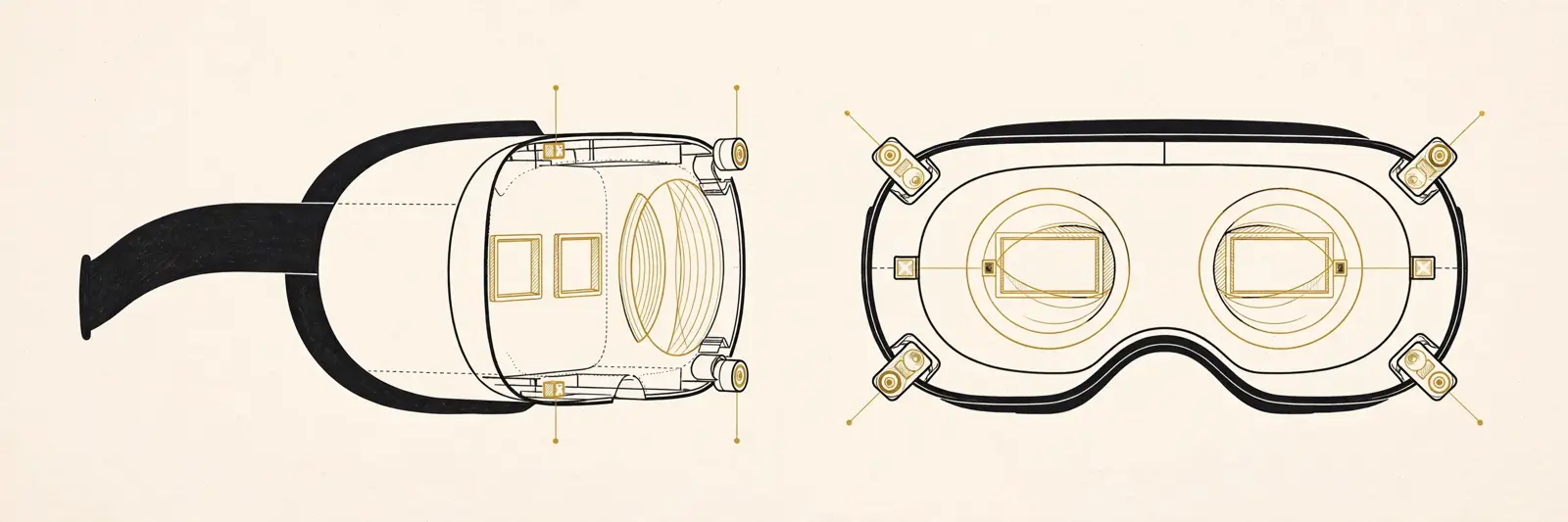
Then a processor has to draw the world twice, once per eye, at high resolution, at a fast and steady frame rate, while predicting where your head will be a few milliseconds in the future so the image it shows matches where you actually end up. Every part of that pipeline exists to serve one goal, a feeling researchers call presence: your brain's conclusion that you are somewhere, rather than looking at something. When presence works, you duck. When it breaks, you feel a fraud, or worse, you feel ill. Which brings us to the hard part.
Why this is genuinely hard to build
The central enemy is latency, the delay between you moving and the image updating. Engineers call the full loop motion to photon: movement in, light out. Varjo, which builds headsets for pilots and surgeons, explains that research puts the meaningful threshold at around 20 milliseconds. Above that, delays become noticeable, the world seems to swim behind your movements, and the brain starts rejecting the illusion. Below it, the delay is generally imperceptible and a major cause of sickness disappears. Hitting that budget means the sensors, the processor, the rendering, and the display all have to finish their work in less time than a single blink of an eye, every frame, without exception. Early consumer headsets missed the budget badly. Modern ones live inside it, and that difference is a large part of why today's VR feels different from the VR people tried and abandoned a decade ago.
Latency is only one front in the war. The deeper problem is that your balance system and your eyes evolved to agree with each other, and VR asks them to disagree. Your inner ear, the vestibular system, reports motion to your brain. Your eyes report motion too. In a headset, the eyes can report flying, falling, or racing forward while the inner ear, correctly, reports that you are standing still in your living room. Researchers call this sensory conflict, and the leading theory of motion sickness says the brain reads the mismatch as a warning sign, possibly poison, and responds with nausea. This is why experiences where your virtual body slides around under joystick control make newcomers ill, while experiences where the motion you see is motion your body actually makes tend not to. It is a constraint written into your biology, not a bug any engineer can patch.
Your eyes cause a third problem, and it has no full solution in any headset you can buy today. In real life, two focusing systems move together: your eyes rotate to point at an object, and the lens inside each eye changes shape to focus at that object's distance. Cross your eyes at your finger and the lens focuses close; look at the horizon and both relax. In a headset, the screen sits at one fixed focal distance, so your lenses must focus there, while your eyes rotate to point at virtual objects that appear to be centimeters or kilometers away. A 2026 paper in the Journal of the Society for Information Display describes this vergence accommodation conflict as a fundamental problem of current near eye displays: the natural link between the two systems is broken, and the result is eye strain, visual fatigue, and for some people, headaches that cap how long a session can last. Laboratories are working on varifocal lenses, light field displays, and holographic displays that would fix it properly. None of them are in a product at your local store.
Finally, there is the triangle every designer fights: computing power, battery, and weight, all sitting on your face. Sharper images and faster frames need more computing. More computing needs more battery and makes more heat. Bigger batteries are heavier. Every gram rests on your nose and neck, and every fan you add to cool the chip adds noise next to your ears. This is why headsets improve in steps rather than leaps, and why the devices are still measured in hundreds of grams while the glasses winning the market are measured in tens. The technology is not standing still. It is pushing against physics, physiology, and your wallet at the same time.
Three waves, and what killed the first two
VR has been declared the future at least three times, and understanding the first two deaths explains the third life.
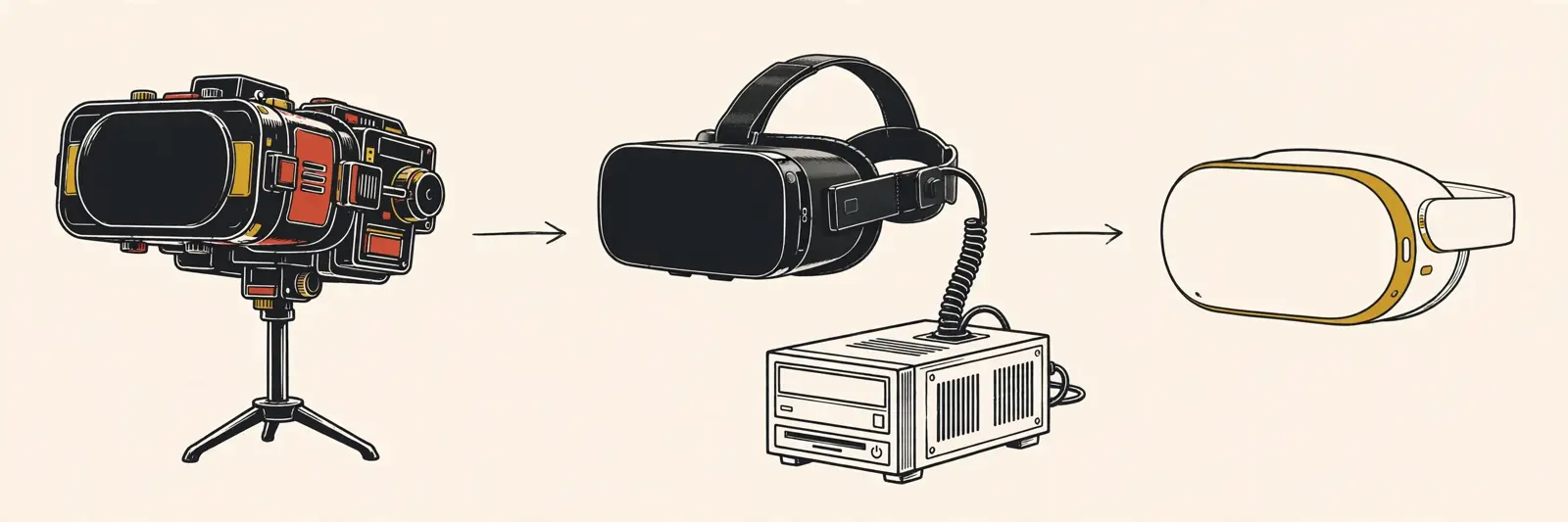
The first consumer wave broke in the 1990s. Its monument is Nintendo's Virtual Boy, launched in Japan in July 1995 and in North America that August at $179.95. It was designed by Gunpei Yokoi, a genuine Nintendo legend. It showed games in red and black only, because its display used red LED lights, the only affordable technology that could do the job. Head tracking, the feature that makes VR feel like a place, was cut before launch, so the Virtual Boy shipped as a tabletop box on a stand that you leaned into, more peep show than headset. It could not do the one thing VR must do. Players reported eye strain, headaches, and neck pain, Nintendo built in prompts telling players to take a break every 15 to 30 minutes, and the library stopped at 22 games. Roughly 770,000 units sold worldwide. Nintendo discontinued it in Japan within about five months and in the United States by the summer of 1996. Palmer Luckey, who would later restart the industry, has said the Virtual Boy damaged VR's reputation for a generation. He has a point: for twenty years, "virtual reality" meant, to most people who had tried it, a headache in a red box.
Watch: Virtual Boy: NOT Nintendo's Biggest Failure, from Did You Know Gaming. Their hour long history, researched from Japanese magazine archives and Gunpei Yokoi biographies, shows what the machine was meant to be before the compromises piled up.
The second wave started on Kickstarter. In August 2012, Luckey's company Oculus asked the internet for $250,000 to build a developer version of its Rift headset. It raised more than $2.4 million from over 9,000 backers. In March 2014, Facebook bought Oculus for $2 billion, $400 million in cash and the rest in stock, and suddenly the biggest social company on Earth was betting that the next computing platform would be worn on the face. The consumer Rift and HTC's Vive arrived in 2016 to enormous press. They were also tethered by cables to expensive gaming PCs, cost as much as a console before the PC, and launched into a content drought: lots of demos, few things worth doing for a second hour. A cheaper detour, phone based VR like Google's Cardboard and Daydream and Samsung's Gear VR, sold the idea at low prices but could track only the rotation of your head, not your position in the room, which gutted presence and invited sickness. Google and Samsung both eventually walked away from those lines.
Read the two failures together and the causes repeat: too expensive, too uncomfortable, too much friction, and not enough worth doing once the novelty wore off. Each wave fixed one problem and died of the others.
The third wave is the standalone one. The Oculus Quest line removed the PC and the cable and put the whole computer in the visor. The Quest 2, sold at games console prices, built the installed base that the rest of this story keeps running into, an estimated 20 million units in its first two and a half years. Wave three fixed price and friction. Comfort, session length, and the breadth of things worth doing remain its open wounds, and they are exactly the wounds visible in the 2026 numbers.
The headline numbers went down
Start with the hardware, because that is where the pain is. IDC expected shipments of mixed reality and virtual reality headsets to fall 42.8 percent in 2025, even as the wider XR market, powered by smart glasses, grew fast. In the third quarter of 2025, Meta held 75.7 percent of the entire XR market, a dominant share of a category whose center of gravity is moving away from the bulky headset.
The Register, working from IDC figures, put hard unit numbers on the two flagship products. Apple shipped about 45,000 Vision Pro headsets in 2025, down from 390,000 in 2024. Apple even paused production with a supplier during the year before relaunching the device with an M5 chip in the fourth quarter. Meta shipped 1.7 million Quest headsets in the first three quarters of 2025, down 16 percent year over year. For comparison, Meta shipped 5.6 million Quest and Quest Pro units across 2024.
Marketing money tells the same story. Sensor Tower data cited by The Register showed Apple cutting its US advertising spend on Vision Pro by more than 95 percent in 2025, and Meta cutting Quest ad spend by more than 55 percent. Companies do not slash advertising on products they expect to explode.
The money: a $19.2 billion year
Meta's Reality Labs division remains the financial engine of the whole industry, and its losses remain staggering. The division lost $19.2 billion in 2025 on just $2.2 billion of revenue, according to GamesBeat figures reported by Gadget Review. In the second quarter of 2026 it lost another $4.62 billion on $431 million of revenue, a result that counted as good news only because analysts had expected a loss closer to $5.07 billion. Since late 2020, Reality Labs has piled up about $83.6 billion in cumulative operating losses against $11.8 billion in total revenue.
The strategy shifted in plain sight. In January 2026, Meta cut an estimated 10 percent of Reality Labs, more than 1,000 workers, and shut down three game studios it had bought: Armature Studio, Twisted Pixel, and Sanzaru Games. A Meta spokesperson told Polygon the company was shifting some of its investment from the metaverse toward wearables, and planned to reinvest the savings into wearables growth. Reporting on the division's finances since then puts roughly 70 percent of Reality Labs operating expenses on AI glasses and wearables rather than headsets.
Watch: Why the Metaverse Failed: How Meta Lost $92 Billion, from Million Dollar Mistakes. It walks the bet year by year using Meta's own filings, from the 2021 rename through the empty Horizon Worlds to the glasses pivot.
How the economics were supposed to work
Those losses were not an accident or a surprise inside Meta. They were the plan, and the plan was borrowed from game consoles. Sell the hardware at or below what it costs to build, take a loss on every box, and make the money back on the other side: a cut of every game and app sold in your store, subscriptions, and eventually services and advertising, all flowing for years from an installed base that is expensive for anyone to leave. Consoles proved the model can work beautifully, provided two things happen. The base has to get big enough, and the owners have to keep buying.
Meta executed the first half about as well as it could be done. The Quest 2's low price built the base, and the base, as the next section shows, kept buying. The problem is scale and time. A console generation recoups its subsidy from a few hundred million game sales. Reality Labs has been spending at the level of a national research program, on research whose payoff, if it comes, arrives as a new computing platform rather than as game sales. That is a venture capital bet wearing a console's clothes, and it only makes sense if the platform prize at the end is real. It also only continues while one man, Mark Zuckerberg, keeps choosing to fund it out of an advertising business that prints money. The entire consumer VR industry, in other words, has a single point of failure, and it is a person.
In April 2026, the subsidy era showed its first crack from an unexpected direction: the AI boom itself. Meta announced that, effective April 19, 2026, the Quest 3 would rise by $100, from $499.99 to $599.99, and the Quest 3S would rise by $50, to $349.99 for the 128 GB model and $449.99 for the 256 GB model. TechCrunch noted it was Meta's first ever price increase on existing VR hardware. Meta's own explanation pointed at memory chips: the global surge in AI data centers has sent the price of the memory used in headsets sharply upward, and the cost of building the hardware rose with it. Read that again, because it is the strangest sentence in this whole story. Artificial intelligence, the technology Meta is pivoting its spending toward, is now literally raising the price of virtual reality hardware by competing for the same chips.
The plot twist: usage hit record highs
Here is where the obituary falls apart. At the Game Developers Conference in March 2026, Meta's director of games, Chris Pruett, told developers that in 2025 Quest hit its all-time highest number of unique users in the platform's history. That happened in a year with no new Quest hardware launch. Horizon Store revenue rose slightly year over year, in-app purchase revenue grew more than 10 percent, and more than 100 titles each grossed over $1 million in 2025. The Horizon+ subscription passed 1 million subscribers and paid out almost $20 million to developers.
Read the two halves together and a clear picture forms. The installed base built up in the Quest 2 era, when that headset alone sold an estimated 20 million units in its first two and a half years, did not evaporate. People kept their headsets and kept playing. Pruett also noted that teenagers are now the platform's most active audience, and that they discover games through social video on Instagram, YouTube, and TikTok rather than by browsing the store. What slowed was the flow of new buyers, not the behavior of existing owners. That is a maturing platform problem, not a dying platform problem, and it is a much better problem to have.
The platforms are moving to glasses, gamers, and work
Every major player is now placing a different bet than the one they placed in 2021.
Meta's growth product is eyewear. EssilorLuxottica told its investors that 7 million Ray-Ban and Oakley smart glasses were sold in 2025 alone, more than triple the 2024 figure, taking the total since the October 2023 launch to about 9 million. The glasses maker has been building toward 10 million units of annual production capacity, and IDC forecasts the wider XR glasses category to keep growing at a 29.3 percent compound annual rate from 2025 to 2029. Bloomberg reported that Apple, watching this, moved staff off a cheaper Vision headset project to get its own smart glasses out sooner.
Watch: Wait... Smart Glasses are Suddenly Good?, from Marques Brownlee. His hands on time with the display model shows the glasses pitch in practice: a normal pair of glasses first, a computer second, with the screen there only when you ask for it.
Google and Samsung entered the headset race from the other side. Samsung's Galaxy XR launched in October 2025 at $1,799 as the first device running Google's Android XR system, with the Gemini assistant built in. It costs half what Apple charges for Vision Pro and leans on AI help rather than a walled garden of new apps.
Valve, meanwhile, aimed straight at the audience IDC says wants headsets most: gamers. Its Steam Frame, announced in November 2025, is a standalone headset running SteamOS, built first for streaming games wirelessly from a PC, and light at 440 grams in total. It replaces the Valve Index in the lineup. IDC's own forecast matches the strategy: headset demand is strongest in gaming, and the commercial opportunity sits in design, training, and collaboration.
And one platform just left the room
While the others repositioned, Sony quietly exited. In October 2026, Gizmodo reported, citing ZDNet Korea, that Sony had transferred 43 VR, AR, and XR patents between June and September, with a total of 419 patents slated to transfer to Meta, 180 of them US patents. The agreement was reportedly signed back in December 2025. Neither Sony nor Meta commented publicly.
The PlayStation VR2 story, in full, is the second wave's playbook run by a company that lost its nerve. The original PlayStation VR sold more than 5 million units, a real business. The PSVR2 launched in 2023 at $550, which was $150 more than the original and well above its rivals, and Sony supported it with only a couple of first party games. Bloomberg reported in March 2024 that Sony had paused production after building well over 2 million units it had not sold through. A permanent price cut to $399 followed in March 2025, and analyst estimates put lifetime shipments at roughly 3.7 million units, below the cheaper, older original. By September 2026 the headset was reported out of stock on Sony's own US store with no restock date. Selling the patents to Meta is what the end looks like when a company decides its VR research is worth more as someone else's asset than as its own future.
The strategic consequence matters more than the obituary. The second largest console maker on Earth has handed its VR work to the market leader. What remains is a consolidated industry: Meta in the center, Valve serving PC gamers, Apple holding the expensive high end, Samsung and Google testing whether AI assistants can carry a headset, and everyone else renting space in someone else's store. Fewer, bigger bets, placed by companies for whom VR is one product line among many, except for Meta, for whom it remains the company defining wager.
Winter, or slow build?
So which is it? The data says the VR winter story is half right. The winter is real for the original dream: a headset in every home, worn for hours of work and social life, funded by unlimited metaverse spending. That version contracted in 2025 by every measure that matters: units, ad spend, studio headcount, and executive attention.
But the slow build story has the better evidence underneath it. Usage records, store revenue growth, a subscription business paying developers, and a glasses category tripling in a year are not what a dead technology looks like. IDC expects MR and VR headset shipments to rebound in 2026 as new devices arrive, with demand led by gamers and businesses. The industry's shape changed. Its pulse did not stop. VR in 2026 is smaller than the hype promised and sturdier than the obituaries claim, and it is being carried forward by glasses, games, and workplaces rather than by the metaverse.
The first principles at the top of this post explain why both halves can be true at once. The technology crossed the thresholds that matter for play and for practice: latency is under the sickness budget, tracking is solved, the price of a good standalone headset fell to console levels before the chip crunch pushed it back up. It has not crossed the thresholds that matter for all day computing: the focusing conflict is unsolved, the weight is still measured in hundreds of grams, and nobody has built the must have daily application that justifies wearing a computer on your face for eight hours. Technologies do not win all at once. They win use case by use case. VR has won a few, lost the biggest one for now, and is consolidating around the wins. That is not a winter. It is what a technology growing up looks like from the inside.
Why this belongs at Starvard
Starvard teaches the technologies reshaping work and money, and this industry is a live case study in both. The glasses winning the market are AI products first, which is why our AI course belongs next to this story. And an $83.6 billion bet being reallocated in public is a masterclass in how big money actually moves, the subject of our Money course.
Watch
Meta: Meta Connect 2025 Opening Keynote. Zuckerberg's own presentation of where Meta is putting its money, AI glasses front and center, straight from the source.
Marques Brownlee: What's Going on with Apple Vision Pro? The most watched independent reviewer in tech asks why Apple's flagship headset is gathering dust, and answers honestly.
Valve: Steam Hardware Announcement. Valve's official reveal of Steam Frame alongside its new Steam Machine and controller, the gamer-first bet in three minutes of product footage.
Sources
IDC, press release on global XR shipments and the glasses-first shift, for the 42.8 percent headset decline, Meta's 75.7 percent share, and the 2026 rebound forecast: idc.com
The Register, January 2026, reporting IDC unit figures and Sensor Tower ad spend data for Vision Pro and Quest shipments: theregister.com
Gadget Review, July 2026, on Meta's Q2 2026 earnings, citing CNBC, GamesBeat, and EW Intelligence for Reality Labs revenue, losses, and the wearables spending share: gadgetreview.com
Polygon, January 2026, on the Reality Labs layoffs and the closure of Armature, Twisted Pixel, and Sanzaru Games: polygon.com
UploadVR, March 2026, reporting Chris Pruett's GDC talk on record Quest users, store revenue, and developer payouts: uploadvr.com
UploadVR, February 2026, on EssilorLuxottica's earnings and the 7 million smart glasses sold in 2025: uploadvr.com
UploadVR, November 2025, full report on Valve's Steam Frame announcement, specs, and positioning: uploadvr.com
Wikipedia, Samsung Galaxy XR, for the October 2025 launch, $1,799 price, and Android XR platform details: en.wikipedia.org
Varjo, support documentation on latency in virtual and mixed reality, for the motion to photon definition and the research threshold of around 20 milliseconds: varjo.com
Kim and colleagues, 2026, Journal of the Society for Information Display, on the vergence accommodation conflict in near eye displays and the approaches being researched to solve it: onlinelibrary.wiley.com
The Hustle, on the failure of Nintendo's Virtual Boy, its design compromises, health complaints, and short life: thehustle.co
Engadget, Tech Hunters on the Nintendo Virtual Boy, for the 1995 launch, the tabletop design, and the rapid discontinuation: engadget.com
TechSpot and UploadVR coverage of the Oculus era, for the 2012 Kickstarter campaign that raised more than $2.4 million against a $250,000 goal and Facebook's $2 billion acquisition of Oculus in 2014: techspot.com and uploadvr.com
TechCrunch, April 16, 2026, on Meta raising Quest 3 and Quest 3S prices, effective April 19, 2026, and Meta's own pricing announcement giving the same figures and the memory chip explanation: techcrunch.com and meta.com
Gizmodo, October 8, 2026, reporting ZDNet Korea's account of Sony's transfer of VR, AR, and XR patents to Meta, and the PlayStation VR2 price and sales history: gizmodo.com
GA Gadget, October 2026, on the Sony patent transfer to Meta and the unlikelihood of a PlayStation VR3: gagadget.com