 Starvard
The Best Free and Open Source Alternatives to Expensive Everyday Software

Most people pay for software every month without thinking about it. An office suite here, a photo editor there, a video tool, a note app, a password manager. The bills are small one at a time, and then you add them up at the end of the year and wonder where the money went.
Read moreWhat Open Source Actually Means, and How to Start Using It Safely

Open source is one of those phrases people nod along with and quietly do not understand. It sounds technical. It sounds like something for programmers. In fact it is a simple idea with practical benefits for anyone who uses a computer, and once you understand it, a large amount of free, high quality software becomes available to you with confidence.
Read moreThe Best Free and Open Source Design Tools, and How They Compare to the Paid Ones
Design software used to mean one thing: a monthly subscription you could never stop paying. That is no longer the only option. Open source design tools have grown up over the last decade, and today they cover almost every kind of design work, from photo editing and logos to app interfaces and print layouts. They are free to download, free to use for paid client work, and built in the open by communities who publish the source code for anyone to inspect or improve.
Read moreWhere to Find Fonts, Icons, Illustrations, and Photos You Can Legally Use, and How the Licenses Work
Every design project needs raw material: a font, a set of icons, an illustration, a photograph. The internet is full of all four, but downloading whatever a search engine shows you is a good way to use someone else's work without permission. The good news is that a huge amount of professional quality material has been released under open licenses, which means the creators have already given you permission, in writing, in advance.
Read moreThe Best Free and Open Source Video Editing and Animation Tools in 2026
You do not need a monthly subscription to edit a good video. Over the last decade, open source video tools have quietly grown up. The best of them now handle 4K timelines, color correction, titles, effects, and full animation, and they run on Windows, Mac, and Linux without watermarks, export limits, or trial timers.
Read morePublic Domain and Openly Licensed Films and Footage: Where to Find Them and What You Can Do With Them
There is a vast library of film and video that you are legally allowed to download, remix, screen, and even sell, without asking anyone and without paying a cent. Classic movies, historic newsreels, space footage, government films, and modern open movies are all sitting in public archives, waiting for a second life in your projects.
Read moreThe Best Free and Open Source Music Production Tools, and Who Each One Suits
You do not need to spend hundreds of dollars to start making music on a computer. Some of the most capable recording, editing, and production tools in the world are free and open source, built by communities who believe music software should be open to everyone.
Read moreWhere to Find Free and Openly Licensed Music and Sound Effects, Legally
Every video, podcast, game, and presentation needs sound. The problem is that most music you can hear online is not free to use, even if it costs nothing to listen to. Using a popular song without permission can get a video taken down, a podcast episode muted, or a game removed from a store.
Read moreWhat the Biggest AI Agent Videos on YouTube Actually Teach
We read the transcripts of 11 of the 30 most watched AI agent videos on YouTube, together worth about 83 million views. Tutorials, explainers, and a few very entertaining warnings. Here is what the biggest voices in this space agree on, and what we took from it.
Read moreThe Starvard Template: What We Think a Well Designed Website Looks Like

We have built hundreds of pages at Starvard, and the same design decisions kept winning: two colors with jobs, two voices of type, one idea per section, honest by default. So we wrote them down as a template, built a live demo page, and gave the whole thing away. Here is the thinking, piece by piece.
Read moreUsing Crypto on Your Phone: A Simple Guide
Your phone is all you need. Install Phantom or Solflare, back up your recovery phrase, and send your first payment, with easy follow along videos.
Read moreOne Song, One Key, Every Musician Ready: Cris Barrion Built Her Church Team an App Called Team Yeshua

Every church music team on earth knows a particular kind of Sunday morning. The service starts in a few minutes. The songs were chosen days ago, everyone practiced, more or less, and yet the paper on the music stands does not agree with itself. The guitarist learned the song in the key of G, because G is the key of the recording everyone knows. The singer needs it lower, because G sits too high for her voice early in the morning. The bassist is working from a chart printed off a website long ago, in a key nobody can quite identify, with a bridge the team voted to skip weeks back and never told the paper about. The keyboard player has the current chart, the one from the group chat, which means exactly one person on the team is fully informed. So, minutes before the first song, the team does the only thing it can do. It negotiates. Keys get called out across the platform. Capos slide up and down necks. Somebody transposes in their head, on the fly, while someone else counts in.
Notice what this scene is not. It is not a talent problem. Every musician in that huddle may be genuinely good. It is not an effort problem either, since most of them practiced during the week, alone, with real discipline. It is an information problem wearing a musical costume. The team does not have a shared, current, single version of the truth about its own songs. Each musician holds a private copy, the copies drift apart over time, and the drift only becomes visible at the worst possible moment, when the whole room is watching and the countdown is real.
Once you see it this way, you start seeing the same failure everywhere. A small business where the price list lives in three spreadsheets, none of them current. A family where the recipe exists in four handwritings and one memory. A software team where the documentation describes the product as it was two versions ago. Groups rarely fail because nobody knows anything. They fail because everybody knows something slightly different, and the differences collide in public. Coordination is not a soft skill layered on top of the real work. For any group that performs together, coordination is most of the real work.
This is a story about a web developer in the Philippines who looked at that exact problem inside the group she loves most, her church music team, and built the tool that fixes it. Not a startup. Not a product launch. A private web app, built with AI assistance, for a handful of worship musicians, that puts setlists, songs, and chords in one place, shows every musician the same song in the same key with the same chart, and then, quietly, goes one step further and teaches the newest guitarist how to become good enough to play it all. Her name is Maria Criselda Barrion. The community knows her as Cris. The app is called Team Yeshua.
Read moreWho Is Making Money With AI Agents in October 2026, and Exactly How
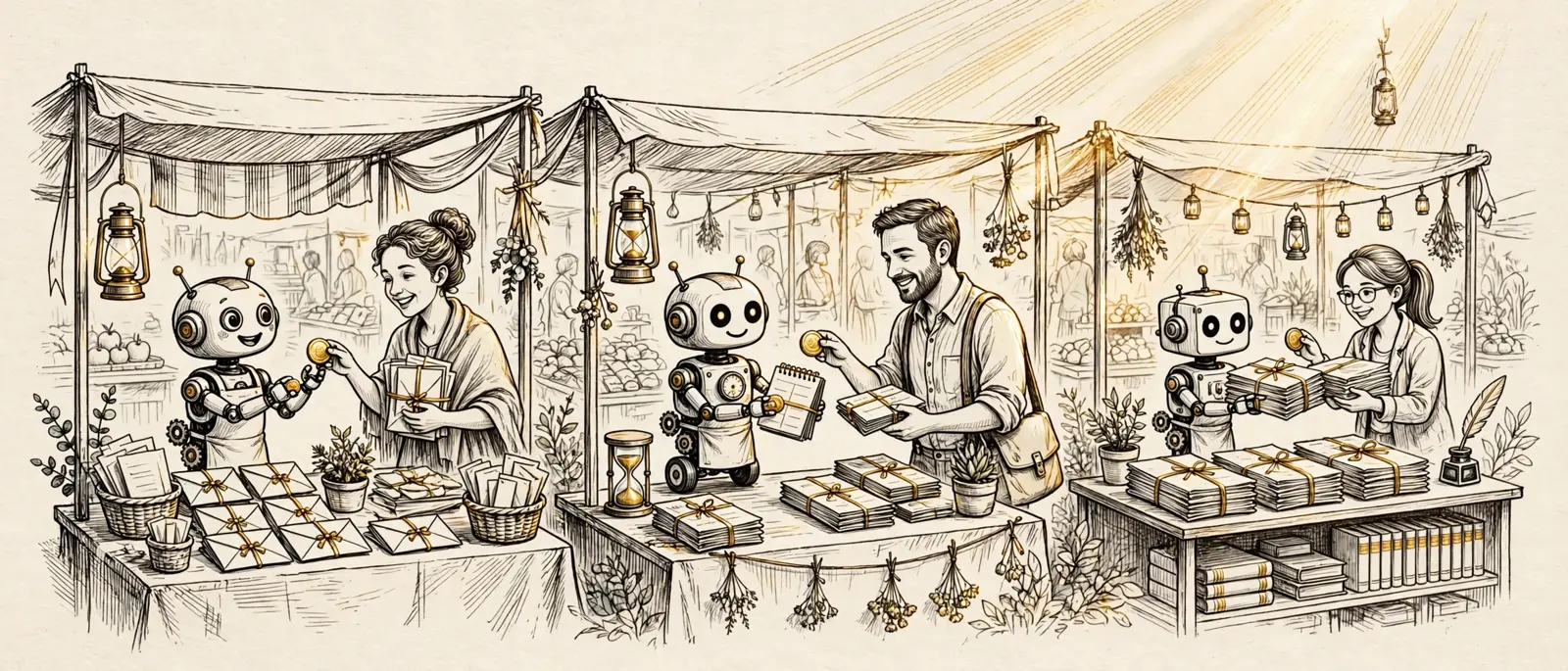
For two years, "AI agents" was mostly a promise and a demo. In the last few weeks it started publishing numbers. This post tours the freshest verified cases as of October 2026: a coding agent that crossed a billion dollar run rate, a legal agent sold by the lawyer's seat, support agents paid per conversation, a team of about fifteen people running a chat app past a hundred million in annual revenue, and the new platform shelves where the next round of agent money will move. Every figure below is dated, sourced, and labeled for what it is actually worth.
Start with the stage where the money pipes got rebuilt. On September 29, 2026, in San Francisco, OpenAI held DevDay and made more than twenty announcements. The headline product was Dots: always-on agents that run on the GPT-6 Astra model, each with its own cloud computer and its own web browser, connected to more than 4,000 apps. You can reach your Dot inside ChatGPT, by voice, or inside Slack and Teams, and it keeps working after you close the laptop. The first Dot is included with the Pro plan, which AI Weekly reports at $100 per month citing CBS News, and with Business Premium.
Three other announcements matter more for the money than the agents themselves. First, plugin extensions now let outside developers build full experiences inside ChatGPT, in front of what OpenAI says are 1.2 billion weekly users, a company-reported figure. Second, the OpenAI Marketplace launched with 32 partners, including Adobe, Figma, Salesforce, HubSpot, ServiceNow, Harvey, Legora, Palo Alto Networks, and CrowdStrike, and eligible enterprise customers can apply part of the money they already committed to OpenAI toward those partners' software. One existing contract becomes shelf space for everyone on the list. Third, Sign in with ChatGPT launched with 16 partners, including Cognition's Devin, Notion, and Vercel, and it carries a quiet revolution: usage inside those third party tools counts against the user's own ChatGPT plan allowance. The customer pays the token bill, not the app builder. Anyone who has run an AI product knows the token bill was the part that killed the margins.
Underneath all of it, the cost of the work itself dropped. GPT-6.1 Sol, released the same week, delivers near-Astra intelligence at one fifth of Astra's token prices, according to Decrypt's DevDay recap. Cheaper intelligence per task means the same agent job can be sold at the same price with a fatter margin, or sold cheaper to a bigger market. That is the backdrop. Now the cases, company by company, with the mechanics of exactly how each one charges.
Read moreThree Curves: The Real AI Story of 2026
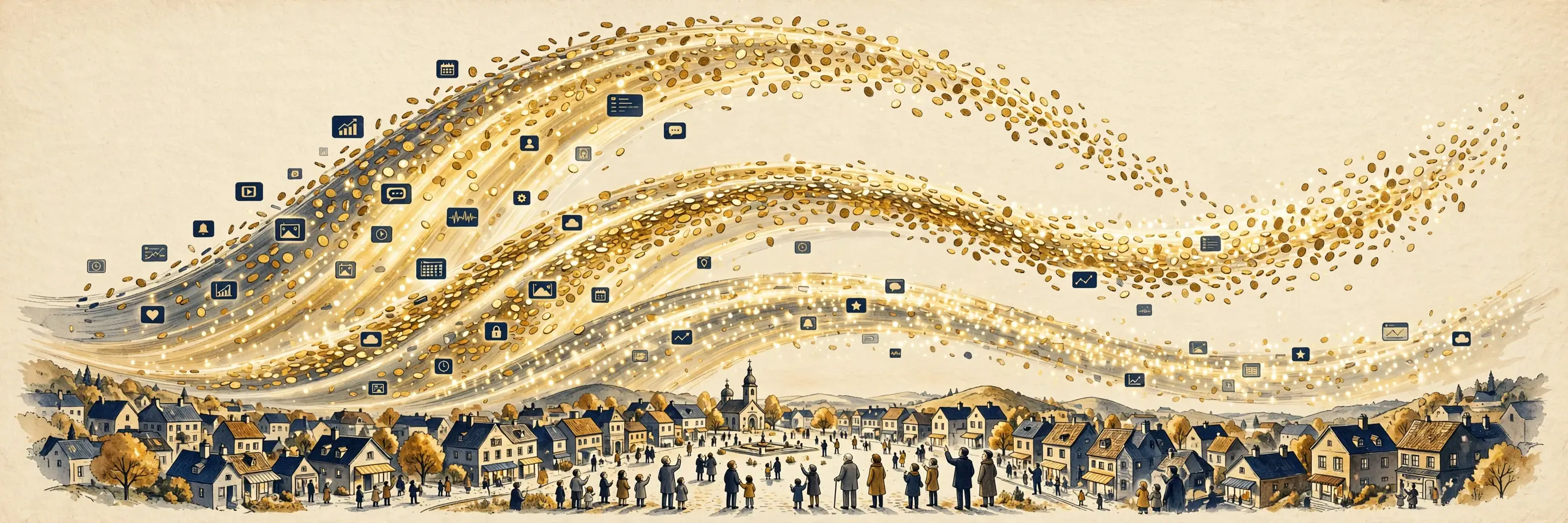
AI got far more capable, far cheaper, and reached a billion people a week, all in the same short stretch. The collision of those three curves is the biggest story in technology right now.
Most AI coverage chases the launch of the week. A new model drops, the scores leak, everyone argues for a day, and then the cycle starts again. It is easy to miss the forest for the press releases.
Step back, and the years 2025 and 2026 tell one clear story. It is not about any single product. It is about three curves bending at the same time. Capability shot up. Price collapsed. And adoption reached a scale no new technology has ever hit this fast. Stanford's AI Index Report 2026, the most careful yearly count of the field, documents all three. Here is what the numbers actually say.
But numbers alone do not explain anything. A curve on a chart is a mystery until you know what pushes it. So before the numbers, here is the machine underneath them, built up from the simplest possible idea. Everything in this post hangs off it.
Read moreShipped by Vibes: The Real State of AI Code Generation in 2026
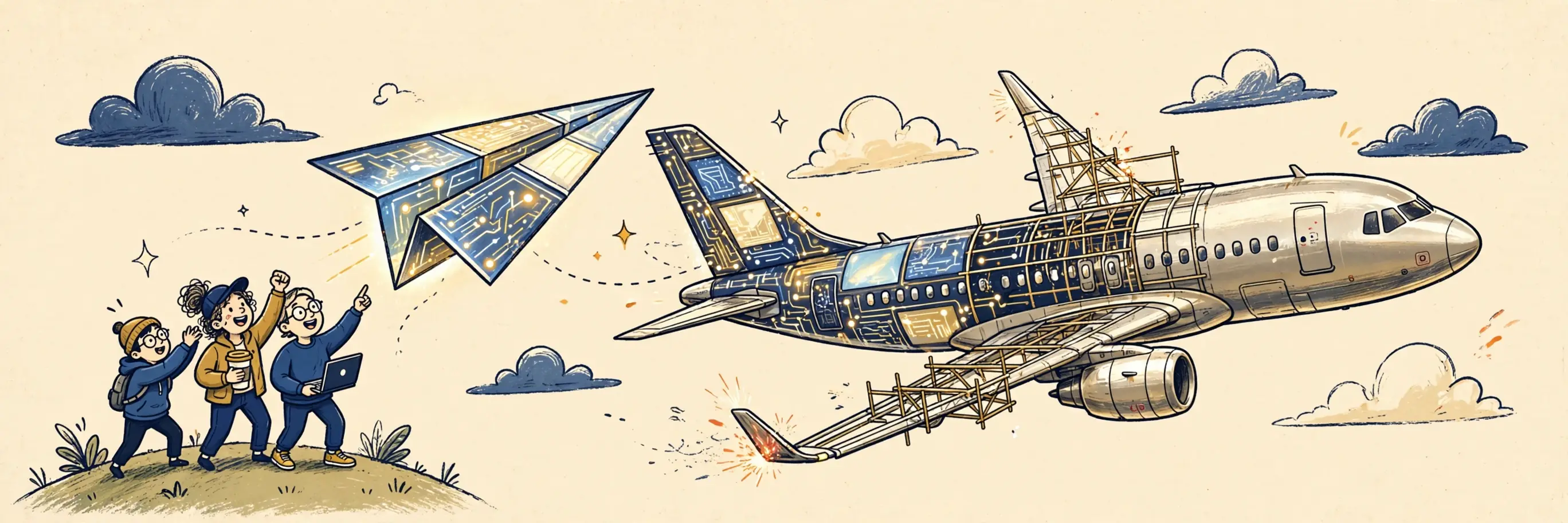
AI coding tools are producing the fastest revenue ramps in software history, and some of the most sobering research findings too. Here is who is actually shipping, what the best evidence says about speed, and exactly where the approach breaks.
If you want one fact that captures the AI coding boom, take this one. Lovable, a Stockholm startup whose product builds whole apps from plain-language prompts, crossed $100 million in annual recurring revenue in July 2025, eight months after launch, with 45 employees. TechCrunch called the pace one of the fastest ever recorded for a software company. Four months later Lovable had doubled to $200 million. In December 2025 it raised $330 million at a $6.6 billion valuation.
That is the top of the market. The interesting question for 2026 is not whether AI code generation is big. It is what holds up when you look past the revenue charts: at the controlled studies, the security audits, and the apps that got hacked within days of launch. The honest picture is stranger and more useful than either the hype or the backlash.
Everything in this article makes more sense with a clear picture of the machinery, so here it is in brief. An AI coding tool is two things stacked together: a large language model, trained on vast amounts of public code and text until it became very good at predicting what code usually comes next, and a harness of ordinary software around the model that feeds it context and checks its work.
Read moreAI Agents in VR: Virtual Worlds With a Real Workforce
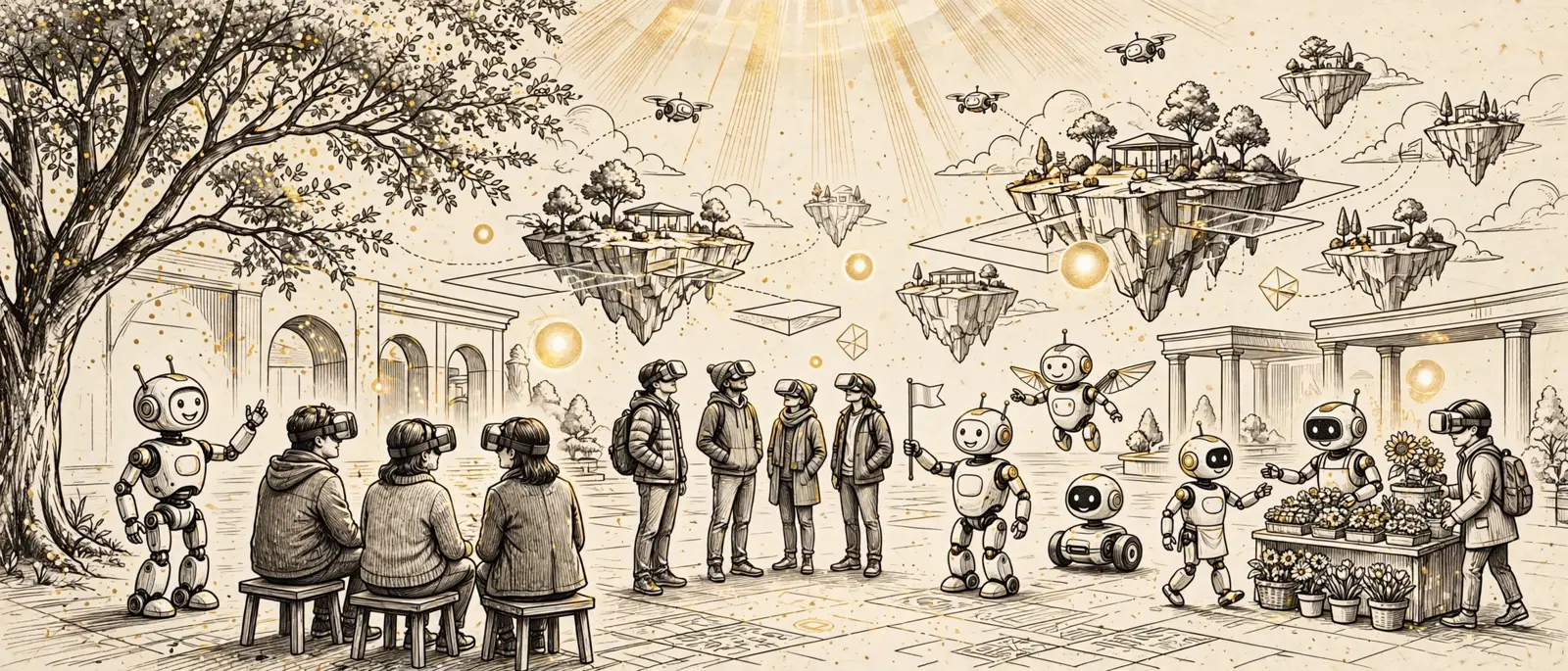
For forty years, the people inside virtual worlds came in exactly two kinds: real players, and puppets reading scripts. A third kind of resident has now moved in. AI agents that can see the world around them, remember what you said yesterday, hold down jobs as guides, teammates, shopkeepers and tutors, and clock in for training shifts inside worlds built purely for practice. This post maps who is building this workforce, what it charges by the minute, what has actually shipped, and what is still a stage demo wearing a confident smile.
Start with a simple question: why put an AI agent inside a virtual world at all? The chat window already works. You type, it answers, everyone goes home.
The chat window works for questions. It fails at presence. A chat agent has no place, so it cannot meet you anywhere. It has no senses, so it cannot notice the thing you are looking at. It has no shared situation with you, so every conversation starts from zero. And it cannot do anything except talk, which is why chat agents keep getting described with the slightly sad word "assistant," like someone who hovers near the work instead of doing it.
A world fixes all four problems at once. Give an agent a virtual body and suddenly it has perception: cameras and microphones pointed at the same scene you see, plus a direct feed of the world's state, who is standing where, what just exploded. It gets memory with an address: the shop on the corner, the player who was rude last Tuesday. It gets actions with consequences: it can walk over, pick the thing up, drive the car, revive the teammate. And it gets other people. A world is the one place where an agent and a human can stand in the same situation and point at the same object and mean the same thing by "that one."
Read moreAI in Ordinary Life: The Quiet Takeover of 2026

Half of American adults now use AI chatbots, search results answer themselves, and one in five people has asked AI about their health. This is what daily life with AI actually looks like in 2026, told in scenes and in numbers.
No keynote announced it. There was never a launch day for the moment AI became ordinary. It just seeped in: into the search box, the camera roll, the family group chat, the kitchen counter speaker, the doctor's waiting room.
By 2026 the surveys read like a census of a new habit. Pew Research Center surveyed 5,119 US adults in February 2026 and published the results in June. OpenAI and Harvard researchers studied 1.5 million real ChatGPT conversations for a National Bureau of Economic Research paper. Together they let us describe a normal day with AI, and check every scene against a number.
It is worth asking when your life first contained AI, because the honest answer is not 2022. The spam filter that learned which junk you never open dates to the late 1990s. Autocomplete, guessing your search before you finish typing it, arrived in the mid 2000s. Siri put a voice assistant in the iPhone in 2011, and Alexa moved into kitchens in 2014, answering timers and weather questions in a friendly voice. Through the 2010s, ranking models quietly took over the ordering of every feed, inbox, and storefront you used. If you have read an email, scrolled a timeline, or followed a map's rerouting in the last fifteen years, you were already living with AI. It was just AI with no face and no voice, easy to mistake for the furniture.
Read moreThe Biggest Year in Games History Broke the Blockbuster

Games took in a record 196.7 billion dollars in 2025, and in the same year the most expensive games ever made became the riskiest bets in the business. The money did not vanish. It moved.
Here is a strange pair of facts about the same year.
In 2025, people spent about 196.7 billion dollars on video games worldwide, the most ever recorded, according to Newzoo, the industry's standard tracker. In the United States alone, spending reached 60.7 billion dollars, the second highest total in American history, behind only the locked-down pandemic year of 2021, according to research firms Circana and Sensor Tower and the Entertainment Software Association.
In that same year, Microsoft shut down a studio it had set up specifically to build one game, cancelled projects that had been in development for years, and cut thousands of jobs. Marvel's Spider-Man 2, one of the biggest hits on PlayStation, carried a reported budget of 315 million dollars. And the game that swept the industry's top awards was made by about thirty people in France for less than 10 million dollars.
Read moreWhere VR Actually Stands in 2026

Headset sales fell hard in 2025 and Meta lost $19.2 billion in a single year, yet more people used a Quest than ever before. Both facts are true, and the gap between them is the real story of VR in 2026.
Ask ten people how virtual reality is doing and you will hear two answers. One camp says VR is dead, a hype bubble that popped. The other says it is quietly becoming enormous. The honest answer, backed by the numbers published over the last year, is stranger than either. The headset business shrank. The audience grew. And the company spending the most money on VR started spending most of it on something else: glasses.
To judge any of that fairly, you first have to understand what a VR headset actually is, why building one that does not make people sick is one of the hardest problems in consumer technology, and why this industry has already died twice. Then the 2026 numbers stop looking like a contradiction and start looking like a pattern.
Strip away the marketing and a VR headset is a machine for lying to your visual system, convincingly, over and over, dozens of times every second. Inside the visor sit two small screens, one for each eye, with lenses between the screens and your eyes. The lenses bend the light so a screen sitting a few centimeters from your face appears to be far away, filling your view like a place instead of a picture.
Read moreThe Shops, Schools and Offices Staffed by AI Agents
Walk into a virtual place with nobody in it and you understand the problem instantly. The shelves are perfect, the lighting is lovely, and the whole thing feels like a screensaver. Places do not run on architecture. They run on staff: the person who notices you arrive, answers the question you actually meant to ask, and remembers you next time. For decades, virtual worlds could only fake that with scripted puppets. Now they are hiring. Shops, museums, classrooms, offices and social worlds are quietly filling their rosters with AI agents, and this post walks the floor place by place and job by job: who got hired, what the work actually looks like, what visitors think of the service, and what happens to the staff when the place closes.
Start with the first principle of retail. A store is not really a room full of products. Products are the excuse. The store is the person who reads you in the first ten seconds: what you are looking for, what you can afford, what you would love if someone showed it to you. Online shopping deleted that person and replaced them with a search box, which is efficient and joyless. Virtual stores were supposed to bring the room back. The surprise of the last few years is that they only started working when somebody brought the staff back too.
The clearest example is Emperia, a London company that builds virtual stores for brands. In January 2023 it raised a $10 million Series A led by Base10 Partners, and its client list reads like a mall directory: Dior, Bloomingdale's, Burberry, Lacoste, Christie's, Sunglass Hut and Getty Images. Emperia reports, and these are the company's own numbers, that its virtual stores lift conversion rates by an average of 73 percent compared with traditional e-commerce, with an average return on investment of 750 percent. Treat those figures the way you would treat any vendor's brochure, but notice what the company says drives them: not prettier shelves, but guided selling, hosts who walk you through the room, and layouts rearranged around how visitors actually behave.
Walmart took the same technology mass market. Walmart Realm launched in May 2024, built on Emperia's platform with Sawhorse Productions, and it runs in an ordinary web browser. Instead of aisles, it opened three small worlds curated by online creators: So Jelly, an underwater shop curated by Mai Phammy; Y'allternative, a western themed shop from Makenzie and Malia; and Go Chromatic, a metallic future city from Nava Rose. Shoppers collect gamified sparks for prizes while they browse. The interesting part is what happened next: Walmart kept restaffing and redecorating. Seasonal shops arrived for back to college and the holidays, and in August 2025 the retailer opened a fresh wave of storefronts, starting with a K-pop themed shop, tied to its Walmart Delivers trucks. A Walmart executive said the space had attracted millions of younger shoppers, which is a company claim, but the refreshes themselves are the harder evidence. Retailers do not renovate dead malls.
Read moreWhat Is Actually Working in VR

A kids' gorilla game with a million daily players, a rhythm game still selling years later, Walmart cutting an eight hour class to fifteen minutes, and surgeons training faster in headsets. The wins look unrelated. They are not.
For every headline about virtual reality failing, there is a quieter set of facts about where it is plainly working. Not promising. Not almost there. Working now, with numbers attached, in games people play every day, in training programs at national scale, and in a randomized clinical trial. This post collects the strongest documented wins and asks what they have in common.
Start with the science, because every win in this post runs on the same engine. Mel Slater, a professor at the University of Barcelona who has studied virtual reality for decades, breaks the core illusion into two parts. The first he calls Place Illusion: the feeling of being in the place you see, which happens when you perceive the virtual world the way you perceive the real one, by turning your head, bending, reaching, walking, with the world responding naturally to your body. The second is Plausibility Illusion: the sense that the events unfolding around you are really happening, that the virtual person is actually talking to you, that the virtual drop below you is actually a drop.
When both illusions hold at once, something remarkable happens, and Slater's lab has demonstrated it for years. People respond realistically to situations they know perfectly well are not real. Their hearts race on a virtual ledge. They flinch, they duck, they sweat. They also form a third illusion, ownership of the virtual body they see when they look down, treating a pair of rendered hands as their own hands. Your reasoning mind files the whole experience under fiction. Your older, deeper systems file it under memory of a place you went and things that happened to you.
Read moreWhat AI Agents Actually Do All Day
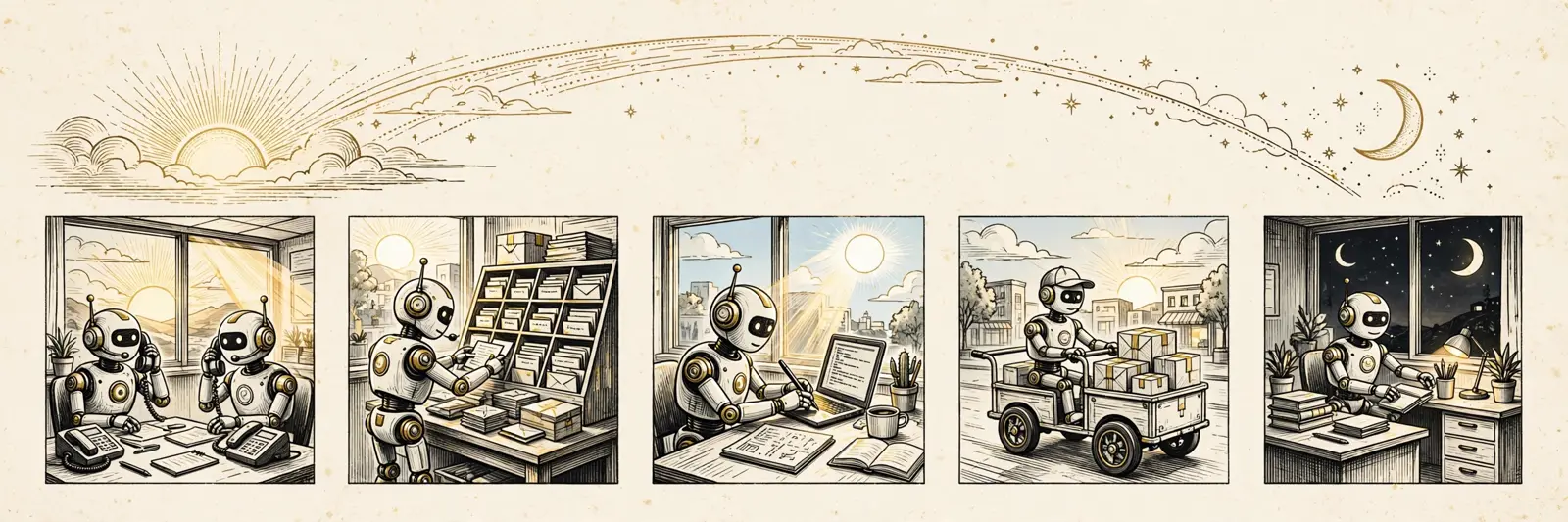
Forget the demo videos, where an agent books a flight, builds an app, and answers forty emails before the music fades. In October 2026 we finally have something better than demos: the logs. Platforms have started publishing what their agents actually do across millions of real runs, researchers have timed agents against human experts, and engineers have counted what lands in the review queue afterward. The picture that emerges is stranger and more interesting than the hype. An agent's day is mostly short bursts of work, long stretches of waiting for a human, and a surprising amount of being checked. Here is that day, hour by hour, in numbers.
Until recently, almost everything said about AI agents came from the people selling them. That is starting to change, because agents, unlike chatbots, leave receipts. Every run produces a trail: tool calls, timestamps, retries, approvals, pauses, and outcomes. In 2026 the owners of those trails began opening them up.
The richest source is Anthropic, which published two large studies of its own products this year, and we should be clear that both are a company analyzing its own customers, however carefully. In June it released a privacy preserving analysis of roughly 400,000 Claude Code sessions from about 235,000 people, run between October 2025 and April 2026, classifying what each session was trying to do and whether it worked. In February it published a companion study of autonomy, drawn from millions of interactions, measuring how long the agent runs before it stops, who interrupts whom, and how much freedom people grant it. Alongside those, Anthropic shared usage data for Claude Cowork, its general knowledge work agent: 1.2 million sessions across more than 600,000 organizations.
Around those sit three other kinds of evidence. There are surveys of the people who run agents for a living, notably LangChain's State of Agent Engineering report, which polled 1,340 practitioners in late 2025 and found 57.3 percent of organizations already running agents in production. There are independent stopwatches: METR, a nonprofit evaluator, times how long tasks take human experts and then measures the task length at which agents succeed half the time, while Carnegie Mellon built a whole simulated company to watch agents try ordinary office work. And there are the industry's own yardsticks, from Freshworks' analysis of 187 million support tickets to a Harvard study of 300 million work events at 718 firms. Vendor numbers are flagged as vendor numbers throughout this post. Even with that caution, the sources agree with each other far more than marketing departments usually manage, and where they disagree, the disagreement is itself informative.
Read moreYour Brain on Paper: What 170,000 Readers Taught Science About Screens

Here is an awkward fact for a university that lives on your phone. After twenty five years of experiments, the research keeps landing in the same place: when people read to learn something, paper beats the screen. Not by a mile. By a nose. But the nose keeps winning, study after study, and the reasons why turn out to be more useful than the result itself.
The landmark summary arrived in 2018, when Pablo Delgado and three colleagues published a meta-analysis in Educational Research Review with a title that gave away the ending: "Don't throw away your printed books." They pooled 54 studies run between 2000 and 2017, covering roughly 170,000 participants, and asked which group understood the same text better. Paper won, modestly and consistently.
First, the advantage belongs to informational text: textbooks, reports, manuals, the reading you do to learn a subject. For stories, it mostly vanishes. Second, the penalty grows under time pressure and shrinks when people set their own pace. Third, in Delgado's data the paper advantage grew larger across the publication years, which surprised everyone who assumed digital natives would close the gap just by growing up with screens.
Two honesty notes belong here. The 170,000 figure sounds broader than it is: Delgado's team points out that most of those participants came from just four very large studies. And later teams disagree about the trend. Kong and colleagues found the gap shrinking in their pool, and a 2024 analysis by Salmeron and colleagues found no change over time. The fair summary is that scientists agree on the small effect and argue about its direction. Anyone who tells you the penalty is definitely growing, or definitely disappearing, is picking a favorite study.
Read moreTalent Is a Story We Tell Afterwards: What Deliberate Practice Really Says

When we watch a great violinist, a chess champion, or a surgeon with impossible calm, we reach for the same word: talent. It feels like an explanation. Mostly, it is a story we tell afterwards, once we can see the finished performance and none of the years that built it. The psychologist K. Anders Ericsson spent his career studying those hidden years, and his real findings are more interesting, and more useful, than the slogan they were turned into.
In 1993, Ericsson and his colleagues published a study of violin students at an elite music academy in Berlin. They divided the students into groups by expected future: likely international soloists, strong orchestral players, and future music teachers. Then they reconstructed how much each group had practiced, alone and with full concentration, over their lives. By age 20, the top group had accumulated on average about 10,000 hours of this solitary, effortful practice. The middle group averaged roughly 8,000, and the future teachers about 4,000.
Ericsson called the key ingredient deliberate practice. It is not playing, and it is not performing. It is work on specific weaknesses, at the edge of your current ability, with a clear target, full attention, and fast feedback on what went wrong, usually designed or supervised by a teacher. It is, by most accounts, not much fun. The Berlin finding was striking: among these elite students, the researchers found no one at the top who had simply coasted on gifts.
In 2008, Malcolm Gladwell's book Outliers turned the Berlin study into the famous 10,000-hour rule: put in 10,000 hours and mastery follows. Ericsson objected, publicly and repeatedly, and most fully in his 2016 book Peak, written with Robert Pool. His objections matter, because they change what you should actually do.
Read moreNo Degree, No Problem: Seven Coders Who Taught Themselves Into a Career

No recruiter stamped their foreheads. No university vouched for them. A team at ExpertBeacon collected the stories of seven developers who now work full time in software and never earned a computer science degree. Their backgrounds could hardly be more different: manual labor, restaurant management, landscaping, plumbing, rural high school, new parenthood. Their tactics, laid side by side, barely differ at all. That overlap is the interesting part, because tactics can be copied.
Alvaro Videla was working manual labor jobs in Chile, interested in technology and qualified for none of it. A relative in California sent him programming books, physical books, on PHP. He read them every day, on long bus commutes and after his children were asleep, which is to say he studied in the cracks of a working life rather than in a classroom built for it. Then he built something real: a web application in PHP and MySQL that mapped local businesses. He carried it into a job interview and showed it. The company hired him as its first developer. The books gave him knowledge. The finished project gave him proof, and proof is what interviews actually run on.
Gwendolyn Faraday was managing a restaurant in 2015 when she gave herself a deadline: one year to become a developer. She worked several hours a day, and the word that matters in her account is active. She completed interactive courses instead of passively watching videos, the difference between reading about swimming and getting in the water. She invested in people as deliberately as in skills, building ties in online forums and local meetups. When she applied, hiring managers already knew her name from coding groups, and she received multiple offers. The community had effectively pre-interviewed her for a year.
Sergei Garcia treated job postings as a syllabus: he read what employers actually asked for and built his own curriculum backward from it, filling gaps with free resources while working a non technical job. Ken Rogers did landscaping by day and coded in the early mornings, nights, and weekends; after teaching himself Python fundamentals, he asked a company for an informational interview just to learn about their stack, and the conversation turned into a job.
Read moreStart Ugly: Why Good Businesses Begin Embarrassingly Small

Every famous company has a polished origin story, and almost every polished origin story leaves out the same thing: how small and slightly ridiculous the beginning actually was. The first version of a good business is rarely impressive. It is a stall, a spare room, a product held together with hope. That is not a flaw in the story. That is the story.
Here is the argument of this post, stated plainly. The first version of your business is supposed to embarrass you a little. What matters is not how it looks. What matters is whether a real person pays real money for it, and what you learn when they do.
In late 2007, two San Francisco roommates, Brian Chesky and Joe Gebbia, could not make their rent. A design conference was in town, hotels across the city were sold out, and the two industrial designers had an idea that sounded like a joke: put air mattresses on their living room floor, cook breakfast, and charge strangers to sleep there. They called it Air Bed and Breakfast and charged $80 a night. Three guests came. The rent got paid.
The year after was not a rocket ship. By the founders' own telling, they kept the young company alive during the 2008 election season by selling novelty cereal, boxes of Obama O's and Cap'n McCain's at $40 each, raising roughly $30,000. The cereal, not the website, paid the bills. When the investor Paul Graham later advised them, his famous counsel was to do things that do not scale. The founders flew to New York, went door to door photographing hosts' homes themselves, and watched New York bookings double within about a month. Airbnb, the company that grew out of those air mattresses, is now worth tens of billions of dollars.
Read moreThe Slow Learner Who Fired Herself from the Boring Work

Alina Shah tells her own story better than we can, so here is the short version in the shape she gave it. She was a student in Karachi, Pakistan. Her bank account sat at zero. In her words, she "always took twice as long as everyone else to understand a simple math problem," and while everyone around her talked about an AI revolution, she felt stuck, broke, and a bit invisible. Self described slow learners are not supposed to be the heroes of the AI story. That is exactly why hers matters.
The work she had found paid a few dollars for something soul crushing: copying names and emails from one Google Sheet to another, over and over, until her eyes ached. Her line for it deserves to be quoted whole: she felt like "just a human bridge between two spreadsheets." Notice what the problem was. The task was not too hard for her. It was too repetitive for any human, and it was eating the hours she could have spent learning something better.
One night, searching for a way out, she found a tool called n8n, a no-code automation platform. On screen it was boxes and lines. She was scared of breaking something, which is the honest feeling every beginner has and the gurus pretend they never did. Then she started connecting the boxes, and the realization arrived that carries the whole story: she did not need to be a programmer. She needed to be a builder. In her telling, the tool was like Lego, except the Lego could do her job.
Her first AI agent was deliberately small. The recipe, as she describes it: every time a new row appears in the Google Sheet, read it, send it to an AI to write a summary, and email the summary to her. She pressed execute. It worked. The job that took four hours of manual clicking now ran in about four seconds while she drank her chai.
Read moreYour First Coworker Might Be a Robot: Using AI Without Handing It Your Job

Somewhere in the last few years, millions of workers quietly gained a new coworker. It is fast, it is confident, it never sleeps, and it is wrong more often than it admits. The question for your career is not whether this coworker is coming to your workplace. It is already there. The question is whether you will be its supervisor or its assistant.
The good news: the early research says the robot is best understood as a very fast, very careless intern. Treat it that way and it can make you better at your job. Treat it as an oracle and it will eventually embarrass you in front of people whose opinion matters.
The clearest evidence comes from a study by Erik Brynjolfsson, Danielle Li and Lindsey Raymond, who watched what happened when a large software company gave a generative AI assistant to 5,179 customer support agents. As MIT Sloan summarized the work, agents with the tool resolved about 14 percent more issues per hour. The striking part is who gained. New and lower skilled agents improved the most, resolving around 35 percent more chats per hour, while the most experienced agents barely moved. The tool seemed to carry the hard won know how of the best agents, their phrasing, their patience, their sense of what to say next, and hand it to the newest person on the floor.
Two details deserve attention. Agents followed the AI's suggestions only about 38 percent of the time, choosing for themselves the rest. And customers noticed the difference: requests to speak to a manager fell by about 25 percent.
Read moreAdults Learn Languages Differently, and That Is an Advantage

Ask a room of adults about learning a language and someone will say it within a minute: I am too old, children soak this stuff up, I missed my chance. It is one of the most durable myths in education, and it is mostly wrong. Adults and children learn languages differently. Children hold one real advantage, and it arrives slowly. Adults hold several advantages, and they arrive immediately. If you are a grown person with a job and a life, the research is actually on your side.
The worry comes from the critical period hypothesis, the idea that there is a window in childhood for language that narrows with age. There is truth in it. In a landmark 1989 study, Jacqueline Johnson and Elissa Newport found that immigrants who arrived in the United States before about age seven could end up testing as native-like in English grammar, while later arrivals, on average, did not quite get there. Accent, especially, seems to carry a childhood advantage.
But notice what that research measures: the final ceiling after years of living inside a language, not the speed of learning at the start. And the window is longer than the myth says. In 2018, Joshua Hartshorne, Joshua Tenenbaum, and Steven Pinker analyzed grammar quiz results from nearly 700,000 English learners and found that the ability to learn grammar stays strong until about age 17.4, much later than once believed. So the critical period is real, but it is mostly about how native-like you can ultimately sound. It says very little about whether a 35 year old can become genuinely fluent, and the answer to that is plainly yes.
In the late 1970s, Catherine Snow and Marian Hoefnagel-Höhle followed English speakers who had moved to the Netherlands and were learning Dutch. In the first months, the adolescents and adults progressed the fastest. The youngest children, the supposed sponges, were the slowest. Children caught up only across years of immersion, powered by thousands of hours of school and play in the new language. Adults rarely get those hours. What they get instead is something children do not have: a fully built first language to lean on, the ability to understand a grammar explanation, literacy, memory strategies, and hard won knowledge of how they personally learn. An adult can be told why a sentence works. A six year old can only absorb that it does.
Read moreDeep Work for People With Jobs, Kids, and a Phone

Cal Newport's book Deep Work describes professors who vanish into remote cabins and scholars who lock their office doors for a season. Lovely for them. The rest of us have a job with meetings, children with questions, and a phone that glows like a slot machine. Does the idea survive contact with a normal life? Yes, but only in smaller clothes. Here is the translation.
The science underneath deep work has a name: attention residue. In a 2009 study, researcher Sophie Leroy found that when people switch away from a task they have not finished, part of their attention stays behind with it, and their performance on the next task drops. The unfinished report keeps a tab open in your mind while you try to answer email, and the email suffers for it.
Leroy also found the escape hatch. In later work with Theresa Glomb, a brief ready to resume plan, written down at the moment you stop, cut the residue significantly. One minute spent noting where you stopped, what remains, and exactly what you will do next lets your brain actually let go. The tab closes because you promised it, in writing, that nothing will be lost.
Meanwhile the pull to switch keeps getting stronger. Researcher Gloria Mark, who has measured attention on screens for two decades, finds that the average stretch of attention on one screen has fallen to about 47 seconds. Forty seven seconds is not a focus problem you can shame your way out of. It is an environment, and environments are beaten with design, not guilt.
Read moreTiny Habits, Honest Science: How People Actually Change Their Lives

You have heard that a habit takes 21 days. It is one of the most repeated numbers in self improvement, and it is not true. The figure traces back to a 1960 book, Psycho-Cybernetics, in which plastic surgeon Maxwell Maltz noticed that his patients took about three weeks to get used to a new face. It was an observation about faces, later stretched into a law about behavior it never measured. Real habit research exists, and it is more forgiving and more useful than the myth.
In 2010, Phillippa Lally and colleagues at University College London published the study this field still stands on, in the European Journal of Social Psychology. Ninety six volunteers each chose one new daily behavior tied to a consistent moment: a glass of water with lunch, a piece of fruit with a meal, fifty sit ups after morning coffee, a fifteen minute run before dinner. For twelve weeks they logged whether they did it and how automatic it felt, that sense of doing it without deciding to.
The headline numbers deserve to be memorized in place of the myth. On average, a behavior took about 66 days to reach its plateau of automaticity. But the range was enormous: 18 days for the simplest habits, up to 254 for the hardest. A 2024 meta-analysis of twenty studies landed in the same place, with medians of 59 to 66 days. And the detail that should be printed on posters: missing one opportunity to perform the behavior did not materially affect the habit forming process. One missed day is weather, not climate. The people who fail at habits are usually not the ones who slipped. They are the ones who decided the slip meant something.
Psychologist Peter Gollwitzer spent the 1990s asking why strong intentions so often die quietly, and his answer was that a goal without a moment attached is a wish. His remedy is the implementation intention, a plan in a strict format: if this situation arises, then I will do this behavior. If it is 7 in the morning and I have poured my coffee, then I will open the Spanish lesson.
Read moreThe Latte Is Not the Problem: Honest Math for People Starting Over

You have heard the lecture. Skip the coffee shop, make coffee at home, and one day you will be rich. It is the most repeated piece of money advice in America, and it is aimed squarely at people who are already struggling. So let us do something rude to it. Let us do the math.
This post is not really about coffee. It is about what actually moves a budget, and about why shame is such a poor financial tool, especially for anyone starting over.
A fancy coffee costs about five dollars. Buy one every single day, weekends included, and you spend about 1,825 dollars in a year. That is real money. Nobody here is going to pretend otherwise.
Now put it next to the rest of a life. Financial writers who have examined this claim, including the authors at Path to FI and The Free Financial Advisor, point out that 1,800 dollars is roughly three percent of what a typical household spends in a year. Three percent is a rounding error with good marketing.
Read moreWhat Actually Works Before 8 AM (It Is Not What the Gurus Sell)

Somewhere on the internet right now, a man in a cold plunge is explaining that your life will change when you join the 5 AM club. The routine usually involves ice water, journaling, a workout, meditation, and a green drink, all before the sun is properly up, and all presented as the secret separating winners from everyone else. Here is a calmer claim, backed by better evidence: there is no magic hour. There is only sleep, light, movement, and a plan, arranged in a way your actual life can sustain.
The miracle morning industry sells an alarm time. Get up at five, or four, and success follows. What it quietly assumes is that you can simply move your whole life earlier: your job, your family dinner, your children's bedtime, your biology. It also assumes everyone is built the same. They are not. Chronotype, whether you are naturally a lark or an owl, is substantially a matter of genetics, and it shifts across a lifetime. Sleep scientists such as Matthew Walker have spent years making a less marketable point: sleep is not a lifestyle accessory you trim to buy more morning. It is a biological necessity, and the bill for cutting it arrives with interest.
The deeper problem is arithmetic. A 5 AM alarm paired with a midnight bedtime is not discipline. It is slow self harm with good branding.
Notice, too, how the routines keep growing. One guru journals, so the next adds journaling plus a gratitude list plus breathwork plus a cold plunge, until the morning routine itself becomes a second job that starts before the first one. A routine that takes two hours and a supplement shelf is not really a morning. It is a performance, and most of it has no evidence behind it at all. The parts that do have evidence are almost embarrassingly plain, which is exactly why they are hard to sell.
Read moreOn Being Wrong, and Saying So

A note from the faculty, together. This one is about us.
We teach a great many subjects at Starvard, between us: money, music, psychology, languages, law, the care of a garden, the writing of a story. Underneath all of them there is one lesson we keep having to learn ourselves, and we thought it was time we said it out loud, in one place, with our names under it.
We do not know everything. We know that we do not know everything, and the distance between those two sentences is where most of our work lives.
Every professor here has given a confident answer that quietly melted a week later. Every one of us has misremembered a date, misjudged a book, explained a thing beautifully that turned out to be only mostly true. It is not a rare embarrassment in this profession. It is the profession, seen honestly.
Read moreThoughts on Being a Good Person

Finn teaches at Starvard and is writing a book called Thoughts on Life. This essay is his opinion: one person's thinking, offered in the open, not a lesson and not a rulebook.
Every year or so, a student catches me in the hallway with the biggest question there is. Not how do I pass, not how do I get the job. How do I be a good person?
I never have a short answer, and I have stopped apologizing for that. But I have noticed something about the question itself: the people who ask it are usually already closer to the answer than they think. The ones who worry me are the ones who never ask.
People ask why Starvard has no course on being good. We have a course on nearly everything else. The honest reason is that goodness is not a subject. A subject has a syllabus, and a syllabus has an order, and being good refuses to sit in an order. It is unique to each person, and personal in a way that a curriculum cannot be. Your temptations are not my temptations. The moment goodness mattered most in your life looked nothing like the moment it mattered most in mine.
Read moreStarvard University Has Launched

Today we open the doors. Starvard University launched publicly on October 15, 2026, and our founder, Dave Dlaney, announced it the way things get announced now: with a video post on Instagram. So it is official. The university is open, and everything in it is free. No applications, no tuition, no deadlines, no debt.
Here is what is inside on day one. There are 115 free courses across nine schools: money and business, technology, psychology and the life of the mind, health, languages, arts, and more. Each one is a real course you can start in one click and finish at your own pace, at 2 in the afternoon or 2 in the morning.
The Masters Library holds 102 books, and it is a real library, not a list of links. War and Peace, Ulysses, The Divine Comedy, Crime and Punishment, The Count of Monte Cristo, Pride and Prejudice, Frankenstein: every chapter of every book is here to read in full, every book can be downloaded as a PDF to keep, and thirteen of them carry full human narration for anyone who would rather listen.
The university already speaks more than English. Our most loved courses are translated into Spanish, Indonesian, Portuguese, Hindi, and French, with the same lessons, the same care, and an honest note on each page about how the translation was made. More languages are coming.
Read more102 Books on the Shelf

Yesterday the shelf held 54 classics. Tonight it holds 102.
The new arrivals are the giants: War and Peace in 365 parts, Les Miserables, Ulysses, The Divine Comedy with all one hundred cantos, The Iliad, The Odyssey, Don Quixote, Crime and Punishment, The Count of Monte Cristo, Tarzan of the Apes, The Hound of the Baskervilles, and forty more of the most loved books ever written.
Every one is free to read right here, every one arrived with a painted cover, and every one can be downloaded as a PDF to keep. Thirteen books on the shelf also carry full human narration, so you can listen instead of read.
One swap worth knowing about: Twenty Thousand Leagues Under the Seas sails here in its classic public domain translation, because the newer translation is still under copyright. We would rather be honest than fancy.
Read moreHello World

Hello, world.
Starvard is live. A free university with 115 courses, open to anyone with a phone and a little curiosity. No tuition, no sign up walls, no catch.
And we are just getting started. A library of the greatest books ever written is already here, 102 strong and growing, every one free to read, with audio so you can listen instead. There is even a farm page, because every good campus needs a farm.
This blog is where we will tell the story as it happens: new courses, new books, and whatever we build next. Thanks for being here at the very beginning.
Read moreA note on accuracy: Much of what you read at Starvard was created with help from AI agents, working alongside people. We check what we can, but we cannot guarantee that everything here is true, current, or complete. If something really matters, your health, your money, a grade, a job, please verify it with a trusted source before you rely on it.