 Starvard.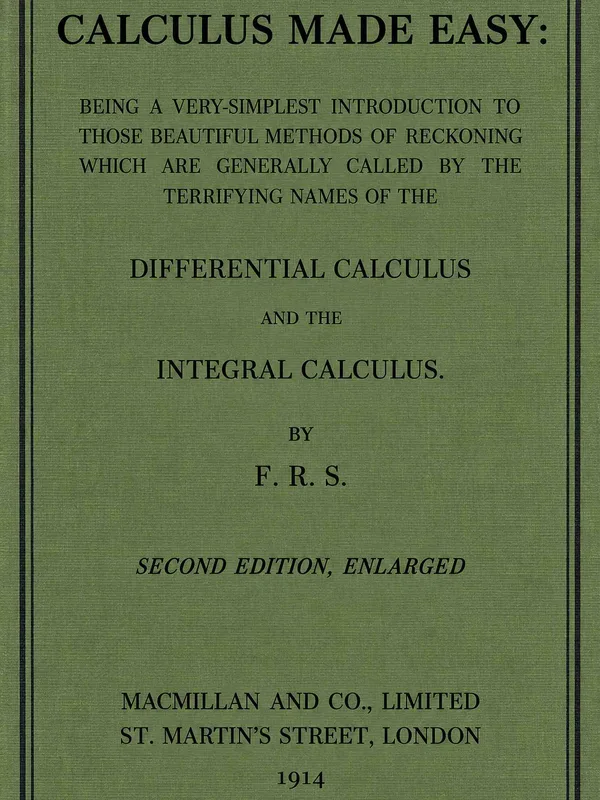
Starvard University · Science
The friendliest first course in calculus ever written, following Silvanus P. Thompson: small steps, plain words, and real problems from the start.


Hello, my name is Finn, and I'm going to help you understand this course.
Here it is, explained like you are 10:
Calculus sounds scary, but it is really just two simple tricks. One trick tells you how fast something is growing right now, like the speed of a rolling ball at one exact moment. The other trick adds up lots of tiny pieces to find a whole, like counting thin slices to measure a pie. A kind teacher named Silvanus Thompson wrote a famous book to prove that ordinary people can do this. He put a funny saying at the front: what one fool can do, another can. In this course you will learn his tricks step by step, with small numbers and plain words.
Many students meet calculus as a wall of symbols and give up before they discover how simple the ideas underneath are. Silvanus P. Thompson, a British engineer and teacher, wrote Calculus Made Easy in 1910 to tear down that wall. His method is to explain each symbol in common sense terms, start with the easiest cases that could possibly work, and only add harder rules when you need them. This course follows his order and his spirit: small bits first, then rates of change, then the rules of differentiating, then slopes and turning points, then growth, and finally integration.
You do not need to be a genius, and you do not need much algebra beyond powers and simple equations. What you need is patience with tiny steps. By the end you will be able to differentiate simple functions on sight, find where a quantity reaches its best value, explain why bank interest and living things grow by the number e, and recover areas by reversing the whole process. Thompson promised that the easy calculations really are easy. Work through the lessons in order, pencil in hand, and test his promise for yourself.
The whole course in brief
What you will be able to do after this course
The eight lessons
Lesson 1
Thompson opens his book with the exact fear most beginners feel. Calculus has terrifying names, the differential calculus and the integral calculus, and textbooks often seem designed to impress you with how clever their authors are. His prologue makes the opposite promise. Considering how many fools can calculate, he writes, it is surprising that learning the same tricks should be thought difficult or tedious. Some calculus tricks are quite easy, and those are the ones this course teaches.
On his title page stands the motto of the whole book, an old saying he calls an ancient simian proverb: "What one fool can do, another can." Take it as encouragement, not insult. The people who use calculus daily, engineers, physicists, economists, are not magicians. They learned a small set of moves, one at a time, and practiced them until the moves became habits. You will do the same.
Here is the whole subject in one sentence. The differential calculus asks how fast things change. The integral calculus asks how much has piled up in total. Everything in the lessons ahead is one of those two questions, asked about curves, motions, growth, and areas. When a symbol looks frightening, translate it back into one of those questions and the fear usually shrinks.
Lesson 2
Thompson says the preliminary terrors can be abolished by stating, in common sense terms, what the two principal symbols mean. The first symbol is d, and it merely means a little bit of. So dx means a little bit of x, and dy means a little bit of y. Mathematicians often say an element of instead, but a little bit of is the honest translation, and these little bits may be considered indefinitely small.
Smallness is relative, and Thompson is careful about this. One minute is a tiny part of a week, yet a huge stretch of time for a camera shutter. A little bit means small compared with the quantity you are studying, so small that its square is smaller still and can safely be neglected. That single permission, to drop the square of a little bit, is the engine of every calculation in this course.
The second symbol is a long S, the integral sign, and it merely means the sum of. Where d chops a quantity into little bits, the integral sign gathers the bits back together. You will meet it properly in the last lessons. For now, hold on to the pair: dx is one little bit of x, dy is the little bit of y that goes with it, and their ratio dy/dx compares the two.
Lesson 3
You already think in rates of change. A car speedometer shows one: kilometres or miles covered per hour. But notice what the needle really reports. It does not wait for a full hour. It tells you the rate at this instant, the distance you would cover in an hour if you kept going exactly as now. That idea, the rate at a moment, is the heart of the differential calculus.
Thompson begins with two quantities that depend on each other. Call one of them x, and call the other, which depends on it, y. If x grows by a little bit dx, then y will generally grow by some little bit dy. The ratio dy/dx measures how much y grows for each unit of growth in x. If dy is large compared with dx, y is changing fast. If dy is nearly zero, y is barely changing at all.
Some rates you know use different names. Speed is distance changing with time. A wage is money changing with hours worked. A slope on a price chart is cost changing with quantity. In each case there is a this depends on that pair, a little push on one side, and a resulting change on the other. Calculus simply makes that everyday reasoning exact, by letting the little bits shrink as small as we please.
Lesson 4
Differentiating means finding dy/dx, and for simple powers there is a pattern you can discover yourself. Start with y = x^2. Let x grow by a little bit dx. Then y becomes (x + dx)^2, which is x^2 + 2x dx + (dx)^2. The last term is the square of a little bit, so we neglect it. Subtract the original x^2 and the growth of y is dy = 2x dx. Divide by dx and you get dy/dx = 2x.
Try y = x^3 the same way. Expanding (x + dx)^3 gives x^3 + 3x^2 dx plus terms carrying (dx)^2 and (dx)^3, which we neglect. So dy = 3x^2 dx, and dy/dx = 3x^2. One more, y = x^4, gives dy/dx = 4x^3. Put the results in a row and the rule jumps out: the derivative of x^n is n times x^(n-1). Bring the power down in front, and lower the power by one. That is the power rule.
Two finishing touches. A constant added to a function, like the 5 in y = x^2 + 5, never changes, so its little bit is zero and it vanishes when you differentiate. A constant multiplying a function, like the 3 in y = 3x^2, simply carries through, giving dy/dx = 6x.
Lesson 5
Draw a curve and pick a point on it. The derivative at that point is the slope of the curve there, the steepness of the tangent line that just touches it. Where the derivative is positive the curve climbs as you move right. Where it is negative the curve falls. Thompson devotes a chapter to this geometrical meaning because it turns algebra into something you can see: differentiating measures steepness.
Now the payoff. At the very top of a hill on the curve, a maximum, and at the very bottom of a dip, a minimum, the tangent is level for an instant. At that instant the slope is zero, so dy/dx = 0. To find turning points, differentiate, set the derivative equal to zero, and solve. Then check the slope on each side to tell a top from a bottom.
A farmer has 100 metres of fencing for a rectangular pen against a long wall, so only three sides need fence. If the short sides are x metres, the long side is 100 - 2x, and the area is A = 100x - 2x^2. Differentiate: dA/dx = 100 - 4x. Setting this to zero gives x = 25, so the long side is 50 metres and the best area is 1,250 square metres. Calculus found the best pen.
Lesson 6
Some things grow by a fixed amount. Others grow in proportion to how big they already are: savings earning interest on interest, bacteria doubling, a hot drink cooling faster when it is much hotter than the room. Thompson calls this the law of organic growth, and it leads to the most important number in calculus after pi.
Follow his reasoning with money. Start with 1 unit and let it grow at 100 percent over a period, added in many small instalments, each instalment itself starting to grow at once. Add the growth once and you end with 2. Add it in two steps of half growth and you end with 2.25. Add it in more and more, smaller and smaller steps, and the final total does not run away. It settles at about 2.71828, the number written e. Thompson notes that all schoolboys know pi stands for 3.141592, while e, an even more important number to him, goes untaught.
The function y = e^x has a beautiful property: its rate of growth equals itself. Differentiate it and you get e^x back again. That is why e appears wherever change is proportional to size, in populations, radioactive decay, cooling, and continuous interest. When the proportion is negative, the same function describes decay, shrinking by a steady fraction rather than a steady amount.
Lesson 7
Every operation in mathematics has a reverse: subtraction undoes addition, and a square root undoes a square. Integration is differentiation done backwards. Someone hands you dy/dx, the rate, and asks: what was y, the quantity that changes at that rate? Answering that question is integrating, and Thompson insists you learn it by reversing the rules you already know.
So run the power rule in reverse. You know that x^3 differentiates to 3x^2. Therefore 3x^2 integrates back to x^3. And since x^2 differentiates to 2x, the integral of 2x is x^2. In general, to integrate x^n, raise the power by one and divide by the new power: the integral of x^n is x^(n+1) divided by (n+1). Check any answer by differentiating it. If you land back where you started, the integration is right.
One honest loose end. Many different functions share the same derivative, because y = x^2, y = x^2 + 5, and y = x^2 + 100 all differentiate to 2x: the constant vanishes. So an integral always carries a plus C, an unknown constant, until some extra fact, like a starting value, pins it down. Far from being a nuisance, that constant is where the facts of your particular problem enter.
Lesson 8
Why gather little bits at all? Because many wholes are easier to measure in slices. To find the area under a curve, Thompson cuts it into thin vertical strips. Each strip is almost a rectangle: its height is the value of y there, its width is a little bit dx, so its area is about y dx. The integral sign, the long S that means the sum of, adds all the strips. As the strips get thinner, the sum settles on the exact area.
A first calculation. Find the area under y = x^2 from x = 0 to x = 3. Integrate: the integral of x^2 is x^3/3. Evaluate at the ends: at 3 it is 27/3 = 9, and at 0 it is 0, so the area is 9 square units. Notice the method, because it never changes: integrate, substitute the top limit, substitute the bottom limit, and subtract.
The same two moves solve problems far from geometry. Given a speed at every moment, integrate to recover the distance travelled. Given the rate at which water flows into a tank, integrate to find how much water arrived. Given a growth rate, integrate to find the total increase. Differentiation breaks a whole into rates, integration builds rates back into wholes, and Thompson's closing chapters show the pair at work repeatedly.
Sources
This course is taught from classic texts that are free for anyone to read. Every method in the lessons traces back to one of these books.
Graduation
You now own the heart of calculus. You can translate the symbols into plain words, find how fast a simple function changes, locate its highest and lowest points, follow growth to the number e, and reverse the whole process to rebuild totals and areas. Keep Thompson's motto beside you as you practice: what one fool can do, another can. Work a few problems each week, check every integral by differentiating it, and the tricks will stay yours.
Keep learning
This course is part of Starvard University, striving for greatness.
A note on accuracy: Much of what you read at Starvard was created with help from AI agents, working alongside people. We check what we can, but we cannot guarantee that everything here is true, current, or complete. If something really matters, your health, your money, a grade, a job, please verify it with a trusted source before you rely on it.