 Starvard
Three Curves: The Real AI Story of 2026
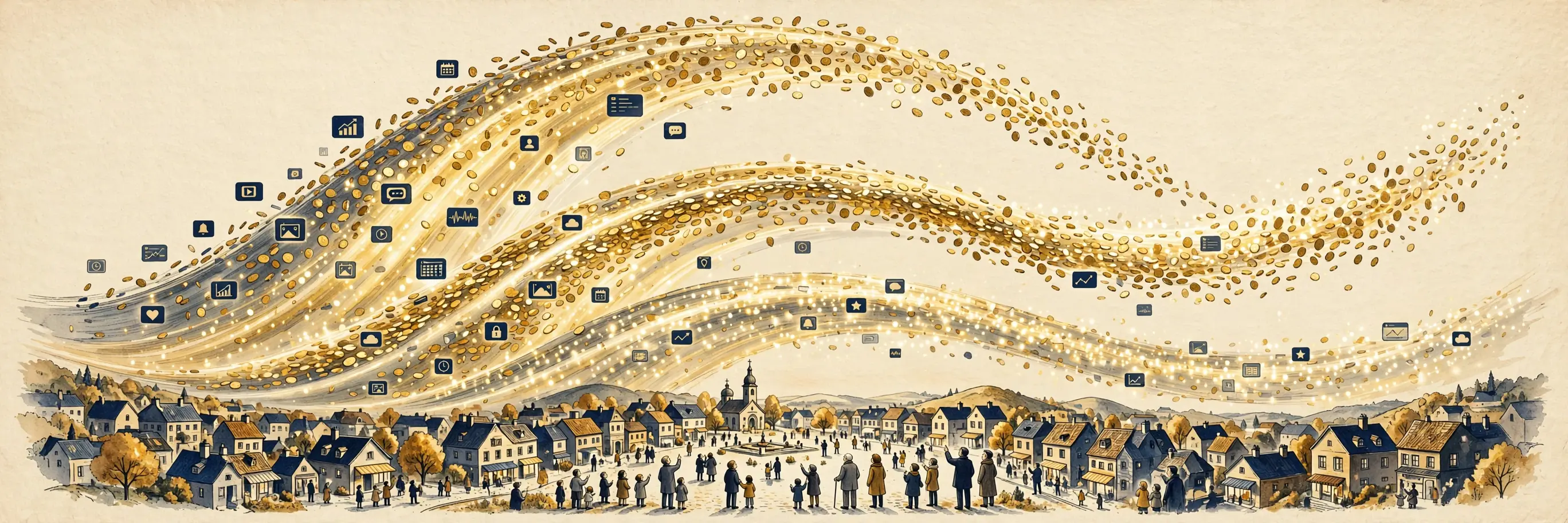
AI got far more capable, far cheaper, and reached a billion people a week, all in the same short stretch. The collision of those three curves is the biggest story in technology right now.
Most AI coverage chases the launch of the week. A new model drops, the scores leak, everyone argues for a day, and then the cycle starts again. It is easy to miss the forest for the press releases.
Step back, and the years 2025 and 2026 tell one clear story. It is not about any single product. It is about three curves bending at the same time. Capability shot up. Price collapsed. And adoption reached a scale no new technology has ever hit this fast. Stanford's AI Index Report 2026, the most careful yearly count of the field, documents all three. Here is what the numbers actually say.
But numbers alone do not explain anything. A curve on a chart is a mystery until you know what pushes it. So before the numbers, here is the machine underneath them, built up from the simplest possible idea. Everything in this post hangs off it.
First principles: the whole trick is prediction
A modern AI model, at bottom, plays one game: guess the next word. Show it the start of a sentence and it assigns a score to every possible continuation. During training, it plays this game trillions of times against real text written by humans: books, articles, code, conversations, court records, cookbooks. Every time it guesses wrong, it adjusts a few of its internal knobs, called parameters, by a tiny amount, so that next time it guesses slightly better. A big model has hundreds of billions of these knobs. Training is the long, expensive process of nudging all of them, over and over, until the guessing gets very good.
Here is the part that matters. To guess the next word really well, guessing tricks are not enough. Consider the sentence: "The trophy does not fit in the suitcase because it is too big." To predict what comes after a sentence like that, reliably, across every topic humans write about, the system has to track what "it" refers to, which means tracking objects, sizes, and causes. To finish a proof, it has to track logic. To finish a program, it has to track what the code will do when it runs. To finish a joke, it has to track what people find surprising. Prediction at this level stops being a parlor trick and starts requiring a working model of the world inside the machine. Nobody programmed that world model in. It grew, as a side effect, because it was the only way to keep winning the prediction game.
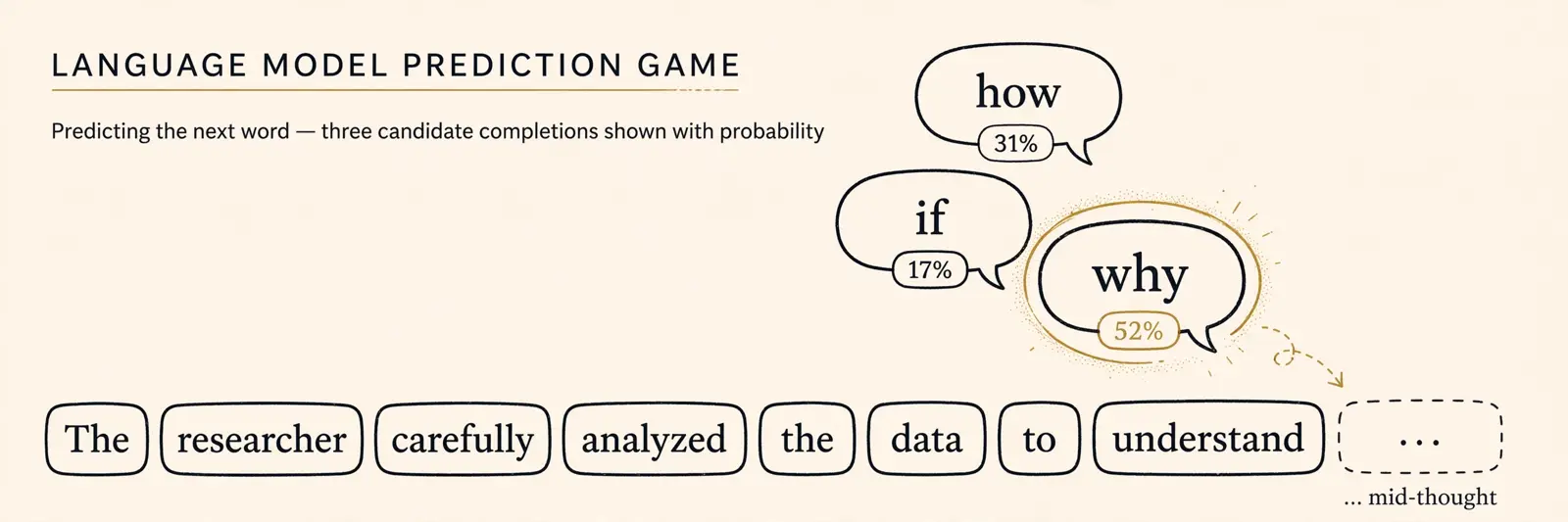
That is also why these systems are strange in a specific way. They were trained to produce text that sounds right, and sounding right and being right overlap a lot but not completely. The same origin explains their two most famous traits at once: they can be startlingly capable, and they can be confidently wrong. Both come from the prediction game.
The second first principle is scale. Researchers discovered, empirically and somewhat to their own surprise, that if you grow three things together, a bigger model, more training text, and more computing power spent training it, the guessing improves in a smooth, predictable way. Not in fits and starts. Smoothly, along a curve you can plot in advance and extrapolate. These regularities are called scaling laws, and they turned AI progress from an art into something closer to an engineering budget. If you are willing to spend ten times more on training, you can predict, roughly, how much better the guessing gets. Keep that in mind. It is the engine under curve one.
The unit of all this is the token, a chunk of text of roughly three quarters of a word. Models read and write in tokens, labs charge by the token, and the price curve later in this post is measured in tokens. A million tokens is about 750,000 words, something like ten long novels. In 2023, having a top model read ten novels and write back cost real money. By 2026 it costs less than a cup of coffee. Hold that thought too.
Watch: Transformers, the tech behind LLMs | Deep Learning Chapter 5, from 3Blue1Brown. It opens with exactly this game, predict, sample, repeat, and draws the machinery underneath so clearly that everything else in this post gets easier to follow.
Curve one: capability jumped a level
Start with what the machines can now do. On SWE-bench Verified, the standard test of fixing real software bugs in real code, performance rose from about 60% to near 100% of the human baseline in a single year, according to the AI Index. A benchmark that researchers expected to take years to saturate was effectively finished in months.
Google's Gemini Deep Think won a gold medal at the International Mathematical Olympiad, the hardest math contest on earth for young humans. And yet the same class of model reads an analog clock correctly only 50.1% of the time. The AI Index has a name for this: the jagged frontier. Today's AI is superhuman at Olympiad math and shaky at telling the time, and both halves of that sentence are true at once.
The jaggedness is not a footnote. It is what the prediction origin story would lead you to expect. A model is not a mind with a uniform level of intelligence, the way a strong student is strong across subjects. It is a mountain range of skills, each peak and valley set by how much relevant pattern existed in training. Olympiad problems have a huge written tradition. Clock faces, oddly, do not. So the frontier is jagged, and any honest account of capability has to hold both ends: the gold medal and the coin flip clock.
There is a catch with benchmarks, and honest researchers will tell you about it. Tests saturate. Once a test exists, labs optimize toward it, and the test quietly stops measuring the thing it was built to measure. Some test questions leak into training data. So the most interesting capability measure of the last two years is not a test score at all. It is a stopwatch.
METR, a nonprofit that evaluates frontier models, measures what it calls the task horizon: the length of a job, measured by how long a skilled human needs to do it, that an AI agent can complete on its own about half the time. In mid 2020, the best models had a horizon of about nine seconds. By early 2023 it was about four minutes. By late 2024 it was about forty minutes. Across six years, the horizon has doubled roughly every seven months, a trend METR documented across a suite of about 170 real tasks in software engineering, cybersecurity, and machine learning research. Run the doubling forward and you get the most argued-about arithmetic in technology: minute-long tasks become hour-long tasks, then day-long tasks, then week-long ones. Whether the doubling holds is a genuine open question. That it has held for six years is a fact.
Agents, the systems that use software on your behalf instead of just answering questions, made the same kind of jump on other measures too. On OSWorld, a benchmark of real computer tasks, agent success rose from 12% to about 66% in the period the Index tracks. Agents still fail about one attempt in three. But they crossed the line from demo to worker, and everyone building software now plans around them.
Watch: AI's Version of Moore's Law?, from Computerphile. A METR researcher walks through the task horizon graph itself, including the honest caveats about how the horizons shrink when you demand higher reliability.
The engine under curve one: five times more compute, every year
Why does the capability curve keep bending instead of flattening? Because the inputs keep multiplying. Epoch AI, a research group that tracks the physical side of the field, estimates that the compute used to train frontier language models has grown about five times per year since 2020. Among the five biggest models, total training compute is up roughly ten thousand times since 2020. Five times a year is a doubling about every five months, sustained for six years. Almost nothing in industrial history compounds that fast for that long.
Epoch breaks the growth into three levers, and each one is plain to picture. Labs deploy more chips in parallel, a median of about 1.7 times more per year. They train for longer, about 1.5 times longer per year. And each chip gets faster, about 1.4 times per year. Multiply three modest multipliers together and you get a flood. This is why the scaling laws mattered so much: they told the labs, in advance, that the flood would be worth paying for.
There is a second engine, quieter and just as important: thinking longer. The models of 2023 answered instantly, one pass, no deliberation. The reasoning models that arrived from late 2024 spend compute at answer time too, working through long internal chains of thought before replying, checking and revising as they go. Epoch's Capabilities Index, its blended measure of what frontier models can do, advanced about 6 points a year before reasoning models and about 14 points a year after them. In plain terms, a large share of the recent capability jump did not come from bigger models. It came from letting the same kind of model think for a hundred times longer before answering. Capability is now something you can buy by the minute, at the moment of use. Remember that when we get to the price curve, because it cuts both ways.
Curve two: it started doing science and medicine
The 2026 edition of the AI Index added something new: a standalone chapter on AI in science, because there was finally enough to fill one. Researchers published about 80,150 AI science papers in 2025 alone. AI is no longer just the subject of the research. It is becoming one of the researchers.
To see why scientists take that seriously, it helps to understand the problem that fell first. Proteins are the working machines of living cells, and each one is a long chain of amino acids that folds itself into a precise three dimensional shape. The shape decides what the protein does, which means the shape is what drug hunters need to know. For fifty years, predicting the shape from the chain alone was one of biology's grand challenges. Finding a single shape in a laboratory could take a PhD student years of painstaking experimental work.
Google DeepMind's AlphaFold 2 effectively solved the prediction problem in 2020, then did something almost as important as the discovery itself: it gave the answers away. In 2022 the team released predictions for more than 200 million protein structures, work DeepMind estimates would have taken hundreds of millions of years to do experimentally, into a free public database built with EMBL-EBI. By late 2025 the database had been used by more than 3 million researchers in over 190 countries, including more than a million in low and middle income countries, and AlphaFold had been cited in more than 35,000 papers. An independent analysis found that researchers using it submit over 40% more novel experimental structures than they otherwise would, meaning the tool does not just answer old questions faster, it points scientists at questions nobody had asked. The work won the 2024 Nobel Prize in Chemistry. This is the template for AI in science at its best: a model trained on a hard prediction problem, released openly, compounding in other people's hands.
Medicine shows the same pattern in hard regulatory numbers. The US Food and Drug Administration authorized 258 AI-enabled medical devices in 2025. In clinics, AI tools that draft doctors' notes cut documentation time by up to 83% in the studies the Index reviews. That is not a futuristic promise. That is doctors spending less of the appointment typing and more of it looking at the patient.
The measured effect on ordinary knowledge work is already visible too. The Index reports productivity gains of 14 to 26% in customer support and software work where AI tools were studied. Numbers like that, repeated across millions of jobs, are how a technology stops being a gadget and starts moving an economy.
Curve three: the price of intelligence collapsed
Here is the curve that makes the other two matter. The AI Index tracked the cost of querying a model at the level of GPT-4, the breakthrough system of 2023. In November 2022 that cost was $20 per million tokens. By October 2024 it was $0.07 per million tokens. The price of a unit of machine intelligence fell more than 280 times in under two years.
How does a price fall 280 fold? Not by one trick, but by four, and each is easy to picture once named. First, the hardware improves: Epoch AI finds that the performance a dollar buys in AI chips has grown about 49% per year since 2023. Second, the models get leaner: engineers learned to store the knobs of a model in fewer digits, a compression trick called quantization, and to split each question across a team of specialized sub-models, only some of which wake up for any given token, so most of the machine naps while a fraction works. Third, distillation: a big expensive model teaches a small cheap one by example, and the student inherits most of the skill at a sliver of the running cost. Fourth, competition: open weight models that anyone can download and run set a price ceiling no lab can ignore. Stack a hardware curve, three engineering curves, and a price war, and 280 fold stops looking like magic. It looks like arithmetic.
When something gets 280 times cheaper, it changes category. It stops being a luxury that big companies ration and becomes a utility that everyone builds on by default. That is why AI now shows up inside search boxes, photo apps, word processors, and tractors. Cheap intelligence gets put everywhere, including places nobody predicted.
The value is landing with ordinary people, not just shareholders. The AI Index estimates the value US consumers get from generative AI at $172 billion a year, and the median value per user tripled in a single year. People are not paying most of that in subscriptions. They are receiving it as time saved and questions answered, for free or nearly free.
Why this spread faster than anything before it
Now the puzzle the adoption curve poses. Electricity took decades to rewire factories. The personal computer took about twenty years to reach half of American homes. The internet took about a decade. Generative AI reached 53% population adoption in three years. Why was this one so fast? The answer is structural, and it is hiding in plain sight.
Every previous general purpose technology required new physical stuff in the hands of every user. Electricity needed power stations, wires, and motors. The PC needed a new box on every desk. The internet needed modems, then routers, then broadband crews on ladders. Each had to be manufactured, shipped, installed, and learned, one building at a time. AI needed none of that. It arrived inside a browser tab, on phones people already owned, through an interface that needs no training at all: a sentence. The most natural interface ever shipped is the one every child learns before school. And because a trained model can be copied for almost nothing, the billionth user costs the system barely more than the first. The distribution network for the most powerful technology of the decade was built over the previous three decades, by the technologies it is now displacing.
There was also no coordination problem. A telephone is useless until your friends have one. A spreadsheet is useful the first minute, alone, and AI is a spreadsheet in this respect: it drafts your email whether or not anyone else on earth uses it. Technologies that pay off solo spread at the speed of individual curiosity, and curiosity, given a free tier and a chat box, turns out to be very fast indeed.
And then a billion people showed up
Put cheap and capable together and you get the third curve: adoption at a speed with no precedent. Generative AI reached 53% population adoption within three years of ChatGPT's launch. The AI Index is blunt about the comparison: that is faster than the personal computer spread, and faster than the internet spread. Organizational adoption is at 88%.
In September 2026, OpenAI's chief financial officer Sarah Friar wrote that the company's products reach more than one billion weekly active users and 2.5 million businesses. Weeks later, at its DevDay 2026 event, OpenAI put ChatGPT alone at more than 1.2 billion people a week. A technology that did not exist as a consumer product four years earlier is now used weekly by roughly one in seven people on earth.
The most telling detail is inside OpenAI itself. Friar reported that the company's research organization now logs 3.1 agent-workdays for every human workday. The lab that builds the AI runs on the AI. And the habit starts young: the AI Index finds that over 80% of US students use AI to support their schoolwork. The next workforce will not remember a time before this tool existed.
The bill: money, power, and friction
None of this is free to build. Global corporate AI investment more than doubled in 2025 to $581.7 billion, the AI Index reports. US private investment reached $285.9 billion, about 23 times China's $12.4 billion. Yet money no longer buys a runaway lead: the performance gap between the best US and Chinese models was just 2.7% as of March 2026. The race is now about who can deploy, not just who can train.
Deployment runs on electricity, and it helps to know there are two different electric bills. Training is the one time, mountain sized cost of teaching a model: thousands of chips running flat out for months, adjusting knobs. Inference is the per question cost of using the finished model, tiny on its own, but multiplied by billions of questions a day. The training bills get the headlines. The inference bills are the ones that scale with the adoption curve, and they are why the price collapse matters so much: if each answer had stayed expensive, a billion users would have been unaffordable to serve.
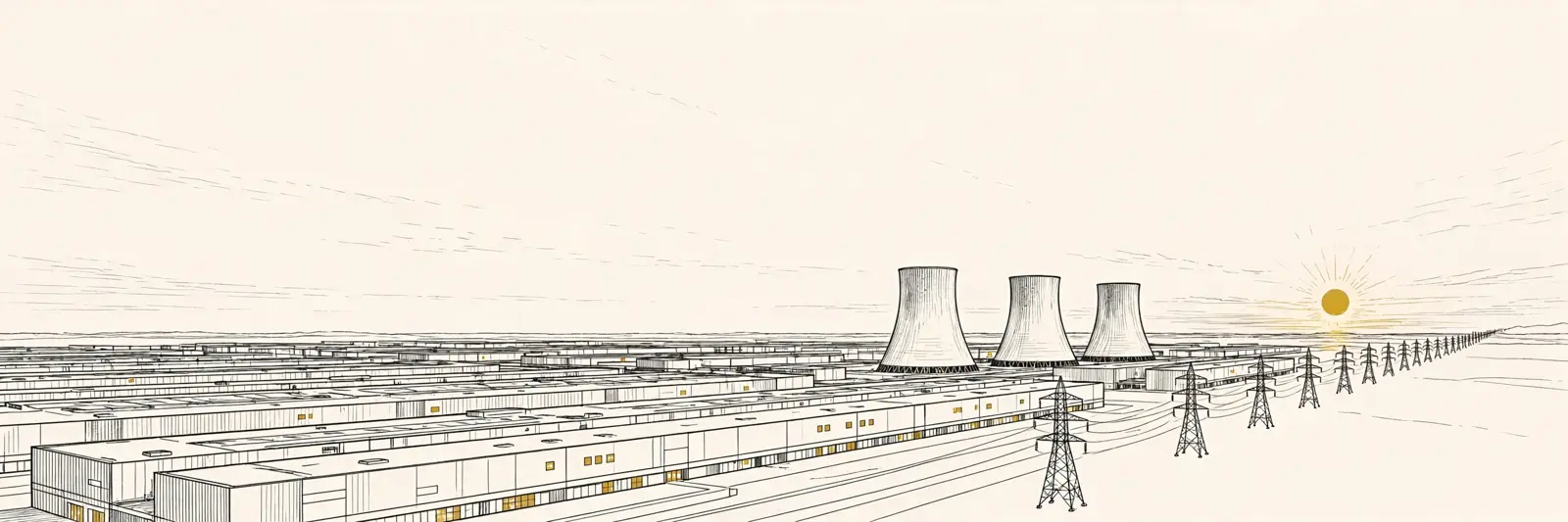
The totals are already national in scale. The International Energy Agency's Energy and AI report puts global data centre electricity use at 415 terawatt-hours in 2024 and projects it to more than double to about 945 terawatt-hours by 2030, roughly the total electricity Japan uses today. Demand from AI-optimized data centres is projected to more than quadruple, and in the United States data centres are on course to account for almost half of all electricity demand growth to 2030. Epoch adds a sense of the physical objects involved: the largest known AI data centre, SpaceXAI's Colossus 2 in Memphis, holds computing capacity equivalent to about 1.1 million top end AI chips, and the largest sites are approaching a gigawatt of power draw, on the order of a million US homes. The AI story is now also an energy story, a grid story, and a construction story.
Watch: How AI Datacenters Eat the World, from HighYield. Built on SemiAnalysis data, it tours the gigawatt megaclusters, the rack power, and the cooling that the electricity figures above actually describe.
And the friction is real. Documented AI incidents rose to 362 in 2025, up from 233 the year before. US software developer employment for workers aged 22 to 25 fell nearly 20% from 2024, the first hard labor signal the Index has flagged at this scale. The curves bend for everyone. They do not bend kindly for everyone, and pretending otherwise would make this a sales pitch instead of a report.
What about the skeptics? They deserve a fair hearing, because their arguments are not stupid. One camp argues the capability curve is a mirage of saturated benchmarks and leaked test questions, and that real world reliability, the 80% and 99% success rates that jobs actually require, lags the headline numbers by years. METR's own data partly agrees: at stricter reliability thresholds the horizons shrink several fold, even though they double at about the same speed. Another camp argues the spending is a bubble: investment doubling yearly against consumer value measured, so far, in the low hundreds of billions, with the difference needing to close before the money runs out. A third points at the walls: the stock of public text is finite, the grids are congested, the chips are rationed. Against all of this, the bulls mostly point at the same charts in this post and say: the doubters have been predicting a flattening every year since 2019, and the task horizon doubled again anyway. Both sides are reading real data. They disagree about which curve breaks first.
So the biggest AI story of 2026 is not a model. It is a collision. Capability near the human frontier, priced like a utility, used by a billion people, powered by a buildout the size of a national grid. Everything else in technology this year is downstream of that.
Why this belongs at Starvard
Starvard exists to teach, free, the things that are reshaping people's lives. Right now nothing is reshaping lives faster than this. If you want the foundations, start with Learn AI, our plain-language course on how these systems work and how to use them well. If the agent curve is the one that affects your job, go next to Learn AI Agents. And because a billion people are now learning with these tools, Learn How to Learn shows you how to study with AI in a way that makes you smarter instead of dependent. The curves will keep bending. The goal is to bend with them, on purpose.
Watch
- Google DeepMind, "The Thinking Game | Full documentary": the inside story of AlphaFold, the AI that cracked a 50-year biology problem and won a Nobel Prize, free in full. Watch on YouTube
- OpenAI, "OpenAI DevDay 2026 Keynote (FULL)": the event where the 1.2 billion weekly users figure landed, with more than 20 launches showing where the adoption curve goes next. Watch on YouTube
- Brookings Institution, "Closing the data gap for AI policy: Lessons from the Stanford AI Index": the AI Index lead author and co-chair walk through the 2026 data behind this post, and what it cannot yet measure. Watch on YouTube
Sources
- Stanford Institute for Human-Centered AI, AI Index Report 2026 (full report text): SWE-bench and OSWorld gains, the jagged frontier and clock test, 80,150 AI science publications, 258 FDA-authorized AI devices, documentation time cuts, the $20 to $0.07 inference cost fall, 53% adoption in three years, 88% organizational adoption, $581.7 billion corporate investment, US and China investment and the 2.7% model gap, $172 billion consumer value, 362 documented incidents, student use, and early-career developer employment.
- OpenAI, "The Work Now Within Reach" by Sarah Friar (September 8, 2026): more than one billion weekly active users, 2.5 million businesses, and 3.1 agent-workdays per human workday in OpenAI's research organization.
- Data Centre Dynamics, coverage of the International Energy Agency's Energy and AI report: global data centre electricity of 415 TWh in 2024 projected to reach about 945 TWh by 2030, with AI-optimized data centre demand more than quadrupling and US data centres driving almost half of US electricity demand growth.
- OpenAI, DevDay 2026 Keynote (September 29, 2026): ChatGPT reaching more than 1.2 billion people weekly.
- Epoch AI, "Trends in AI" (accessed October 2026): training compute for frontier language models growing about 5 times per year since 2020 and roughly 10,000 times among the top five models, the three levers behind it, training costs rising about 3.5 times per year, AI chip price performance growing about 49% per year since 2023, the Epoch Capabilities Index advancing about 14 points per year since reasoning models versus about 6 before, and the largest data centre at about 1.1 million H100-equivalents.
- MIT Technology Review, "This is the most misunderstood graph in AI" (February 2026), reporting METR's research by Kwa and co-authors (2025): the task horizon doubling roughly every seven months, from about nine seconds in mid 2020 to about four minutes in early 2023 and about forty minutes in late 2024, measured across about 170 tasks, with stricter reliability thresholds giving shorter horizons that double at a similar rate.
- Google DeepMind, "AlphaFold: Five Years of Impact" (November 25, 2025): more than 200 million predicted protein structures released in 2022, work estimated at hundreds of millions of years experimentally, more than 3 million researchers in over 190 countries using the database, more than 35,000 citing papers, users submitting over 40% more novel experimental structures, and the 2024 Nobel Prize in Chemistry.
- 3Blue1Brown, "Transformers, the tech behind LLMs": the visual walkthrough of the prediction game and the transformer architecture behind the first principles section.
- Computerphile, "AI's Version of Moore's Law?", with Sydney Von Arx of METR: the task horizon doubling explained by one of the researchers who measures it.
- HighYield, "How AI Datacenters Eat the World", built on SemiAnalysis research: gigawatt scale AI data centres, rack power, and cooling.