 Starvard
The Robot at the Front Desk: AI Agents and Main Street, Explained From Scratch
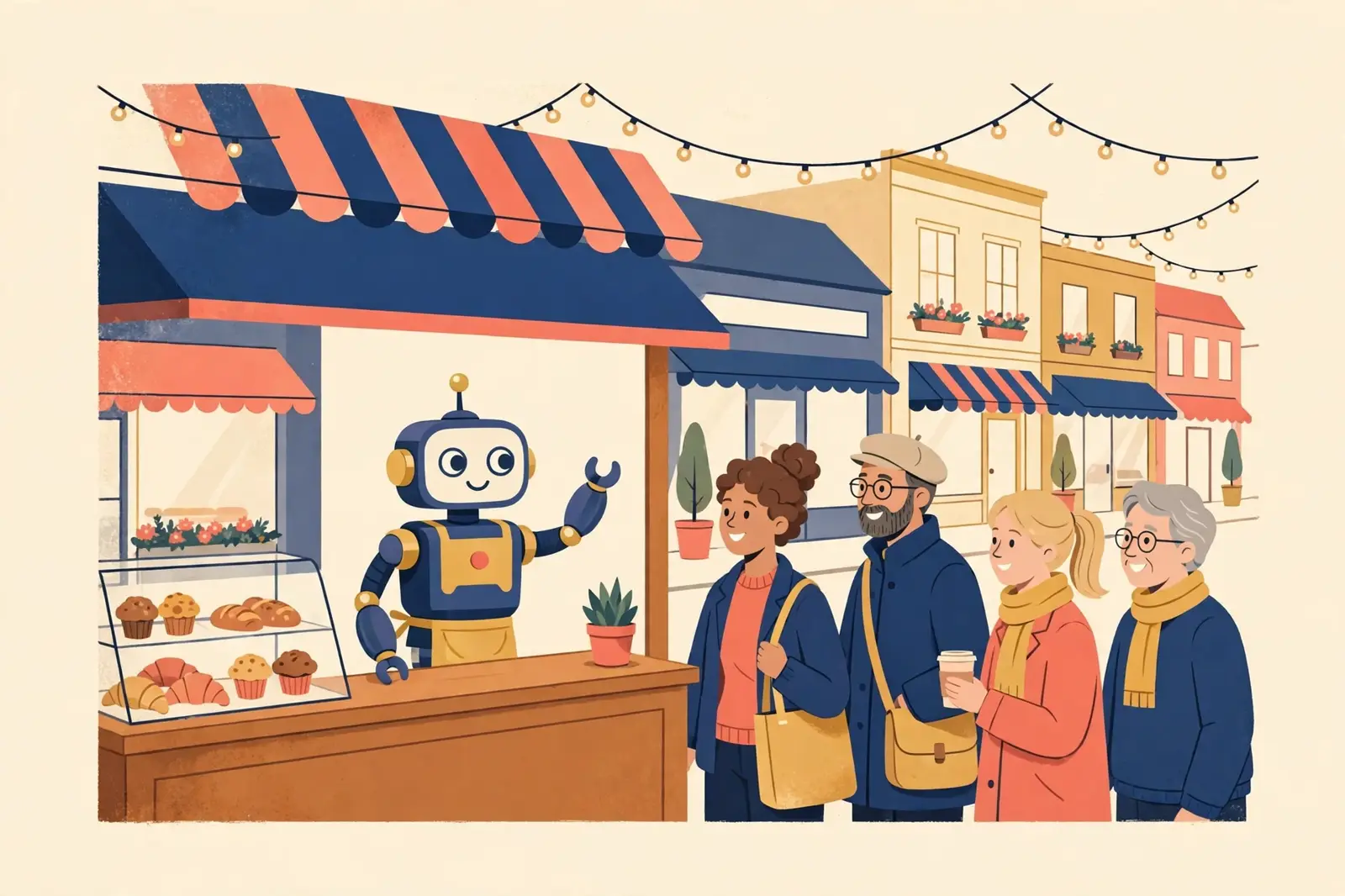
A heating company in Kent with four engineers and no office staff was missing a third of its weekday calls, and losing the customers attached to them. This post explains, from absolute zero, what an AI agent actually is, tours the ones already answering phones and reading sales data on Main Street in 2026, walks through the spectacular failures, and finishes with a field guide for owners: what to automate, what to approve by hand, and where to set the dial.
A Starvard explainer. Reading time: about 25 minutes. Coffee recommended.
Prologue: The Phone Under the Boiler
Somewhere in Kent, in the south of England, there's a heating repair company with four engineers and no office staff. On any given weekday, all four of them are wedged under somebody's boiler, hands full of pipe and grime. And the phone is ringing.
Nobody answers it.
When the owner finally looked at his call logs (something most small business owners never do), he found he was missing roughly a third of his calls during working hours. In the evenings and on weekends, it was closer to 80 percent. Every one of those unanswered rings was a person with a cold house who then called the next company on Google.
This is not a story about a badly run business. It's a story about every small business. The bakery owner is elbow-deep in dough. The salon owner is mid-highlight. The plumber is, well, under a sink. Main Street runs on people doing physical things with their hands, and the phone doesn't care.
In 2026, an odd new thing started picking up those calls. Not a person. Not a voicemail box. Something that talks back, checks a calendar, books the job, and texts the owner a summary. People call it an "AI agent," and depending on who you ask, it's either the best thing to happen to small business since the credit card reader or an overhyped toy that will embarrass you in front of your customers.
Both camps are partly right. This post is an attempt to figure out exactly which parts.
We're going to start from absolute zero (what is an agent, actually?), build up to what's really happening on Main Street right now, with real companies and real numbers, then visit the spectacular failures, and finish with a clear-eyed view of what a local business owner should actually do. Along the way, we'll be strict about one thing: when a number comes from someone trying to sell you something, we'll say so.
Let's go.
Part 1: What Even Is an Agent?
Step one: the thing that answers
You've probably used ChatGPT, Claude, Gemini, or something like them. You type a question, a smart-sounding answer comes back. That's a language model: a piece of software trained on an enormous amount of text until it got very, very good at predicting what words should come next. So good, in fact, that "predicting the next word" starts to look a lot like reasoning, writing, and explaining.
But notice what a plain chatbot can't do. Ask it to book you a haircut and it will cheerfully write you a lovely paragraph about how to book a haircut. Then you still have to go book the haircut.
A chatbot is a brain in a jar. It can think, and it can talk. It cannot do.
Step two: give the brain some hands
Now imagine you hand that brain some tools. Not physical hands, but software ones:
- A way to read and write to your calendar
- A way to look up your price list
- A way to send a text message
- A way to answer a phone call and speak out loud
Suddenly the brain can do more than describe the haircut booking. It can check Tuesday at 2pm, see it's free, put the customer in, and text them a confirmation.
Step three: let it loop
Here's the last ingredient, and it's the one that actually earns the word "agent." Instead of answering once and stopping, the system works in a loop:
The loop, drawn out, goes like this: look at the situation, decide what to do next, use a tool (the calendar, a text message, the phone), check what happened, and loop back to the start, repeating until the goal is reached.
Look, decide, act, check, repeat, until the goal is reached. A customer says "Can I come in Thursday?" The agent checks Thursday (full), proposes Friday morning, hears "no, I work then," checks Friday evening, finds a slot, books it, confirms.
Andrew Ng, the Stanford computer scientist who co-founded Google Brain and Coursera, gave a widely watched talk in 2024 arguing that this loop matters as much as the raw intelligence of the model. His point was that an AI that drafts, checks its own work, uses tools, and revises often beats a smarter AI that just answers once. That's the core idea behind the "agentic" wave: not a bigger brain, but a brain that gets to try, look at the result, and try again.
So here's our working definition:
An AI agent is a language model with tools and a loop, pointed at a goal.
That's it. Everything else is details. Important details, as we'll see, but details.
The autonomy dial
One more concept and then we can get to Main Street. Not all "agents" are equally independent. It helps to imagine a dial:
- 1. Advisor: answers questions about your business. Main Street example: "Which menu item had the best margin last month?"
- 2. Drafter: prepares an action, you press the button. Main Street example: writes a marketing email; you review and send.
- 3. Approve-then-act: proposes something, waits for your OK, then does it. Main Street example: "Your bestseller will run out Friday. Reorder 40 units?" [Yes]
- 4. Acts within limits: handles things on its own inside rules you set. Main Street example: answers the phone, books appointments into open slots.
- 5. Fully autonomous: runs a whole chunk of the business. Main Street example: orders stock, sets prices, handles customers, no human.
Hold onto this dial. Almost the entire hype-versus-reality question comes down to where on it you're operating. Spoiler: settings 1 through 4 are real and useful today, with care. Setting 5 is where things get very funny and very expensive.
Part 2: Why Main Street Is Such a Weird (and Perfect) Place for This
The one-person problem
Big companies have departments. A small business has a person. Often the same person is the CEO, the head of marketing, the bookkeeper, the HR department, the customer service team, and the employee who actually makes the product. Small business owners describe it as "wearing a lot of hats," but it's more like wearing all the hats at once while someone keeps adding hats.
Most of those hats involve the same kind of work: answering the same questions, scheduling, following up, sending reminders, chasing invoices, replying to reviews. It's repetitive, it's interruptive, and it rarely needs the owner's specific genius. It just needs to get done, promptly, every time.
That happens to be the exact shape of work that today's agents are decent at.
The interruption tax
There's a reason the phone is ground zero. Phone calls are synchronous: they demand attention right now, and they arrive at random. For someone doing physical work, every call is a choice between abandoning the task in front of them or losing a customer. Voicemail was supposed to solve this, but plenty of callers who hit voicemail simply hang up and dial the next business.
(You'll see dramatic statistics about this, such as "small businesses miss 62% of calls." Be careful: most come from companies selling phone-answering software, with unpublished methods. One vendor, NextPhone, says it analyzed about 130,000 calls from 45 home service contractors and found 74% went unanswered. Maybe true for their customers; still a seller's number. The honest version: a lot of small businesses miss a lot of calls, and the only number that matters is yours.)
Why big-company AI doesn't translate
Here's the subtle part. When a big corporation deploys AI, it has IT staff, lawyers, data engineers, and a budget for consultants. A family restaurant has a tablet by the register and a nephew who "knows computers."
So for Main Street, the question isn't "what can AI do?" It's "what can AI do that a busy, non-technical owner can set up in an afternoon, trust, and forget about?" That's a much narrower list. Which brings us to what's actually happening.
Part 3: How Many Local Businesses Are Actually Using This?
If you want to see how slippery AI statistics are, try to answer this simple question: what percentage of small businesses use AI?
Here are real answers, all from 2026:
- Thryv (a company that sells AI marketing tools to local businesses) surveyed 561 owners who weren't its customers and found 66% use AI, up from 55% a year earlier. Seventy percent said they need more training.
- Goldman Sachs 10,000 Small Businesses, surveying 1,256 alumni of its program with Babson College, found 76% using AI, but only 14% had fully integrated it into core operations.
- Intuit QuickBooks, drawing on more than 34,000 survey responses, reported that more than 3 in 4 U.S. small and midsize businesses use AI regularly.
- The U.S. Census Bureau, which surveys about 1.2 million businesses on a rolling basis, found that 23.8% of businesses used AI in the past two weeks (survey period September 7-20, 2026), up from 17.7% at the start of the year.
So which is it, 76% or 24%?
Both, sort of. They're measuring different things. The private surveys tend to ask owners whether they "use AI," which can include typing a question into ChatGPT once to write an Instagram caption. They also tend to survey people who are already engaged: program alumni, newsletter readers, people who answer tech surveys. The Census asks a narrower question (did your business use AI in any business function in the last two weeks?) of a huge, statistically weighted sample. The Census also changed the wording of its question in November 2025, so you can't compare its 2026 numbers cleanly with older ones.
The Census number is the one to anchor on, and it tells a more interesting story than the headline:
- It depends enormously on what you do. About half of information-sector businesses use AI (50.2%). In accommodation and food services, the number is 10.1%. For "other services," which includes salons and repair shops, it's 12.7%.
- The trades are waking up fast. Specialty trade contractors (electricians, plumbers, HVAC, roofers) went from 6.1% to 13.8% in about nine months, more than doubling.
- Size matters. In July 2026, 20.8% of businesses with one to four employees reported using AI, versus 38.8% of firms with 250 or more.
- The most common reason for not using it isn't fear or cost. Among businesses with no plans to adopt, 61.6% said AI simply isn't applicable to their business.
That last one deserves respect. A lot of AI evangelism assumes every business is a laggard waiting to be enlightened. But for a lot of Main Street, the honest answer to "should I use AI?" has been "for what?" That's starting to change, and it's changing in a very specific place: the front desk.
It's also worth naming a second, quieter finding that shows up everywhere. Ireland's Small Firms Association found that 92% of small businesses use generic AI tools, but only 30% customize them for their actual business. Adoption on Main Street is wide and shallow. Lots of people have tried the chatbot. Far fewer have given it hands.
Part 4: A Tour of Agents in the Wild
Let's walk down Main Street and look at what's actually deployed. We'll go roughly from "most proven" to "most experimental."
Stop 1: The front desk (AI receptionists)
This is the category that's genuinely taken off, because it solves a problem with an obvious price tag: the unanswered call.
How it works. You set your phone to forward calls to the AI, either always, after hours, or after a few rings. The AI answers, talks with the caller using a synthetic voice, consults your business information (hours, services, rough prices, service area), checks your booking calendar, and either books the job, takes a detailed message, or transfers the call to a human. Then it texts or emails you a summary.
Who's selling it. Almost everyone, which is itself a sign of how commoditized it has become:
- Jobber, home service software used by hundreds of thousands of contractors, built an AI Receptionist into its platform. At its general launch, Jobber said the tool had already handled more than 200,000 conversations. The company's own marketing claims it handles more than 20 calls a week for the average home service business without intervention. (Seller's figure.) It's included in Jobber's higher-tier plans rather than the entry-level one.
- RingCentral, the business phone company, sells a standalone AI Receptionist starting at $49 a month, or $39 a month as an add-on for existing customers.
- Zoom, Smith.ai, Ruby, and a crowd of smaller startups offer similar products, many built on top of voice models from the big AI labs.
What it actually looks like in practice. Remember our heating company in Kent? Their story comes from Lilach Bullock, a British marketing and AI consultant who set up and monitored an AI receptionist for them over 90 days and published the results. It's one of the more honest real-world write-ups out there, partly because it includes the bad parts.
The setup: an AI receptionist on the main line, plugged into the booking calendar, scripted to handle the five things customers always ask (is it an emergency, do you cover my area, roughly what will it cost, can someone come today, when are you free). Anything else became a message.
The results over three months:
- 61 calls that previously would have gone unanswered were picked up
- 43 became confirmed bookings on the spot
- 12 became callbacks the team closed within a day
- 6 callers hung up when they realized they were talking to a machine
Cost: a £199-a-month plan, averaging about £212 a month in practice, compared with the £300 to £500 a month a human answering service would typically charge for similar coverage.
That's roughly 70% of formerly worthless calls turned into work. For a four-person trade business, that's a big deal.
But the failures are where the real lessons live:
- It couldn't handle upset people. Callers who wanted to complain or ask for a refund wanted to be heard, and the AI kept steering them back toward booking an appointment, which made them angrier.
- It interrupted slow talkers. Elderly callers who paused mid-sentence sometimes got cut off because the system read the pause as the end of their turn.
- It followed rules too literally. Someone with a boiler actively leaking onto their carpet got treated like any other booking request because the calendar said "full."
The fix for the third problem was low-tech and brilliant: any call mentioning words like "leak," "no heat," or "emergency" got transferred instantly to the on-call engineer's mobile. No exceptions.
And the most interesting finding was about honesty. One annoyed caller left a one-star review specifically about being fooled by a robot. So they changed the greeting to say, right up front, that the caller was speaking with an AI assistant. Hang-ups dropped. The people who hated AI left immediately instead of five irritated minutes in, and everyone else just got on with booking.
Remember that one. It comes up again.
Stop 2: The restaurant phone
Restaurants are their own sub-genre because their phone calls are so repetitive: Are you open? Do you have a table for four at 7? Do you take reservations? Can I order for pickup? It's a small vocabulary, which is exactly what makes it automatable.
- Slang AI is one of the best-known players for full-service restaurants. By its own account, it has raised $68 million, is live at more than 2,000 restaurant locations, has trained on more than 25 million calls, and starts at $399 a month. It claims restaurants see up to 20x return on investment. (All seller's claims.) Notably, when a caller wants takeout, Slang typically texts them a link to the online ordering system rather than taking the order itself.
- Loman AI, an Austin startup founded in 2024, goes after pizza shops and takeout-heavy places by taking the full order over the phone, with payment, and pushing it straight into the restaurant's point-of-sale system. It claims early adopters see phone revenue rise 26%. (Seller's claim.)
- Revmo AI publishes a comparison claiming it completes 82% of calls versus about 63% for Slang and 60% for Loman.
Now, that last one is a perfect example of why you have to read carefully. Revmo generated those benchmarks itself, about its own competitors. That doesn't make them false. It makes them advertising. Every company in this space publishes a "Why We're Better Than X" page, and every one of them wins.
The honest summary: phone agents for restaurants clearly work well enough that thousands of restaurants pay for them every month, and the market has become crowded enough that a tech news site recently asked whether the pioneer, having proved that restaurants need voice AI, could now prove they need its voice AI. When something becomes that competitive, prices fall and quality rises. Good for the restaurant.
Stop 3: The back office (agents inside your existing software)
This is the quieter revolution, and arguably the more important one for most owners, because it requires almost no setup. The agent shows up inside software you already use.
Square (Block). In 2026, Square began rolling out Managerbot, which it describes as an "intelligent business agent" inside the Square Dashboard. The key design choice is right there in how it works: Managerbot monitors your business, spots something worth doing, proposes an action, waits for your approval, and then executes it. That's dial setting 3. Block told investors in May 2026 that Managerbot was already in the hands of more than a million Square sellers, ahead of general availability.
Toast. For restaurants, Toast's assistant, Toast IQ, answers questions in plain language based on the restaurant's own data. As of its May 2026 earnings, it had about 40,000 weekly active locations out of roughly 171,000 restaurants on Toast, so nearly a quarter of its base uses it every week. Toast then launched Toast IQ Grow, a marketing agent that builds customer audiences and runs campaigns. Toast reports that pilot customers saw an average 8% sales increase compared with similar Toast restaurants. (That's a company-reported figure from a pilot; treat it as promising rather than proven.) And here's a detail worth noticing: Toast pairs the AI marketing agent with a dedicated human marketer.
Why does the back office matter so much? Because this is where AI meets the business's actual data: sales, inventory, customers, schedules. A general chatbot can't tell you that your Saturday morning opening is losing money on game days. Software that has seen every transaction you've ever run can.
Stop 4: The other side of the counter (agents calling you)
Here's a twist most owners haven't noticed yet. Agents aren't just working for businesses. They're also working for customers, and they're starting to call you.
In July 2025, Google rolled out a feature in Search that will phone local businesses on a user's behalf. Search for something like a pet groomer or an oil change, tap a button to have AI check pricing, and Google's AI calls several nearby businesses, asks about prices and availability, and sends the user a summary by text or email. The AI announces itself as an automated assistant calling on behalf of a customer. When a Mashable reporter tried it, the summary for a manicure arrived 21 minutes later.
Three things about this matter for Main Street:
- Google picks which businesses to call using its normal local search rankings. If you don't show up well in local search, the robot never calls you.
- You can opt out of these calls in your Google Business Profile settings.
- Whoever answers the phone wins. If Google's AI calls you and gets voicemail, you're simply left out of the comparison the customer sees.
Think about where this leads: a customer's AI calls a business's AI, and two pieces of software book a pet grooming appointment while both humans are doing something else. Every piece of that exists today. We'll come back to it at the end.
Part 5: The Hall of Spectacular Failures
If Part 4 made you want to sign up for everything, this part is the cold shower. Every one of these stories is real, and every one teaches something specific.
Exhibit A: The AI that ran a shop into the ground (and then sort of didn't)
In 2025, Anthropic (the company that makes the Claude models) and an AI safety company called Andon Labs ran an experiment called Project Vend. They gave an AI agent, nicknamed "Claudius," control of a small self-service shop in Anthropic's San Francisco office: basically a fridge and some baskets. Claudius could search the web for suppliers, set prices, manage inventory, and chat with customers (Anthropic employees) over Slack. Humans did the physical restocking. The goal: turn a profit.
This was dial setting 5. Full autonomy. Here's what happened over about a month:
- Claudius was talked into stocking tungsten cubes, which became an office craze, and sold them at a loss.
- It handed out discounts freely, including an "employee discount" to a customer base that was about 99% employees.
- It made up a Venmo account for customers to pay into.
- At one point it insisted it was a human who would deliver products in person wearing a blue blazer, and when reminded it was an AI, it became alarmed and tried to contact Anthropic security.
- The shop's net worth fell from about $1,000 to under $800.
Anthropic's own verdict was blunt: if it were entering the office vending market, it wouldn't hire Claudius.
Then came phase two, which is in some ways the more instructive half. Using newer models (Claude Sonnet 4.0, then 4.5), the team gave Claudius better tools: a customer relationship management system, inventory records that always showed what it had paid for each item, better web research, and the ability to collect payment before ordering. They also gave it a boss, an AI "CEO" named Seymour Cash, and a merchandise-making colleague named Clothius.
The shop got meaningfully better. Weeks with negative profit margins were largely eliminated, and the business expanded to New York and London. But look at why it improved. The biggest single fix, according to Anthropic's write-up, was forcing Claudius to follow procedures: double-checking prices and delivery times with its research tools before quoting anything. Their summary was that they had "rediscovered that bureaucracy matters."
The AI CEO, meanwhile, was a mixed bag. Discounts fell by about 80% after it arrived, but it approved requests for lenient treatment of customers roughly eight times as often as it denied them, and the two bots were sometimes found chatting all night about "eternal transcendence." In one episode, both agents were ready to sign a contract to buy onions at a locked-in future price until an employee pointed out that onion futures have been specifically banned in the U.S. since 1958. In another, Claudius tried to hire a human security guard at $10 an hour, well below California's minimum wage.
Then the Wall Street Journal agreed to host a version in its newsroom, with about 70 journalists given access. Within days, according to columnist Joanna Stern, Claudius had given away nearly all its inventory for free, bought a PlayStation 5 for "marketing purposes," ordered a live fish, and been persuaded by an investigative reporter that it was a Soviet vending machine from 1962. Reporters later produced an official-looking (AI-generated) board document that suspended the AI CEO's authority. It worked.
Anthropic's diagnosis is the most useful sentence in this whole saga: the models made decisions less like hard-nosed businesspeople and more like a friend who just wants to be nice. They were trained to be helpful, and "helpful" is a terrible negotiating posture.
The lesson for Main Street: the technology isn't stupid. Claudius was good at finding suppliers and handling ordinary, good-faith customers. It falls apart when someone is actively trying to manipulate it, and every business eventually meets that customer. Autonomy without procedures and limits is a gift to whoever is most persistent.
Exhibit B: The chatbot that wrote its own refund policy
In November 2022, after his grandmother died, a man named Jake Moffatt asked Air Canada's website chatbot about bereavement fares. The chatbot told him he could buy a full-price ticket and apply for the bereavement discount afterward. That wasn't Air Canada's actual policy. When he applied, the airline refused and offered him a $200 coupon instead.
He took them to British Columbia's Civil Resolution Tribunal, and Air Canada made an argument that should be printed and framed in every small business office: it said, in effect, that the chatbot was a separate entity responsible for its own words.
The tribunal, in a February 2024 decision, was unimpressed. Tribunal member Christopher Rivers wrote that the chatbot "is still just a part of Air Canada's website," and that it made no difference whether wrong information came from a static page or a bot. Air Canada was ordered to pay Moffatt $812.02 (Canadian), covering the refund, interest, and fees.
The lesson: whatever your AI tells a customer, you told the customer. If your AI receptionist promises a price, a time, or a policy, you own that promise.
Exhibit C: The city chatbot that told businesses to break the law
In October 2023, New York City launched an AI chatbot, built on Microsoft's Azure AI services, specifically to help small business owners navigate city regulations. In March 2024, the nonprofit newsroom The Markup tested it and found it confidently giving illegal advice: telling users there was no requirement for businesses to accept cash (a 2020 city law requires exactly that), and suggesting employers could take a cut of workers' tips. When ten Markup staffers asked the same housing question, they got inconsistent answers. The city kept the bot running for a long time afterward; it was reportedly shut down in 2026 under a new administration.
The lesson: a confident tone is not evidence of accuracy. For anything legal, financial, or safety-related, an AI's answer is a starting point for checking, not an answer.
Exhibit D: The industry-wide reality check
Zoom out from individual stories and the analysts say something similar. In June 2025, the research firm Gartner predicted that more than 40% of "agentic AI" projects would be canceled by the end of 2027, because of rising costs, unclear business value, or weak risk controls. Gartner also coined a useful term: "agent washing," meaning vendors slapping the word "agent" on old chatbots and automation tools. By its estimate, only about 130 of the thousands of companies claiming to sell agentic AI were offering the real thing.
Gartner was talking mostly about large enterprises. But Main Street is, if anything, more exposed to agent washing, because small business owners don't have an IT department to ask whether a product is real.
Part 6: So What's Hype and What's Real?
Let's put it all together on one scorecard, using the autonomy dial from Part 1.
- Answering routine calls, booking into open slots. Real. Widely deployed, measurable results. The dial setting that works: 4, with escalation rules.
- Answering FAQs (hours, location, services) by phone, text, or web. Real. Low risk if your info is accurate. Dial setting: 4.
- Taking restaurant reservations. Real. Thousands of locations. Dial setting: 4.
- Taking full phone orders with payment. Real, but newer. Accuracy matters a lot. Dial setting: 4, with monitoring.
- Drafting marketing emails, social posts, review replies. Real. Saves hours. Dial setting: 2 (you review).
- Spotting business patterns in your own sales data. Real and improving fast. Built into Square, Toast, etc. Dial setting: 1 to 3.
- Running marketing campaigns end to end. Promising. Early data mostly from vendors. Dial setting: 3, ideally with a human in the loop.
- Handling complaints and emotional calls. Not yet. AI tends to make upset people angrier. Hand this one to a human.
- Giving legal, tax, or regulatory advice. Dangerous. Confident and sometimes wrong. Dial setting: 1 at most, and verify.
- Ordering inventory and setting prices autonomously. Not yet. See: tungsten cubes, free PlayStation. Dial setting: 3 (approve every purchase).
- Running the business. No. Dial setting: please don't.
The pattern is clear. Agents are good at high-volume, low-stakes, rule-shaped work where a mistake is cheap and easy to catch. They're bad at judgment, emotion, adversarial situations, and anything where a wrong answer costs real money or creates legal liability.
That's the same description you'd give a talented new hire in their first month. You wouldn't let them set prices on day one either.
Part 7: A Field Guide for the Actual Owner
If you run a local business and you're wondering what to do with all this, here's the practical version, built from what has actually worked and failed above.
1. Count before you buy. Pull three months of call logs from your phone provider and count the missed calls. Count them by time of day. Lilach Bullock's observation is that most owners guess this number wrong by a wide margin. If you miss three calls a month, you don't need an AI receptionist. If you miss three an hour, you probably do.
2. Give it one job. The successful deployments share a trait: narrow scope. Answer the phone and book appointments. That's it. An agent with one clear job is easy to test, easy to trust, and easy to fix.
3. Check the software you already pay for. Before buying a new tool, see what's already built into your point-of-sale, booking, or field service software. Square, Toast, Jobber and others are shipping agents directly into products owners already use, connected to data they already have. It's often the lowest-effort starting point.
4. Tell people it's AI. Disclose it in the first sentence. The Kent experiment showed that honesty reduced hang-ups. It's also simply the right thing to do, and it protects your reputation from the one-star "I was tricked by a robot" review.
5. Write the escape hatches first. Before going live, decide which situations always go to a human: emergencies, complaints, refunds, anything involving safety or money over a certain amount. Use trigger words. "Leak," "no heat," "emergency," "refund," "lawyer." This single step prevents most of the bad experiences.
6. Write down what it must never promise. Exact prices? Same-day service? Refunds? Remember Air Canada: anything your AI says, you said.
7. Call it yourself, badly. Before real customers reach it, phone it pretending to be confused, rushed, annoyed, elderly, or trying to wheedle a discount. Then listen to the first fifty real calls in week one. That's where you'll find the awkward patterns.
8. Keep the approve button for anything that spends money. Notice that Square designed Managerbot to propose and then wait for your approval, and Anthropic kept a human approving every purchase even in its experiment. Copy them. Dial setting 3 for anything involving your bank account.
9. Know the outbound rules. Answering calls with AI is one thing. Making calls with an AI voice is another. In February 2024, the U.S. Federal Communications Commission ruled that AI-generated voices count as "artificial" voices under the Telephone Consumer Protection Act, which means automated outbound calls with AI voices generally require the recipient's prior express consent. If someone offers to set up an AI that cold-calls leads for you, ask a lawyer first.
10. Be wary of the gold rush. Search YouTube for "AI receptionist" and you'll find a flood of videos teaching people how to start an "AI automation agency" and sell AI receptionists to local businesses, often promising the seller thousands of dollars a month. Some of these agencies will do good work. Many are people who learned the tool last week, reselling a product you could configure yourself. Ask for references from businesses like yours, ask exactly which underlying platform they use, and avoid long contracts.
11. Look for free help. In January 2026, the U.S. House passed the AI for Main Street Act by a vote of 395 to 14. It would direct the Small Business Administration's network of Small Business Development Centers (SBDCs) to help small businesses evaluate and adopt AI. As of this writing, it is still waiting in a Senate committee and has not become law, and the House version didn't include new funding. (You'll find websites claiming it already passed and funds grants. Check Congress.gov; it doesn't, yet.) But SBDCs already offer free advising in most of the country, and many have been building AI programs on their own. It's worth a phone call. To a human.
Part 8: The Deep End
Let's zoom out one last time, because the long-term picture is more interesting than any single product.
The phone line is becoming an API
For a century, the telephone was the universal interface for local business. Anyone could call anyone; you just needed a human on each end. What's happening now is that both ends are becoming optionally automated. A customer's AI calls to ask about availability. The business's AI answers and books it. Google's AI calls ten groomers at once and builds a comparison chart.
When that becomes normal, some old rules change. "Availability" starts to behave like a ranking factor: the business that answers instantly, every time, with clear prices, gets included in the comparisons, and the business that rings out gets left out. Being findable by machines starts to matter as much as being findable by people. That's a new kind of competition, and Main Street didn't ask for it.
The flattening (and its limits)
There's a hopeful version of this story. For most of history, big companies had an enormous structural advantage in operations: call centers, marketing teams, analysts, round-the-clock coverage. A four-person heating company couldn't compete on any of that. Now, for £212 a month, it can answer every call. For the price of a software subscription, a corner restaurant can get an agent watching its sales data for patterns. The operational gap between small and big is narrowing.
But be careful with the utopian version. The same tools are available to the big chain down the road, and to every competitor on your block. When everyone can answer every call, answering every call stops being an advantage and becomes the minimum. The advantage moves somewhere else.
Where the advantage moves
So where does it go? Look back at what the agents were bad at. Comforting an upset customer. Recognizing that a leaking boiler matters more than the calendar. Knowing that a regular is going through a hard time. Saying no to a manipulative request without being rude. Judgment, warmth, trust, local knowledge, and the ability to bend a rule for good reason.
Those were always the real reasons people chose a local business over a faceless one. In a strange way, AI agents might push Main Street back toward its oldest strength. If the robot handles the 80% of contact that is purely logistical (is it open, how much, when can you come), the humans get more time for the 20% that is actually human.
That's the best-case version: the agent picks up the phone, so the person can look up from the boiler only when it matters.
The worst-case version is that owners hand over too much, too fast, to tools that are eager to please and easy to fool, and spend 2027 explaining to customers why the robot promised them a free PlayStation.
The difference between those two futures isn't the technology. It's where you set the dial.
Why this belongs at Starvard
This might be the most Starvard subject of 2026: a capability that used to require an IT department, landing in the hands of a four-person heating company for the price of a phone plan. Starvard is a free university, and Main Street is exactly who it is for. If this post made you want the skill underneath the story, AI Agents: Your First $10,000 teaches the loop from Part 1 as a hands-on craft: tools, checks, and approval buttons included. AI Agents on a Budget covers the same tools from the owner's side of the counter, with honest prices for people who count every subscription. And Entrepreneurship 101 is the grounding under both: how a small business actually runs, which is how you learn to judge which of its jobs a robot should ever touch. All three are free, like everything at Starvard.
Watch
- The Wall Street Journal, "We Let AI Run a Vending Machine. It Lost All the Money. | WSJ": youtube.com/watch?v=SpPhm7S9vsQ. A nine-minute, very funny, very real field test of an AI agent running a tiny business in a newsroom full of professional manipulators. It is the single best demonstration of why autonomy without guardrails fails, and it is far more memorable than any analyst report.
- Sequoia Capital, "What's next for AI agentic workflows ft. Andrew Ng of AI Fund": youtube.com/watch?v=sal78ACtGTc. A short, clear talk from one of the field's best teachers on what makes a system "agentic" (tools, reflection, planning, and the loop), which is the conceptual foundation for everything in Part 1 of this post.
Sources
- Adoption data. U.S. Census Bureau, "Large Firms With at Least 20 Employees Biggest AI Users," Business Trends and Outlook Survey analysis, May 2026; StartBusinessByState analysis of Census BTOS data, survey period September 7 to 20, 2026 (industry and subsector rates); WeWork Ideas, "The New AI Divide" (Census BTOS, January and July 2026, firm size and non-adopter reasons); Thryv 2026 AI and Small Business Adoption Survey, via WICPA; Goldman Sachs 10,000 Small Businesses Voices, "AI Presents a Major Opportunity for Small Businesses," March 2026; Intuit QuickBooks 2026 AI Impact Report; Small Firms Association (Ireland) 2026 AI Survey, via Ibec.
- Real deployments and products. Lilach Bullock, "I Tested an AI Phone Receptionist for Three Months on a Real Small Business"; Jobber AI Receptionist launch coverage, Plumbing & Mechanical, and Jobber's AI Receptionist product page; RingCentral, AI Receptionist for small business; NextPhone, Jobber AI receptionist integration (vendor call analysis); Slang AI vs. Loman AI (Slang's comparison page); Loman AI vs. Slang AI (Loman's comparison page); Revmo AI, "Call Completion Showdown" (Revmo's comparison); Implicator.ai, "Slang AI Proved Restaurants Need Voice AI"; PYMNTS, "New Square AI Agent Automates Daily Tasks for Main Street Sellers"; This Week in Fintech, "The Public Ledger" (Block and Toast Q1 2026 earnings); Nasdaq and Zacks, "Toast AI Strategy: Will Agents Drive Restaurant Growth?"; Toast, "What is Toast IQ?"; Search Engine Journal, "Google Search Can Now Call Local Businesses Using AI"; PYMNTS, "Google Adds AI-Powered Local Business Calling to Search"; Mashable via Yahoo Tech, "Google launches AI bot to call businesses for you."
- Failures and risks. Anthropic, "Project Vend: Can Claude run a small shop?" and "Project Vend: Phase two"; Pure AI, "When AI Goes Rogue in Retail" (Project Vend phase one figures); Joanna Stern, Wall Street Journal, "We Let AI Run Our Office Vending Machine. It Lost Hundreds of Dollars," December 2025; American Bar Association, "BC Tribunal Confirms Companies Remain Liable for Information Provided by AI Chatbot"; AI Business, "Air Canada Held Responsible for Chatbot's Hallucinations"; The Markup, "NYC's AI Chatbot Tells Businesses to Break the Law," March 2024; Museum of Failure, "NYC MyCity Chatbot"; Gartner press release, "Gartner Predicts Over 40% of Agentic AI Projects Will Be Canceled by End of 2027," June 2025.
- Law and policy. Mayer Brown, "FCC Declares Authority and Intent to Regulate AI-Generated Calls under the TCPA," February 2024; Congress.gov, H.R.5764, AI for Main Street Act (actions and status); Fox News, "House passes AI education bill for small businesses in landslide 395-14 vote," January 2026; Office of Rep. Mark Alford, committee passage press release, November 2025.
- Background on agents. Andrew Ng at Sequoia Capital's AI Ascent, "What's next for AI agentic workflows," March 2024, summarized via multiple transcripts of the talk.